3. Balance Sheet II
 Call Kai
 Learn
 Practice Test
 Spaced Repetition
 Match
 Flashcards
 Knowt Play
1/13

There's no tags or description
Looks like no tags are added yet.
14 Terms
What are current assets and examples
Short-term assets that are expected to be converted into economic benefit usually within a year
e.g. cash, inventory, trade receivables, prepaid expenses
What are non-current assets
Long-term resources a business owns and uses in its operations usually for over a year rather than converting them into cash
What are the types of non-current assets and examples
Tangible Assets - Non-Current assets with physical substances
e.g. land, building, factory, equipment, car, furniture, computer
Intangible Assets - Non-Current Assets without physical substances
e.g. patent, copyright, trademark, goodwill
What are current liabilities
A company's short-term financial obligations that are due and payable usually within one year
What are non-current liabilities
Long-term financial debts or obligations that a company does not need to pay off within the next 12 months
Examples of current and non-current liabilities
Not a set list for each as the list is determined on the time frame
e.g. accrued expenses, borrowing (loan), trade payables, customer advance, cash overdraft
How do we calculate share capital
Par value x Number of shares
Par value ≠ Actual Share Price
How do we record the selling of shares at par value on the balance sheet
If shares are sold for par value, increase in equity (share capital) and increase in assets (cash)

How do we record the selling of shares above par value on the balance sheet
If shares are sold for above par value, increase in equity (share capital and share premium) and increase in assets (cash)

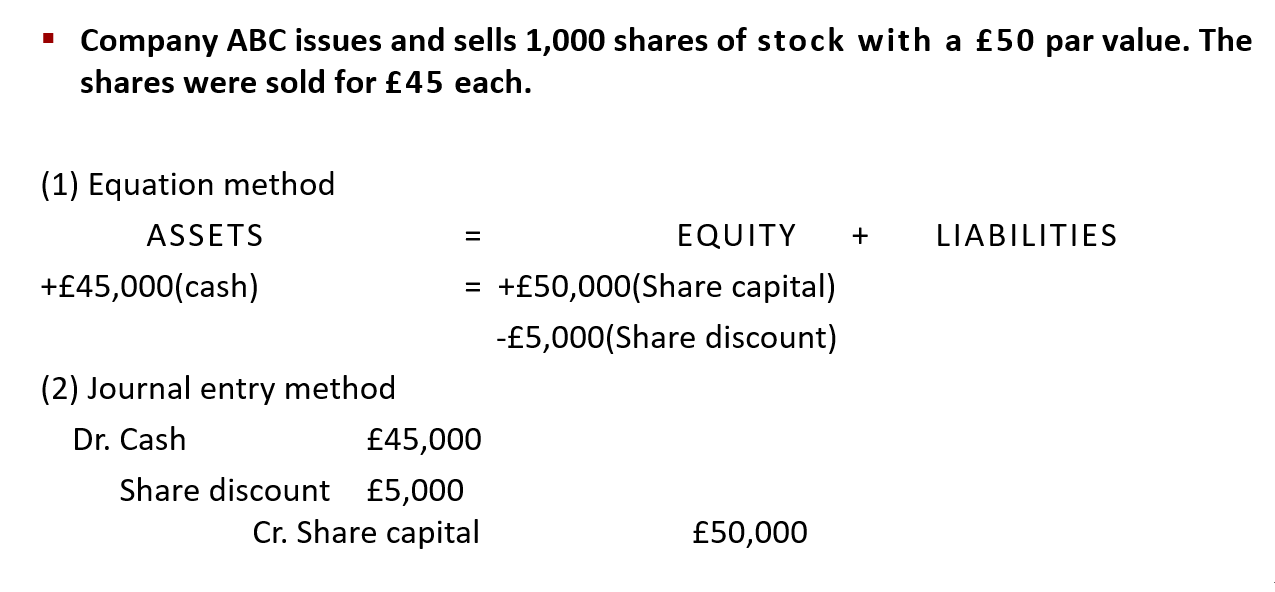
How do we record the selling of shares below par value on the balance sheet
If shares are sold for below value, increase in equity (share capital) but also decrease in equity (share discount) and increase in assets (cash)
How do we record dividends paid now on the balance sheet
Decrease in equity (retained profit) and decrease in assets (cash)

How do we record dividends that are declared on the balance sheet
There is a gap between the declared date and the payment date
Initially, decrease in equity (retained profit) and increase in liabilities (dividend payable)
Once paid, decrease in liabilities (dividend payable) and decrease in assets (cash)

How should the balance sheet be presented
Accounting Standards (e.g. IFRS) do not mandate any single format
Could be any of the formats in the picture

What are the accounting principles
Legal Entity - We record business transactions from the perspective of the company
Dual Aspect - The accounting equation always has to balance
Historic Cost - A company needs to record its assets, liabilities and equity at their original purchase price
Going Concern - A business will continue operating for the foreseeable future, usually at least 12 months
Prudence (Conservatism) -