Biomolecules: Structure, Functions, and Examples in Biology
 Call Kai
 Learn
Learn Practice Test
 Spaced Repetition
 Match
Match Flashcards
 Knowt Play
1/90

There's no tags or description
Looks like no tags are added yet.
Name | Mastery | Learn | Test | Matching | Spaced | Call with Kai | Chat |
|---|
No analytics yet
Send a link to your students to track their progress
91 Terms
Biomolecules
Chemical compounds made by living organisms that are essential for life. The four major types are carbohydrates, lipids, proteins, and nucleic acids.
--> they provide energy, build structures, carry out cell processes, and store genetic information

Macromolecules
large organic molecule composed of many smaller molecules found in living organisms. (lipids are not true polymers because they aren't made of repeating monomer units.)

Organic compounds
Compounds whose chemical structure that contain carbon bonded to hydrogen.

Polymers
a large molecule made of many repeating monomers bonded together.
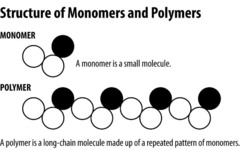
Monomer
a small molecular building block bond with other monomers to form a larger polymer.

Carbohydrates
Composed of carbon (C), hydrogen (H), and oxygen (O) in a 1:2:1 ratio. carbs provide quick/short term energy which is the primary source of fuel for your body.

Monosaccharide
The simplest carbohydrate; a single sugar molecule that are the monomer building blocks for larger carbohydrates.
Three types: glucose, fructose, galactose
Formula: C6H12O6

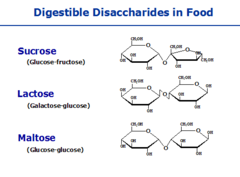
Disaccharide
A carbohydrate made two monosaccharides joined together. Three important: Sucrose, Lactose, Maltose
Formula:
C12H22O11
Polysaccharides
Polysaccharides are complex carbohydrates (polymers) made of many monosaccharides (usually glucose) joined together

what makes sucrose
glucose and fructose

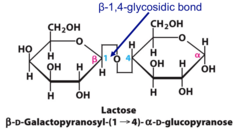
what makes lactose?
glucose and galactose
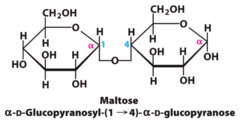
What makes maltose?
glucose and glucose
simple vs complex carbs
Simple carbohydrate: digest quickly and cause rapid spikes in blood sugar.
complex carbohydrates: digest slowly and provide sustained energy.

four main polysaccharides
starch, glycogen, cellulose, chitin
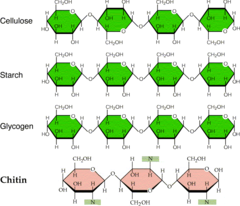
Starch
A polysaccharide made of many glucose molecules that plants use for energy storage.
Glycogen
A polysaccharide made of glucose that animals use for short-term energy storage, especially in the liver and muscles.
Cellulose
A polysaccharide made of glucose that provides structure in plant cell walls. Humans can't digest cellulose.
Chitin
structural support for insects
Carbohydrates use in the body (first choice)
Digestion (hydrolysis) breaks complex carbohydrates into monosaccharides small enough to be absorbed into the bloodstream. Once absorbed, monosaccharides are used for immediate energy needs.
Carbohydrates use in the body (second choice)
If the body has enough energy supply at the moment, the monosaccharides are converted to glycogen for short-term storage in the liver, muscles, and brain.
Carbohydrates use in the body (final choice)
If the body has enough energy supply and glycogen stores are full, the body turns the monosaccharides into fat.
What are lipids?
A group of mostly hydrophobic molecules that include fats, oils, phospholipids, steroids, and waxes.
What is one function of lipids?
They store long-term energy.
What is another function of lipids?
They form cell membranes.
What is a third function of lipids?
They provide insulation.
What is a fourth function of lipids?
They act as chemical messengers.
What are the elements that make up lipids?
Carbon (C), Hydrogen (H), and Oxygen (O).
Lipid "monomers"
fatty acids and glycerol. These are not true monomers because lipids are not true polymers
What is a fatty acid?
A fatty acid is a long chain of carbon and hydrogen with a carboxyl group at one end.
What is the structure of fatty acids?
1. The hydrocarbon tail is a long C-H chain that is hydrophobic and stores energy in its bonds.
2. The glycerol "head" that is hydrophilic
What is the function of the carboxyl group in fatty acids?
The carboxyl group contains COOH and allows the fatty acid to bond with other molecules.
Why are fatty acids important?
Fatty acids combine with glycerol to form triglycerides and help build other lipids.
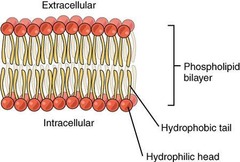
Hydrophobic
"Water-fearing"; a substance that does not mix well with water. Lipids are generally hydrophobic, which helps phospholipids form the cell membrane.
Hydrophilic
"Water-loving"; a substance that interacts easily with water. The hydrophilic parts of phospholipids face the watery environments inside and outside the cell.
Phospholipids
A lipid with a hydrophilic phosphate-containing head and hydrophobic fatty-acid tails. Phospholipids form the basic structure of cell membranes.
Saturated Fat
A lipid made from fatty acids that have no double bonds between carbon atoms

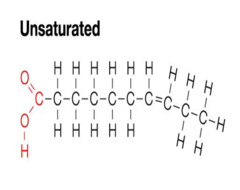
Unsaturated Fat
A lipid made from fatty acids that have at least one double bond between carbon atoms. Bending prevents packing together = liquid at room temp.
Fats (triglycerides)
Fats (triglycerides) consist of a glycerol molecule with 3 fatty acid tails. They store long-term energy, cushion organs, and insulate the body.

cell membrane
Cell membranes provide a barrier between the contents of the cell and the external environment.
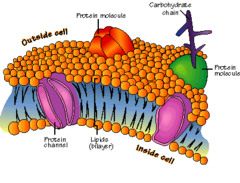
why is it important cell membranes are made out of lipids?
Lipids form a barrier because their hydrophobic tails repel water, creating a bilayer that separates the cell from its environment and controls what enters and leaves.
Steroids
A type of lipid found in cell membranes that are necessary for cell signaling. Contain a rigid backbone of four rings of carbon. (others act as hormones: estrogen/testosterone)

Waxes
A lipid made from a long-chain fatty acid and a long-chain alcohol. Waxes provide waterproofing and protection on plant leaves.
Cholesterol
A steroid lipid found in animal cell membranes that helps regulate membrane fluidity and is also used to make certain hormones. Your cells need cholesterol to maintain structure of cell membranes
Cholesterol problem
When present in excessive amounts it may precipitate (separate) from the solution its in (blood).
Can precipitate against walls of arteries of veins, contributing to high blood pressure and heart disease.
Proteins
Composed of carbon (C), hydrogen (H), oxygen (O), and nitrogen (N); made from amino acids linked by peptide bonds and folded into specific shapes

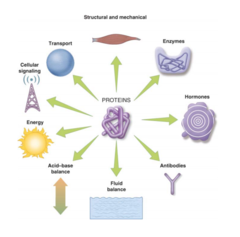
Protein functions
Structure (Collagen in skin, spider silk)
Hormones (Insulin and Glucagon)
Transport (Hemoglobin)
Enzymes (Lactase, Catalase)
Immunity (Antibodies)
...and more. Proteins do everything!
What is the monomer form of proteins?
Amino acid

What is the structure of an amino acid?
A central carbon attached to an amino group (NH2), carboxyl group (COOH), H, and R group.

How do amino acids determine protein structure and function?
The order of amino acids determines how the protein folds, and its shape determines its function.
R group (amino acid)
The variable side group that differs between amino acids that influences an amino acid's properties and helps determine how a protein folds.
How many R groups are there?
20

what makes R group the variable side group?
it is the only part of the structure that changes from one amino acid to the next.
amine group (amino acid)
The functional group -NH₂ found in amino acids. one of the two main functional groups that make up an amino acid.

carboxyl group (amino acid)
A functional group containing carbon, oxygen, and hydrogen (-COOH). It is one of the two main functional groups that make up an amino acid.

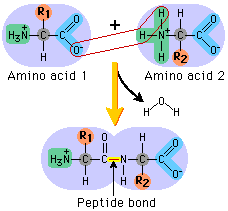
How are amino acids joined together?
Through dehydration synthesis, which forms a peptide bond and releases water.
what is a polypeptide?
A polymer/chain of amino acids linked by peptide bonds.
peptide bond
A covalent bond that forms between the amino group of one amino acid and the carboxyl group of another. Peptide bonds connect amino acids to build proteins.
How does a polypeptide become a functional protein?
It folds into a specific 3D shape that determines its function.
primary structure
The specific sequence of amino acids in a protein. The amino acid sequence influences how the protein folds and ultimately how it functions.

secondary structure
folding of a protein into structures such as alpha helices and beta sheets, mainly caused by hydrogen bonding.

tertiary structure
The third level of protein structure; the overall, three-dimensional shape of a polypeptide due to interactions of the R groups of the amino acids making up the chain.

quarternary structure
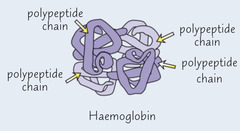
The fourth level of protein structure; the shape resulting from when two or more polypeptide subunits come together to make one functional protein/macromolecule
why is protein structure so important?
-A protein's function depends on its structure.
-Mutations that alter a protein's structure may also alter its function.
ex. sickle cell anemia
CHANGE THE STRUCTURE, CHANGE THE FUNCTION
Hemoglobin
A protein that helps with the transport of oxygen in red blood cells. Oxygen must be transported to cells so they can carry out cellular respiration.
Collagen
A protein that provides support and structure in connective tissues. It helps provide structure to tissues such as skin, tendons, and ligaments.
Insulin
A protein that controls the amount of glucose in the bloodstream. It helps maintain stable blood glucose levels.
enzymes
Proteins that speed up the process in chemical reactions

Nucleic Acids
Composed of carbon (C), hydrogen (H), oxygen (O), nitrogen (N), and phosphorous (P); responsible for storing and transmitting genetic information.

Nucleotide
The monomer form of nucleic acids, made of a sugar, a phosphate group, and a nitrogenous base.

What does DNA stand for?
Deoxyribonucleic acid
What is the primary function of DNA?
To store genetic information
What structure does DNA have?
Two strands in a double helix
DNA function
store, preserve, and pass down the genetic instructions needed to build, control, and maintain living organisms.
RNA
Ribonucleic acid; a nucleic acid involved in using genetic information to make proteins.

RNA structure
single stranded chain of nucleotides
RNA function
The primary function of RNA (ribonucleic acid) is to convert the genetic code stored in DNA into functional proteins that drive cellular life
ATP
(adenosine triphosphate) Special type of nucleic acid; stores and transfers usable energy for cellular processes.
why is ATP important to cells?
Organic molecules → broken down → energy captured in ATP → ATP powers cell activities
Dehydration synthesis
A reaction that joins smaller molecules together to form a larger molecule by removing water.
turns monomers to polymers
Hydrolysis
A reaction that breaks a larger molecule into smaller molecules by adding water.
turns polymers to monomers
Hydrogen Bond
A weak attraction between a partially positive hydrogen atom and a partially negative atom, usually oxygen or nitrogen.
Homeostasis
inorganic compounds
compounds that generally do not contain carbon-hydrogen bonds, such as water and many salts
unicellular vs multicellular
Made of one cell vs made of many cells
metabolism
The maintenance of a stable internal environment despite changes outside the organism. Cells function properly only within certain internal conditions.
What are nutrients?
Substances organisms obtain from their environment that are needed for energy, growth, repair, and normal functioning.
Why do organisms need nutrients?
Organisms need nutrients as raw materials and/or sources of energy.
What is growth in biological terms?
Growth is an increase in size or number of cells.
What does development involve in living organisms?
Development involves changes in an organism as it becomes more mature and specialized.
How do living organisms change over time?
Living organisms change and become more complex over time.
why is carbon important?
Carbon has 4 valence electrons and can form many stable bonds, allowing living organisms to form chains, rings, and complex molecules that make up living organisms.