Structure of DNA
 Call Kai
 Learn
 Practice Test
 Spaced Repetition
 Match
 Flashcards
 Knowt Play
1/17

There's no tags or description
Looks like no tags are added yet.
18 Terms
The structure of the molecule of inheritance must allow the following properties
Must permit accurate and fast WHAT
Must be able to WHAT ‘WHAT’ in some way
Must be able to WHAT or WHAT at a level consistent with the WHAT between the individuals observed
The structure of the molecule of inheritance must allow the following properties
Must permit accurate and fast REPLICATION
Must be able to ENCODE ‘INFORMATION’ in some way
Must be able to MUTATE or CHANGE at a level consistent with the VARIATION between the individuals observed
DNA is made up of NUCLEOTIDES
DNA is made up of NUCLEOTIDES

What is a nucleotide made up of for DNA
WHAT
WHAT
WHAT
What is a nucleotide made up of for DNA
Deoxyribose sugar (5 carbon)
Phosphate group
Base (nucleic acid)

What are the two types of nucleic acids
WHAT
WHAT
What are the two types of nucleic acids
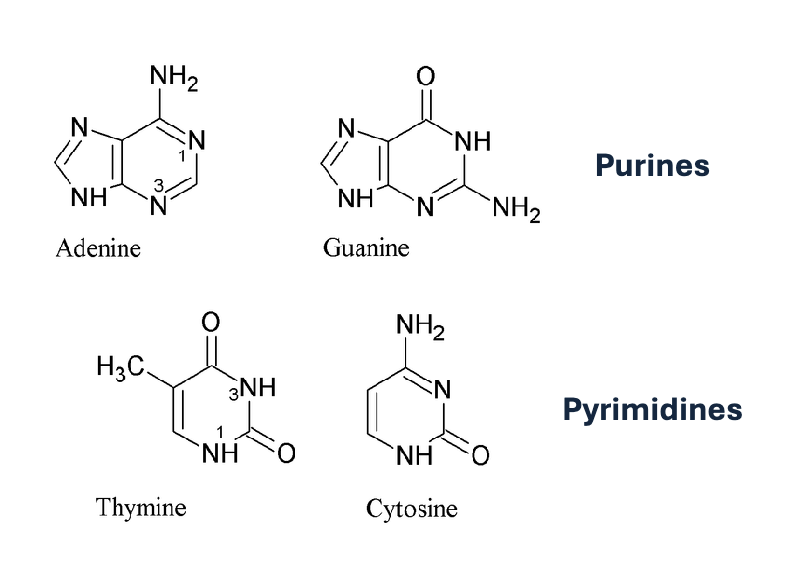
Purines
Pyrimidines

purines
2 rings
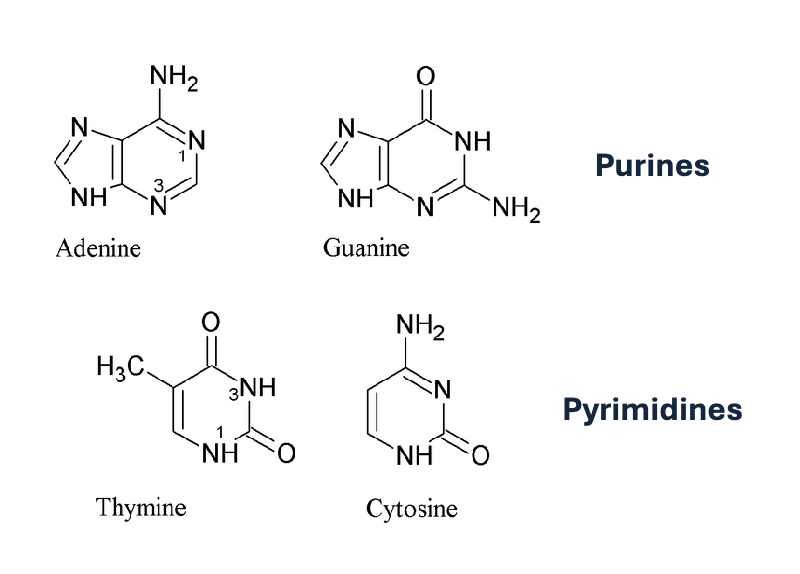
Pyrimidines
1 ring

what bases are in purines
Adinine
Guanine

what bases are in pyrimidine
Thymine
Cytosine
(all have a Y in the name)
Chargaff’s rules in DNA
Number of purines WHAT the number of pyrimidines
Amount of A WHAT T, G WHAT C
Amount of A+T WHAT G+C
Chargaff’s rules in DNA
Number of purines EQUALS the number of pyrimidines
Amount of A EQUALS T, G EQUALS C
Amount of A+T DOESN’T EQUAL G+C
X-ray diffraction images proved that DNA is a WHAT
X-ray diffraction images proved that DNA is a DOUBLE HELIX
Watson and Crick determined that purines had to WHAT with pyrimidines
Based on Chargaff’s rules, they proposed that A always paired with WHAT and G always paired with WHAT
Watson and Crick determined that purines had to PAIR with pyrimidines
Based on Chargaff’s rules, they proposed that A always paired with T and G always paired with C

The structure of DNA is WHAT, meaning there is a WHAT groove and a WHAT groove
The structure of DNA is ASYMMETRICAL, meaning there is a MAJOR groove and a MINOR groove
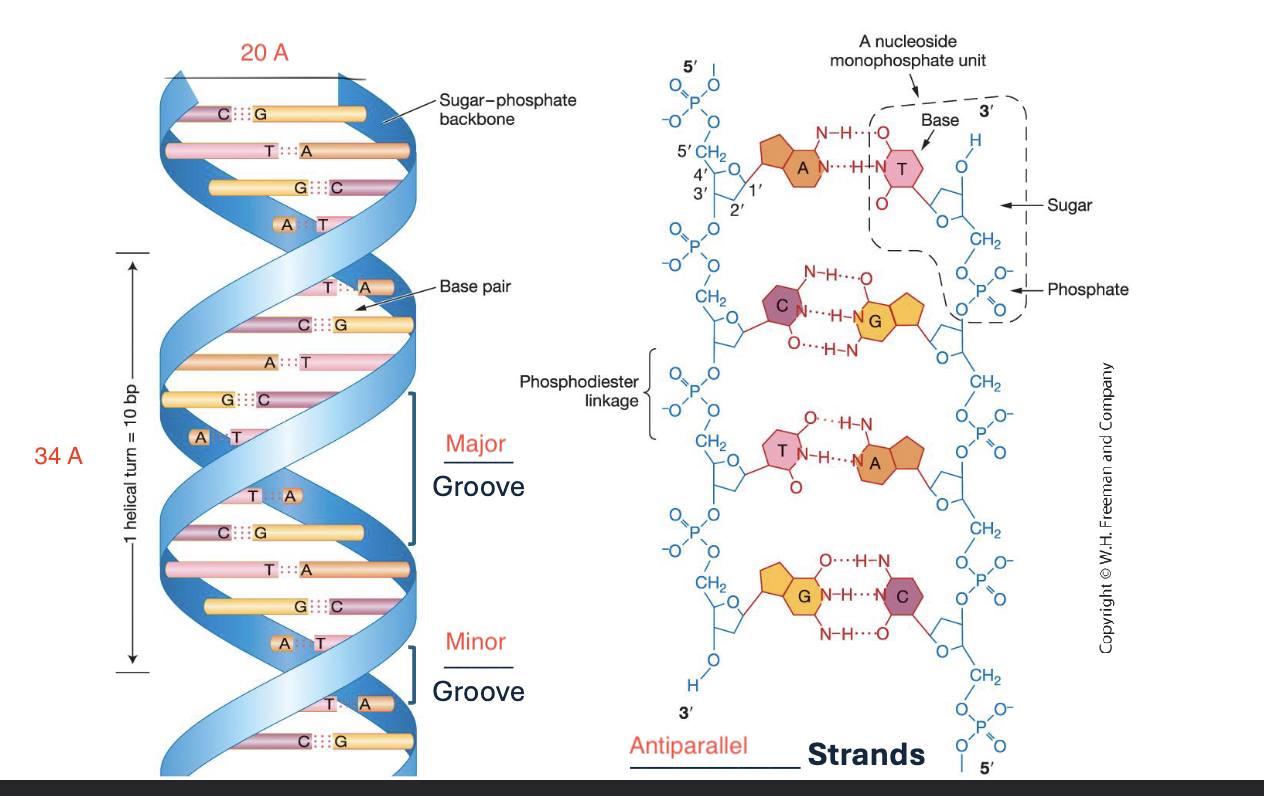
The backbone of DNA is held up by WHAT = WHAT bonds
The backbone of DNA is held up by PHOSPHODIESTER LINKAGE = COVALENT bonds

The two strands of DNA are WHAT which is they they are capable of WHAT
The two strands of DNA are COMPLEMENTARY which is they they are capable of REPLICATING

Adenine and thymine = HOW MANY hydrogen bonds
Guanine and cytosine = HOW MANY hydrogen bonds
Adenine and thymine = 2 hydrogen bonds
Guanine and cytosine = 3 hydrogen bonds

The DNA strands are WHAT
The DNA strands are ANTIPARALLEL

The OH end of the strand is the WHAT end and the phosphorous end is the WHAT end
The OH end of the strand is the 3’ end and the phosphorous end is the 5’ end

The diameter of a double helix is WHATÅ, and the width of 10 base pairs is WHATÅ; therefore, the distance between base pairs is WHATÅ
The diameter of a double helix is 20Å, and the width of 10 base pairs is 34Å; therefore, the distance between base pairs is 3.4Å
