Multiple Sclerosis Rehab
 Call Kai
 Learn
 Practice Test
 Spaced Repetition
 Match
 Flashcards
 Knowt Play
1/67

There's no tags or description
Looks like no tags are added yet.
68 Terms
what is multiple sclerosis?
a neurodegenerative, autoimmune, demyelinating disease of the central nervous system. cause is unknown but the four primary risk factors include immune system dysfunction, genetic predisposition, environmental trigger, and/or infection
what is the most relevant gene associated with MS?
individuals may inherit a genetic susceptibility to autoimmune disorders or to MS itself- HLA-DRB1×15:01 is the most relevant gene associated
what is the pathophysiology of MS?
the auto-antibodies (T cells) attack the body’s own cells and tissues, causing inflammation and damage specifically to CNS axon myelin sheaths and to oligodendrocytes. saltatory conduction along axon is impaired or blocked at sites of myelin sites (demyelination leads to slowed nerve impulses and conduction time along affected axons, leads to increased energy consumption during movement so patient c/o fatigue with activity)
does myelin in MS regrow?
yes it does but is eventually replaced by sclerotic plaques
describe the immune cascade that occurs with MS
see image (BBB = blood brain barrier)

where are plaques in white matter in the CNS primarily located when myelin and oligos are destroyed in MS?
the periventricular areas
cerebellar peduncles
brainstem
dorsal spinal cord
what aspects of MS pathology contribute to the different presentations of patients?
inflammatory attacks, along with scarring and axonal damage, occur randomly and vary widely in severity, location, and frequency and duration from one person to another with MS
what is the epidemiology of MS?
onset occurs between the teens and 40 years of age (rare in young children and adults over 50)
affects up to 1 million people in the US, 200 million worldwide
more common in women than men (2.5:1)
affect primarily caucasian populations from northern climates
evidence of epidemics support theory of exposure to infection agent that triggers inflammatory cascade
what are the critical signs and symptoms of MS?
cranial nerve dysfunction
sensory dysfunction
motor dysfunction
cerebellar dysfunction
vestibular and brainstem
bowel, bladder, and sexual dysfunction
cognitive dysfunction in 50%
persistent fatigue and heat sensitivity common
what components of cranial nerve dysfunction are common with MS?
optic neuritis, retrobulbar neuritis, diplopia
eye movement problems; CN ^ > 3 > 4
facial sensory loss
what components of sensory dysfunction are common with MS?
vibratory and proprioceptive loss
sharp/dull and light touch loss- patchy areas
paresthesias common
pressure in a band-like pattern, burning pain
Lhermittes’s sign = sharp pain with cervical flexion
what components of motor dysfunction are common with MS?
hemiparesis to hemiplegia
paraparesis to paraplegia
quadriparesis in very late in the disease
all include spasticity
what components of cerebellar dysfunction are common with MS?
gait disturbance (wide BOS, staggering, poor reciprocal limb movement)
ataxia, dysdiadochokinesia, dysmetria
dysarthria
intention tremor
what components of vestibular (CN VIII) and brainstem dysfunction are common with MS?
imbalance
dizziness
VOR dysfunction
what components of bowel, bladder, and sexual dysfunction are common with MS?
urgency, frequency, incomplete bladder emptying common in MS (leads to UTIs)
constipation
erectile dysfunction
what components of cognitive dysfunction are common with MS?
there is cognitive dysfunction in 50% of patients, related to distribution of brain lesions not overall severity of disease
what are the characteristics of MS fatigue?
mental or physical fatigue or both
exacerbated by exercise, increased ambient temp, increased body temp
increase with systemic illness
unrelated to disability status
no correlation found with lesion location
no correlation found with depression
what are the types of MS?
relapsing remitting MS
primary progressive MS
secondary progressive MS
what are the characteristics of relapsing remitting MS?
clearly defined exacerbations or relapses with either full or partial recovery, most common → 85%
episodes of acute worsening followed by partial or full recovery and disease stability
between attacks there is no progression of disease, but they often do not return to baseline
evidence of lasting disability over time

what are the characteristics of primary progressive MS?
characterized by continuous worsening or steady disease progression and continual functional decline from onset
rarely see any true decrease in signs and symptoms
not interrupted by distinct relapses or remissions

what are the characteristics of secondary progressive MS?
begins with pattern of clear cut relapses and recovery but becomes steadily progressive over time
continued worsening between occasional acute attacks
may have relapse, minor remission or plateau

what are the revised McDonald Criteria?
guidelines that incorporate clincial and lab evaluations, as well as MRI data to establish MS dx
to be dx with MS based on McDonald criteria, pt must have MRI evidence of dissemination in time and space
what does dissemination in time and space mean?
evidence of CNS damage disseminated in space or appearing in at least two regions of CNS
evidence of damage disseminated in time or occurring at different time points. two or more relapses separated in time (months)
what antibodies are characterisitcally detected in CSF in pxMS?
oligoclonal bands (aka immunoglobulins), the presence of oligoclonal bands can substitute for dissemination in time
which is the gold standard test for MS diagnosis?
MRI- abnormal MRI scans are found in 96% with definite diagnosis of MS
what are the characteristics of the CSF examination with patients with MS?
oligoclonal bands, decreased T suppressor lymphocytes, increased IgG
not unique to MS
useful during acute episodes
what might you see in on an MRI with a patient with MS?
gadolinium (GD) reflects breakdown of BBB and area of active inflammation
some lesions can shrink or disappear
some lesions leave a T2 hyperintensity (white spots)
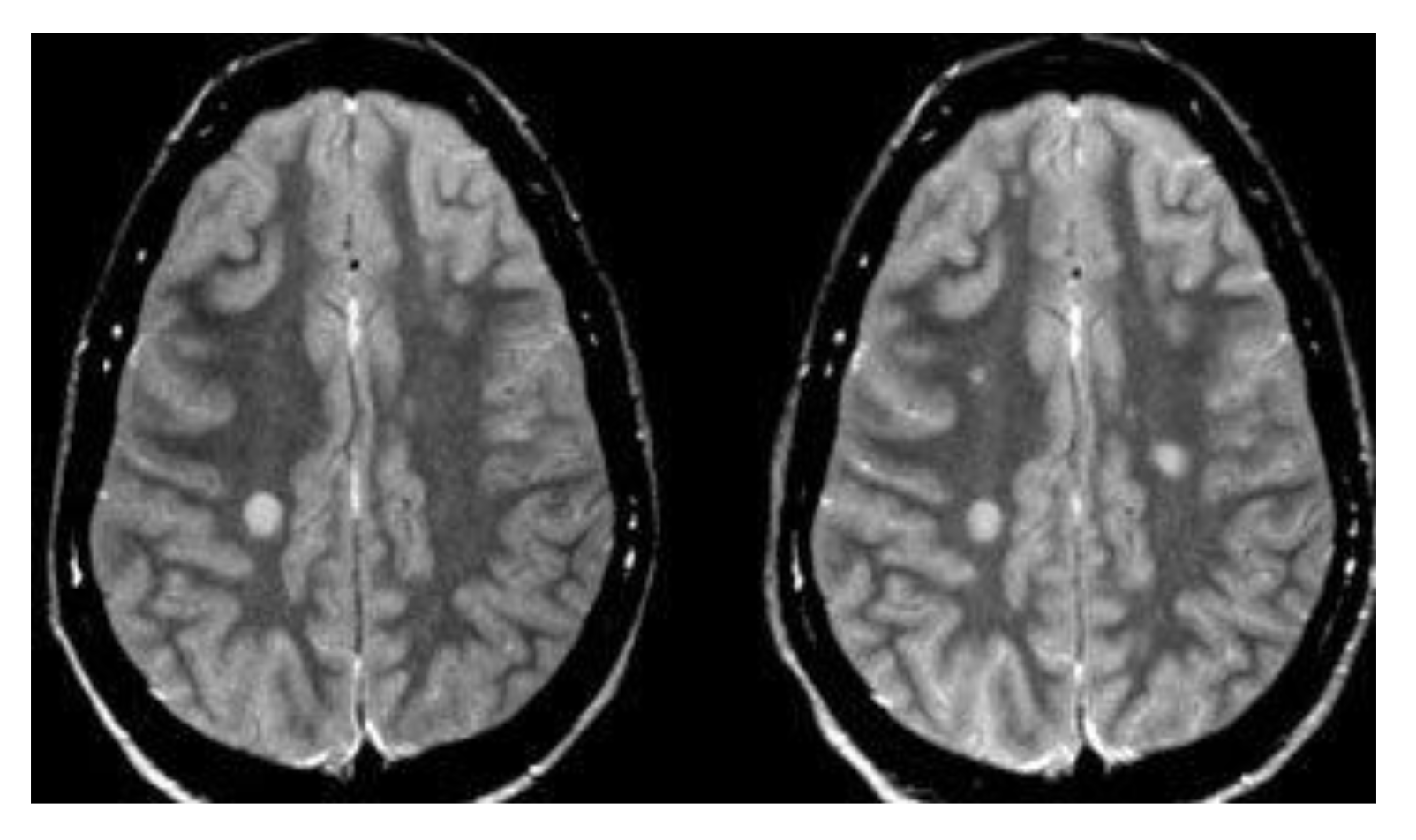
what can be seen in the image?
on the left see a single lesion on a T2 weight MRI, on the right see two new lesions at a 3 month follow up

what can be seen in the image?
peri-ventricular lesions
what are some known triggers for relapse?
infections such as cold, flu, gastroenteritis
stress
pregnancy and post partum
excessive fatigue
physical trauma
receiving general anesthesia
what factor can exacerbate MS symtpoms but isn’t a trigger for relapse?
exposure to higher than usual ambient temps (Uhthoff’s phenomenon) can exacerbate existing symptoms but ISN’T A TRIGGER to relapse
what does pharmacological management look like for acute exacerbation of MS?
high dose steroids: solumedrol (methylprednisolone) over 3-5 days followed by a graudal tapering dose of oral steroids s/a prednisone for 1-3 weeks
why are corticosteroids appropriate for use during acute exacerbations?
do not affect overall course of MS but have been shown to shorten the duration and severity of relapses
PRECAUTION: long term use is associated with severe side effects s/a HTN, osteoporosis, cataracts, muscle wasting, hyperglycemia
what does long term pharmacologic management look like?
many disease modifying therapies (DMT): act to interfere with steps in immune cascade
interferons given by infection or IV
how are interferons meant to work?
they are designed to intervene after T cells have been activated and enter the CNS
interferons must be present before the cascade begins, to be effective
if cascade has already begin, then the patient is treated with corticosteroids
has any drug been shown to achieve sustained remission?
no, but many have been shown to help lesson exacerbations
how are disease modifyign agents administered?
injectable medications
oral medications
infused medications

how important is early drug treatment for MS?
very important, the progression of MS will significantly increase is left untreated or treatment is delayed. beginning treatment early shows lower amounts of progression, which support beginning treatment at the time of diagnosis (see image)

what drugs are used for fatigue symptom management?
amantadine
provigil (monafinil)
prozac (fluoxetine)
what drugs are used for spasticity symptom management?
botox injection
dantrium (dantrolene)
lioresal (baclofen)
valium (diazepam)
zanaflex (tizandine)
what drugs are used for tremors symptom management?
laniazid
nydrazid (isoniazid)
klonopin
clonazepam
what drugs are used for walking/gait difficulties management?
ampyra
what are factors affecting favorable prognosis?
long interval to 2nd attack
complete recovery from 1st attack
female and younger age at onset
low level of disability at 2 and 5 years
MRI with limited T2 weighted hyperintensities
what are factors for poor prognosis?
short interval to 2nd attack
lack of full recovery from 1st attack
older age at onset
early cerebellar and brainstem involvement. (ataxia)
MRI showing significant T2 weight hyperintensives
what should be taken in the PT neuromusuclar exam for patients with MS?
cognitive assessment
fatigue profile
sensory integrity and pain
CN integrity
ROM, joint integrity, contractures, and posture
MMT vs functional strength testing
motor function (motor control and motor planning, coordination, muscle tone, reflexes)
balance
gait
Functional assessment
AD/orthotic devices
environmental assessment
work or school status
social support network, community resources
what cognitive assessment would be appropriate for the PT neuromuscular exam for MS?
short term memory, attention, verbal fluency
MMSE, MoCA
what fatigue assessments would be appropriate for the PT neuromuscular exam for MS?
pattern of fatigue, frequency of naps, sleep
modified fatigue impact scale (MFIS) or fatigue severity scale (FSS)
what functional strength testing would be appropriate for the PT neuromuscular exam for MS?
5 STS, chair stand test
which CNs are most appropriate to assess in MS?
Cranial nerves II, III, IV, and VI are most appropriate to assess in MS due to their roles in vision and eye movement. along with VIII which is responsible for hearing and balance.
what balance assessments would be appropriate for the PT neuromuscular exam for MS?
Berg or tinetti
FSST
walking while talking test, tug or tug cognitive
ABC scale
what gait assessments would be appropriate for the PT neuromuscular exam for MS?
DGI or FGA
25 foot walk test commonly used
6 MWWT has strong correlation to subjective measures of fatigue (2 MWT)
what functional assessments would be appropriate for the PT neuromuscular exam for MS?
CARE tool
What are the recommended tests and measures for MS (recommended by the ANPT MS Edge Task force)?
EDSS
MSIS-29
MSWS-12
MFES
MFIS
FSS
describe the EDSS (Kurtzke Expanded Disability Status Scale)
10 pt ordinal scale rates overall disability due to MS
Scores based on the neurological exam, combines impairment and disability
has poor responsiveness (does not detect change in disease severity over time)
what are the components of the EDSS?
functional systems plus the ability to walk: pyramidal, cerebellar, brainstem, sensory, B&B, visual, mental function
0 = normal neurologic exam 10 = death due to MS
does not measure cognition or fatigue
describe the MSIS-29 (Multiple Sclerosis Impact Scale)
measures physical and psychological impact of MS
29 item self report questionnaire
very sensitive to clinical change indicating that it can be used to monitor disease progression over time
what are the components and scoring of the MSIS-29?
20 items of physical impact of MS
9 items of psychical impact of MS
5 point likert scale- scores range from 1 to 5
describe the MSWS-12 (12 item MS walking Scale)
self report measure of impact of MS on individual’s walking ability
12 item self-report questionnaire
“in the past two week, how much has MS … limited your ability to walk?”
5 point likert scale (scores range 1-5 and total score out of 60)
describe the MFES (modified falls efficacy scale)
14 item interviewer administered falls questionnaire
ordinal scale 1-10, score calculated by averaging scores on all rated items
appears sensitive to mild levels of loss of confidence (more testing needed for MS pops)
describe the MFIS (modified fatigue impact scale)
21 item self report questionnaire
fatigue is assessed in terms of physical, cognitive, psychosocial
reported from 0 to 4, total out of 48
cutoff score is 38
describe the fatigue severity scale
9 item self report fatigue questionnaire
differentiates fatigue from clinical depression
7 point likert scale, score by summing responses and dividing by 7: fatigue FSS >= 5, non-fatigue FSS <=4
correlates highly with MFIS
what is important to note about interventions with MS?
DO NOT OVERFATIGUE (use RPE scale and daily activity log)
incorporate activity → rest → activity → rest daily cycle
encourage flexibility of routine - nap/rest midday
AVOID overheating (use ice packs, cold drink, eat frozen fruit, cooling vest, cold not hot showers, spray bottle)
Hot tub for MS patients?
NO
what are some intervention strategies for MS?
exercise for flexibility, balance, strength, conditioning (pilates, yoga, tai chi, low reps)
avoid overworking any one muscle group
manage spasticity with meds and stretching
exercise with fan, spray bottle
encourage acceptance of AD during certain activities for energy conservation
connect them with support system (national MS society)
what are the general guidelines for exercise for people with MS?
exercise is safe, not associated with increased risk of either relapse or adverse events
exercise response or influenced by many factors
patients with RRMS in an exacerbation should not exercise until remission is evident
due to exercise induced increases in core body temperature, individuals with heat intolerance may be more tolerant to resistance exercise than aerobic exercise
what are the specific aerobic exercise recommendations for MS?
frequency 2-3 times a week
duration progress gradually from 10 to 30 mins
intensity moderate and range between 11 and 13 on 20 point RPE scale or 40-60% O2
what are the specific advanced aerobic exercise recommendations for MS?
frequency up to 5 days a week
duration can approach 40 minutes
intensity up to 15 on RPE
70% peak O2
can add addition of running or cycling
what are the specific resistance exercise recommendations for MS?
frequency 2-3 times a week
exercise bouts from 1 to 3 sets of 8-15 rep max and consists of approx 5-10 exercises
focus on large muscle groups esp LE and rest between bouts for 2-4 minutes
minimum 1 day to rest muscles