Review Notes: Lipid Biosynthesis - Biosynthesis of Cholesterol
 Call Kai
 Learn
 Practice Test
 Spaced Repetition
 Match
 Flashcards
 Knowt Play
1/12

There's no tags or description
Looks like no tags are added yet.
13 Terms
Fates of Cholesterol
vital constituent of cell membranes
synthesis of steroid hormones
production of bile acids/salts & excretion
bile salts are the ONLY way cholesterol leaves the body
synthesis of vitamin D
Cholesterol
cholesterol = a weakly amphipathic sterol
composed of 4 hydrocarbon rings & polar OH - thus likes to be found in membranes
ALL mammalian cells can synthesize cholesterol
mainly synthesized in LIVER, intestines, adrenal gland & reproductive organs
occurs in cytosol
precursor of carbon atoms for cholesterol: ONLY acetate
cholesterol can be produced from fat, sugar & proteins where ALL the carbons are from acetate
discovered they isotopically labelled A-CoA’s
final form of cholesterol is 27C, BUT cholesterol synthesis requires 36C
3 acetates (2C) per mevalonate (6C) & we need 6 mevalonates → thus need 36 C to make cholesterol
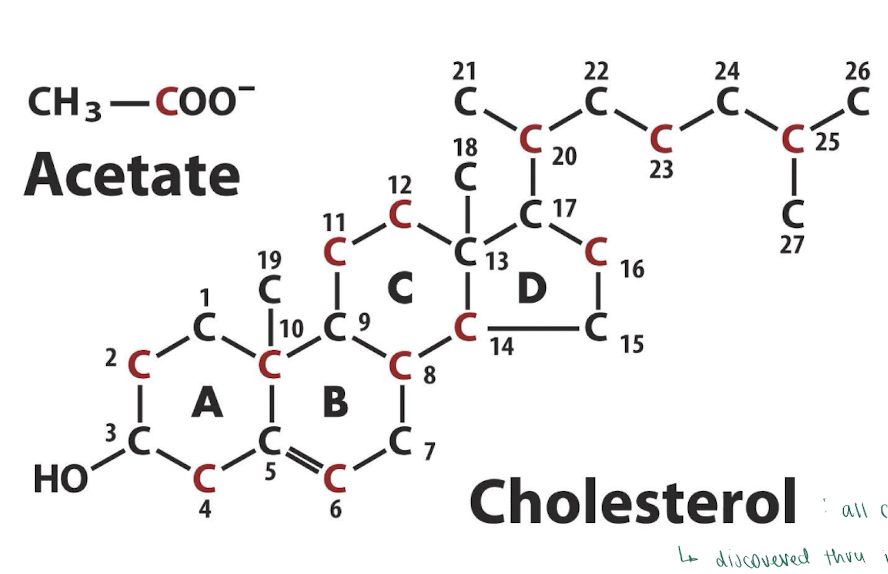
endogenous synthesis of cholesterol = cholesterol from dietary sources
→ cholesterol is made from acetate in 4 main stages
greatest formation occurs in the LIVER
have to transport A-CoA from matrix → into cytosol
crosses as citrate using tricarboxylic acid transporter at IMM, them porin at OMM
enzymes used: citrate syntheses (requires H2O) & ATP-citrate lyase (requires 1ATP)
result: transports A-CoA to cytosol + produces OAA in cytosol

→ HMG-CoA reductase is the MAJOR regulatory step in cholesterol biosynthesis
requires 2 NADPH
Cholesterol synthesis requires:
transport of A-CoA into cytosol: 1 ATP + 1 H2O
stage 1: 2 NADPH
stage 2: 3ATP
stage 3: 1 NAPDH
stage 4: 16 NADPH
total = 4 ATP, 19 NADPH, 1 H2O
Cholesterol synthesis generates:
transport of A-CoA into cytosol: 1 Pi
stage 2: 1 Co2 + 1Pi
stage 3: 4 PPi
stage 4: 2 NADH + 16 H2O
total = 2 NADH, 16 H2O
Stages of Cholesterol Synthesis
Step 1: transport Acetyl-CoA out of mitochondria → cytosol
requires H2O in matrix & ATP in cytosol
citrate synthase uses H2O to convert OAA + A-CoA → citrate
citrate crosses IMM via tricarboxylic acid transporter
citrate crosses OMM via porin into cytosol
ATP-citrate lyase uses ATP to convert citrate → OAA + A-CoA
A-CoA is used in cytosol to make cholesterol
Stage 1: A-CoA → HMG-CoA
requires 1 H2O
thiolase combines 2 A-CoA’s → Acetoacetyl-CoA
this thiolase is DIFF than B-OX of FA
HMG-CoA synthase uses 1H2O to reduce carbonyl to an alcohol + attaches -CH2-CO2- onto Acetoacetyl-CoA → forms HMG-CoA

note: this is the same 3 steps in formation of ketone bodies, BUT that occurs in the mito matrix whereas this is in the cytosol

Stage 1: HMG-CoA → mevalonate
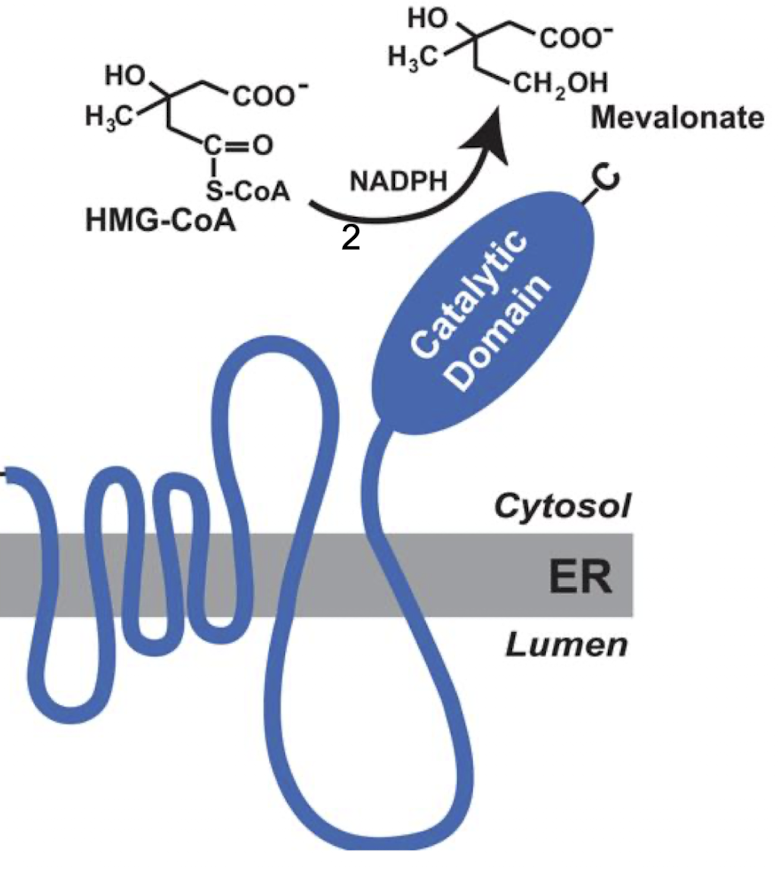
HMG-CoA reductase is the MAJOR regulatory step in cholesterol biosynthesis
statins inhibit this enzyme to decrease endogenous cholesterol (from diet)
catalytic group faces cytosol
requires 2 NADPH - used to add OH & remove CoA
HMG-CoA reductase uses 2 NADPH to reduce carbonyl of HMG-CoA to a CH2 w an OH attached & remove CoA → forms mevalonate
produces 2 NADP+ in cytosol
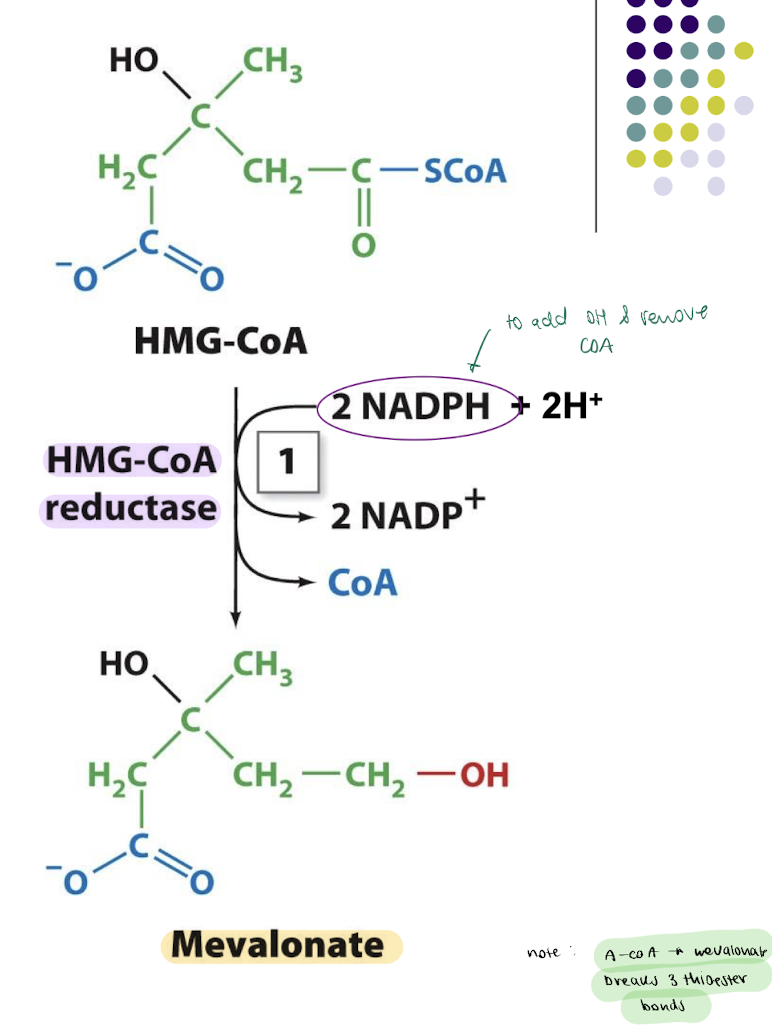
note: similar to ketogenesis in matrix, EXCEPT that occurs in the matrix & uses HMG-CoA lyase to form Acetoactetae instead of this step
note: HMG-CoA synthase & HMG-CoA lyase used in ketogenesis aren’t exactly opp bc syntheses used H2O

overall: stage 1 converted 2A-CoA → mevaolante
broke 3 thioester bonds
reactants: 3 A-CoA + H2O + 2 NADPH
Stage 2: mevalonate → activated isoprene units
Isoprene = 5C backbone for steroids
also found in ETC’s Q to keep it anchored to phospholipid bilayer
requires 3ATP to convert mevalonate → IPP or DMAPP
IPP & DMAPP contain activated isoprene groups w 5C
mevalonate kinase uses 1ATP to add PO4 to mevalonate → phosphomevalonate

phosphomevalonate kinase uses ATP to add another PO4 → 5-pyrophosphomevalonate

note: have to decarboxylate this product just like how OAA is easy to decarboxylate & Acetoacetate is easy to decarboxylate in ketogenesis


decarboxylase uses ATP to remove CO2 → isopentenyl pyrophosphate (IPP)
involves:
phosphorylation
decarboxylation
dephosphorylation

note: can use isomerase to convert IPP → DMAPP

Stage 3: IPP + DMAPP → squalene
IPP + DMAPP makes 10C , then add IPP, then use NADPH to add another of the same product → get squalene (30C)
requires 1 NADPH

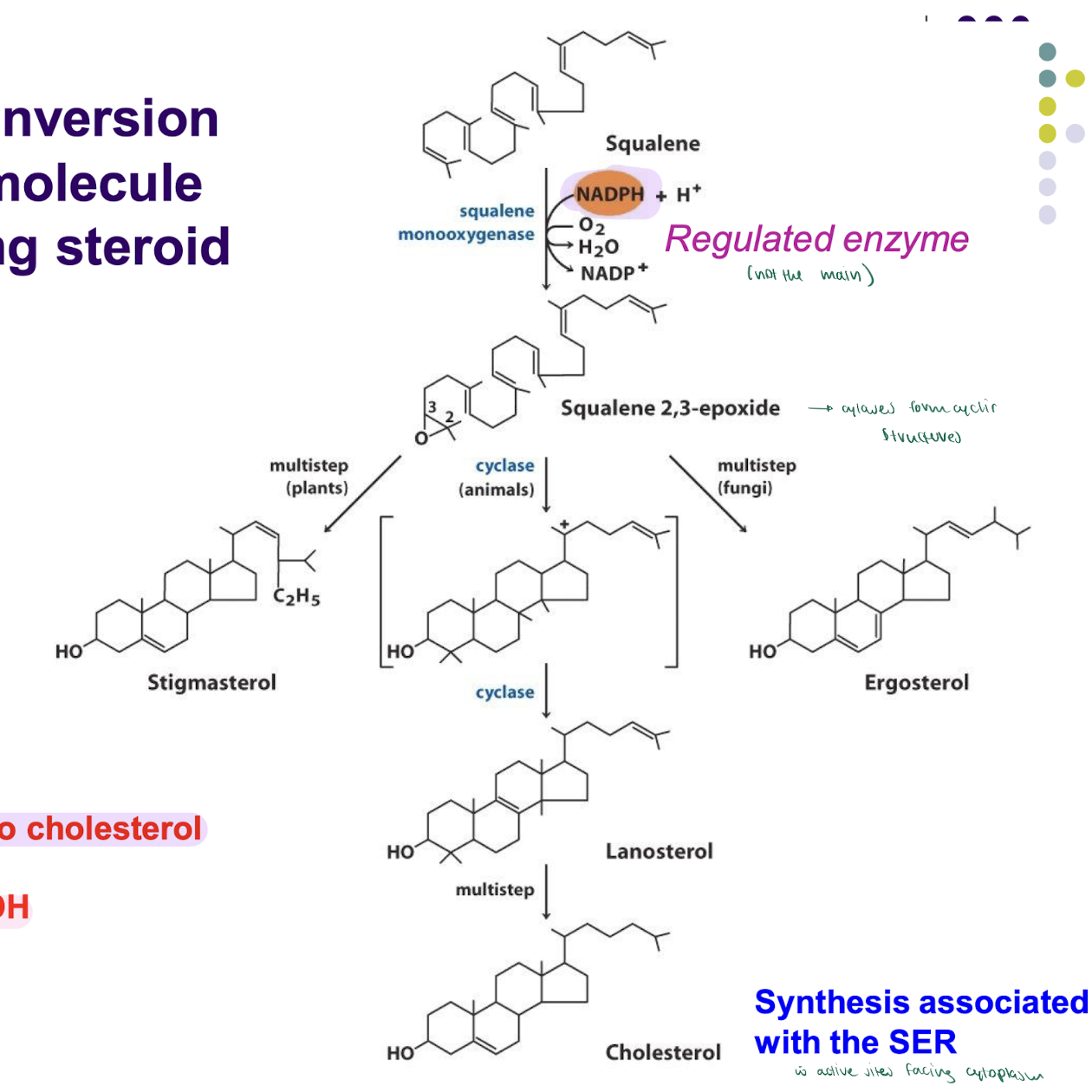
Stage 4: linear squalene → 4-ring steroid nucleus
requires 16 NADPH & generates 2 NADH + 16 H2O
involves a regulated enzyme: squalene monooxegenase that requires NADPH & produces H2O
synthesis is associated with the SER w active sites facing cytoplasm
Summary: Stages of C
Step 1: transport Acetyl-CoA out of mitochondria → cytosol
requires H2O in matrix & ATP in cytosol
citrate synthase uses H2O to convert OAA + A-CoA → citrate
citrate crosses IMM via tricarboxylic acid transporter
citrate crosses OMM via porin into cytosol
ATP-citrate lyase uses ATP to convert citrate → OAA + A-CoA
A-CoA is used in cytosol to make cholesterol
Stage 1: A-CoA → HMG-CoA
requires 1 H2O
thiolase combines 2 A-CoA’s → Acetoacetyl-CoA
this thiolase is DIFF than B-OX of FA
HMG-CoA synthase uses 1H2O to reduce carbonyl to an alcohol + attaches -CH2-CO2- onto Acetoacetyl-CoA → forms HMG-CoA
Stage 1: HMG-CoA → mevalonate
HMG-CoA reductase is the MAJOR regulatory step in cholesterol biosynthesis
statins inhibit this enzyme to decrease endogenous cholesterol (from diet)
catalytic group faces cytosol
requires 2 NADPH - used to add OH & remove CoA
HMG-CoA reductase uses 2 NADPH to reduce carbonyl of HMG-CoA to a CH2 w an OH attached & remove CoA → forms mevalonate
produces 2 NADP+ in cytosol
overall: stage 1 converted 2A-CoA → mevaolante
broke 3 thioester bonds
reactants: 3 A-CoA + H2O + 2 NADPH
Stage 2: mevalonate → activated isoprene units
Isoprene = 5C backbone for steroids
also found in ETC’s Q to keep it anchored to phospholipid bilayer
requires 3ATP to convert mevalonate → IPP or DMAPP
IPP & DMAPP contain activated isoprene groups w 5C
mevalonate kinase uses 1ATP to add PO4 to mevalonate → phosphomevalonate
phosphomevalonate kinase uses ATP to add another PO4 → 5-pyrophosphomevalonate
decarboxylase uses ATP to remove CO2 → isopentenyl pyrophosphate (IPP)
involves:
phosphorylation
decarboxylation
dephosphorylation
note: can use isomerase to convert IPP → DMAPP
Stage 3: IPP + DMAPP → squalene
IPP + DMAPP makes 10C , then add IPP, then use NADPH to add another of the same product → get squalene (30C)
requires 1 NADPH
Stage 4: linear squalene → 4-ring steroid nucleus
requires 16 NADPH & generates 2 NADH + 16 H2O
involves a regulated enzyme: squalene monooxegenase that requires NADPH & produces H2O
synthesis is associated with the SER w active sites facing cytoplasm
Q. Which of the following is not an intermediate in the synthesis of squalene from acetyl-CoA?
a. activated isoprene
b. malonyl-CoA
c. mevalonate
d. HMG-CoA
e. all of the above are involved in the synthesis of squalene
A-CoA → squalene is stage 1-3 in cholesterol synthesis in cytosol
answer: malonyl-CoA ISNT an intermediate in the synthesis of squalene, its a part of FAS (NOT cholesterol synthesis)
Q.

acetate supplys all the carbons for cholesterol synthesis
final form of cholesterol is 27C, BUT cholesterol synthesis requires 36C
3 acetates per mevalonate & we need 6 mevalonates → thus need 36 C to make cholesterol
36/16 = 2.25 → 3
answer: 3 are necessary
Q. How much energy is REQUIRED for synthesis of cholesterol from A-CoA in cytosol
A-CoA is in the cytosol already, thus don’t need to use 1 ATP in its transport from the matrix
Stage 1: uses 2 NADPH =
stage 2: uses 3ATP
stage 3: uses 1 NAPDH
stage 4: uses 16 NADPH & produces 2 NADH
gross: 19 NADPH, 3 ATP
net:
note: it requires 1 H2O, but produces 16 H2O
CHECK ON CANVAS
Cholesterol synthesis requires:
transport of A-CoA into cytosol: 1 ATP + 1 H2O
stage 1: 2 NADPH
stage 2: 3ATP
stage 3: 1 NAPDH
stage 4: 16 NADPH
total = 4 ATP, 19 NADPH, 1 H2O
Cholesterol synthesis generates:
transport of A-CoA into cytosol: 1 Pi
stage 2: 1 Co2 + 1Pi
stage 3: 4 PPi
stage 4: 2 NADH + 16 H2O
total = 2 NADH, 16 H2O
Relationship between cholesterol synthesis & synthesis of ketone bodies
→ HMG-CoA is an intermediate in both the synthesis of cholesterol (cytosol) & synthesis of ketone bodies (matrix)
How does the LIVER cell know what to do?
Well Fed state: glucose/proteins & FA’s are used to make cholesterol
Fasting state: synthesis of ketone bodies in matrix

Well Fed state: glucose/proteins & FA’s are used to make cholesterol
Glycolysis & B-OX of FA’s provide 2 A-CoA in the matrix
2 A-CoA are transported into cytosol as citrate (uses 2 enzymes + requires 1 ATP & 1 H2O)
in cytosol 2 things occur:
produces NADPH in cytosol: citrate → OAA → malate -malic enzyme→ pyruvate + NADPH
cholesterol synthesis:
citrate + ATP -lyase→ 2 A-CoA (cytoplasm)
2-AcoA -thiolase→ Acetoacetyl CoA (cytoplasm)
acetoacetyl CoA -HMG-coA synthase→ HMG-CoA (cytoplasm)
HMG-CoA -HMG-CoA reductase→ mevalonate (SER)
mevalonate → → → cholesterol (SER)
Fasting state: synthesis of ketone bodies in matrix
B-OX of FA’s provide 2 A-CoA in matrix
2 A-coA -thiolase→ Acetoacetyl-CoA
acetoacetyl CoA -HMG-coA synthase→ HMG-CoA
HMG-CoA -HMG-CoA lyase→ acetoacetate
acetoacetate → B-Hydroxybutyrate
Regulation of HMG-CoA Reductase
→ HMG-CoA reductase catalyzes the rate-limiting & major regulatory step in cholesterol biosynthesis
regulated primarily by phosphorylation→ degradation of molecule
HMG-CoA Reductase is regulated in 2 ways
Long-term regulation
by rate of gene transcription (enzyme made) & rate of enzyme degradation
Short-term regulation (ex. right after a meal)
by covalent modification: HMG-CoA reductase is INACTIAVTED when phosphorylated
high [AMP] → AMPK phosphorylates reductase, thus inactive
high [glucagon] → PKA phosphorylates reductase
high [insulin] → PP-1 dephosphorylates reductase
by competitive inhibition: statins competitively bind to active site of reductase → inhibited
ex. AMPK (sensor for AMP - low energy in cytosol) decreases activity of HMG-CoA reductase in cholesterol synthesis & ACC in FAS
high AMP:ATP ratio → activates AMPK
AMPK phosphorylates HMG-CoA reductase → inactivating the reductase & driving its degradation
result: decreased cholesterol synthesis & eventual degradation
AMPK phosphorylates ACC → inactivates ACC
result: decreased FAS
Q. is HMG-CoA reductase likely to be active in the phosphorylated state?
No, bc glucagon causes phosphorylation via PKA bc of low blood sugar (fasting state), thus we DONT want cholesterol synthesis active
note: insulin increases HMG-CoA reductases activity, bc it results in the dephosphyrlation of it
How do we Store & Transport Cholesterol?
→ esterification converts cholesterol to a more PHOBIC form fro storage & transport
store cholesterol as a non polar cholesteryl ester that can enter lipid droplets
via ACAT, which is activated by high [cholesterol]
adds acyl group to store cholesterol as an ester

How are cellular levels of cholesterol controlled?
→ individual cells CANT degrade cholesterol
cholesterol levels are regulated by:
how much you’re making (endogenous)
by the uptake of extracellular cholesterol using lipoproteins
receptors bring cholesterol into cells
efflux out of cell
generally impaired in diseases
a small fraction leave body as bile salts - but they can be reabsorbed
note; endogenous synthesis is used in the synthesis of various cellular molecules & membranes