D generation diversity 2 - 4
 Call Kai
 Learn
 Practice Test
 Spaced Repetition
 Match
 Flashcards
 Knowt Play
1/14

There's no tags or description
Looks like no tags are added yet.
15 Terms
Recap → how is diversity generated in antibodies ?
Combinatorial diversity – selecting different combinations of gene segments.
Junctional diversity – adding or removing nucleotides when gene segments are joined.
Somatic hypermutation – introducing mutations to improve antibody affinity.
Isotype switching – changing the antibody class and therefore its function, without changing its original antigen specificity.
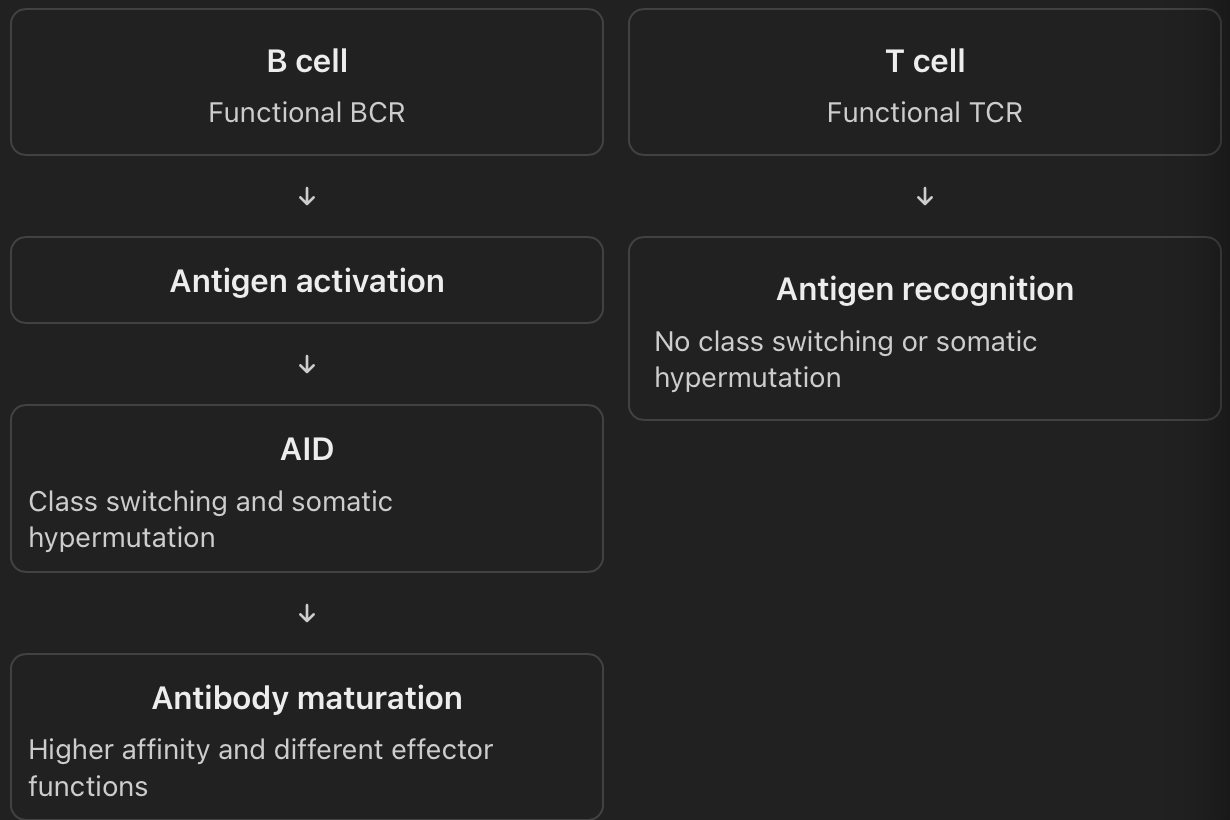
The first two mechanisms also generate T-cell receptor (TCR) diversity. The last two occur in B cells, not T cells.
Recap → Describe the components involved in the immunoglobulin loci

Recap → Germline DNA and B cell DNA
V, D, J, C regions are inherited from parents. They are rearranged and for B-cell DNA.

Explain how DNA is lost during V, D, J rearrangement
During V(D)J recombination:
Specific gene segments are selected.
Intervening DNA forms a loop.
The loop is cut out and removed.
The selected gene segments are joined together.

Explain the mechanism behind V, (D), J recombination
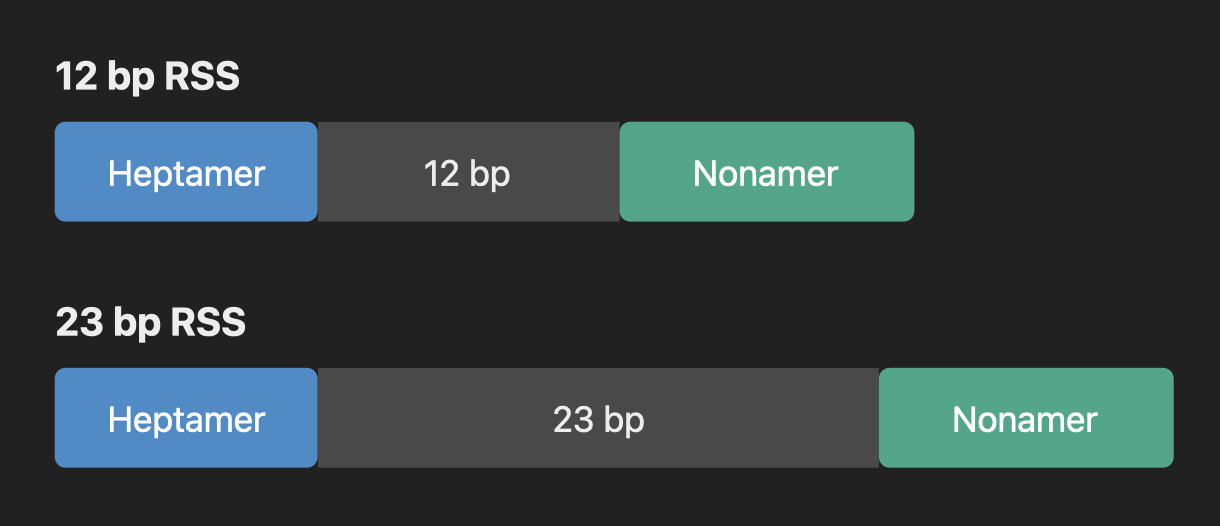
Recombination signal sequences (RSS)
RSS are specific DNA sequences located next to V, D and J gene segments.
They act as signposts, telling enzymes where to cut the DNA.
Each RSS contains:
Heptamer: 7 base pairs.
Spacer: 12 or 23 base pairs.
Nonamer: 9 base pairs.
What is the 12/13 rule in V (D) J recombination?
A gene segment with a 12 bp RSS generally only recombines with a gene segment with a 23 bp RSS.
Importance: Ensures appropriate gene segments are joined together and prevents incorrect combinations, such as direct V–J joining in the immunoglobulin heavy chain.

Key enzymes to remember: RAG1 and RAG2 initiate V(D)J recombination in developing B and T lymphocytes.
How does V (D) J recombination cause variation?
Rejoining of DNA is not always precise. This creates additional diversity known as junctional diversity.
There are three main ways this occurs:
Addition of P nucleotides.
Addition of N nucleotides.
Removal of existing nucleotides.
P nucleotide addition (palindromic)
When the DNA hairpin is opened asymmetrically, it produces a single-stranded overhang. Complementary nucleotides are added to fill the gap, creating a palindromic sequence.

N nucleotide addition (non-templated)
An enzyme called terminal deoxynucleotidyl transferase (TdT) randomly adds nucleotides between gene segments.
These nucleotides are not copied from an existing DNA template.

Non-productive rearrangements
Because nucleotide addition and removal are imprecise, recombination can disrupt the reading frame.
Productive rearrangement: Produces a functional antibody chain or TCR chain.
Non-productive rearrangement: Produces a non-functional chain.
If a lymphocyte cannot achieve a functional rearrangement, it may undergo apoptosis.
This explains why diversity comes at a price – many developing lymphocytes die.
Explain what further changes can occur during antibody maturation
After B-cell activation, two further changes can occur:

Both processes involve activation-induced cytidine deaminase (AID) and depend on transcription.
What is AID ?
Activation-induced cytidine deaminase (AID)
AID is an enzyme that converts cytosine (C) into uracil (U) in exposed single-stranded DNA.

Explain the process of isotope switching
Antibodies have five main classes (isotypes): IgM, IgD, IgG, IgA and IgE.
Each antibody class has a different heavy chain constant region, allowing it to perform different immune functions.
ADDDD
Explain what somatic hypermutation is
Somatic hypermutation introduces mutations into the antibody variable region following B-cell activation.
Occurs predominantly in germinal centres.
Initiated by AID.
Introduces mutations into the DNA encoding the antigen-binding region.
Mutations can increase, decrease or have no effect on antibody affinity.

Explain affinity maturation
Affinity: The strength of binding between an antibody binding site and its antigen.
Affinity maturation is the process by which B cells producing higher-affinity antibodies are preferentially selected.

B cells undergo somatic hypermutation.
B cells produce antibodies with different affinities.
B cells with higher affinity are better able to capture antigen and receive survival signals.
These B cells preferentially survive and proliferate.
Over time, the average affinity of antibodies increases.
How do these processes refer to T cells ?

Summary info

Overall summary diagram