UNIT 5 BIOLOGY B3 - KIDNEYS
 Call Kai
 Learn
 Practice Test
 Spaced Repetition
 Match
 Flashcards
 Knowt Play
1/23

There's no tags or description
Looks like no tags are added yet.
24 Terms
What is excretion and why is it important?
The removal of metabolic waste products from the body.
It is important because they are toxic, so must not build up
What is osmoregulation and why is it important?
Regulation of water and salt/ion content of blood
Important because it would cause water to enter or leave cells so they can shrink and burst, could affect blood pressure and ability to sweat.
What is the function of the kidneys?
Filtering waste products from blood and turns them into urine
What is the function of the renal arteries and renal veins?
Renal arteries = delivers oxygenated blood to continues
Renal vein = carries deoxygenated blood away from kidneys
What is the function of the ureter and bladder?
Ureter = carries urine from kidney to bladder
Bladder = stores urine prior to removal
Why does Urea have to be removed from the blood?
Its metabolic waste
Its toxic
It cannot be broken down by body, so would build up and affect enzyme action
What is the nephron?
The nephron filters blood
Fluid is pushed out of blood capillaries and flows through the nephron
Useful substances are reabsorbed back into the blood capillaries
Anything not reabsorbed becomes urine and leaves the body

Label the structures of the Nephron
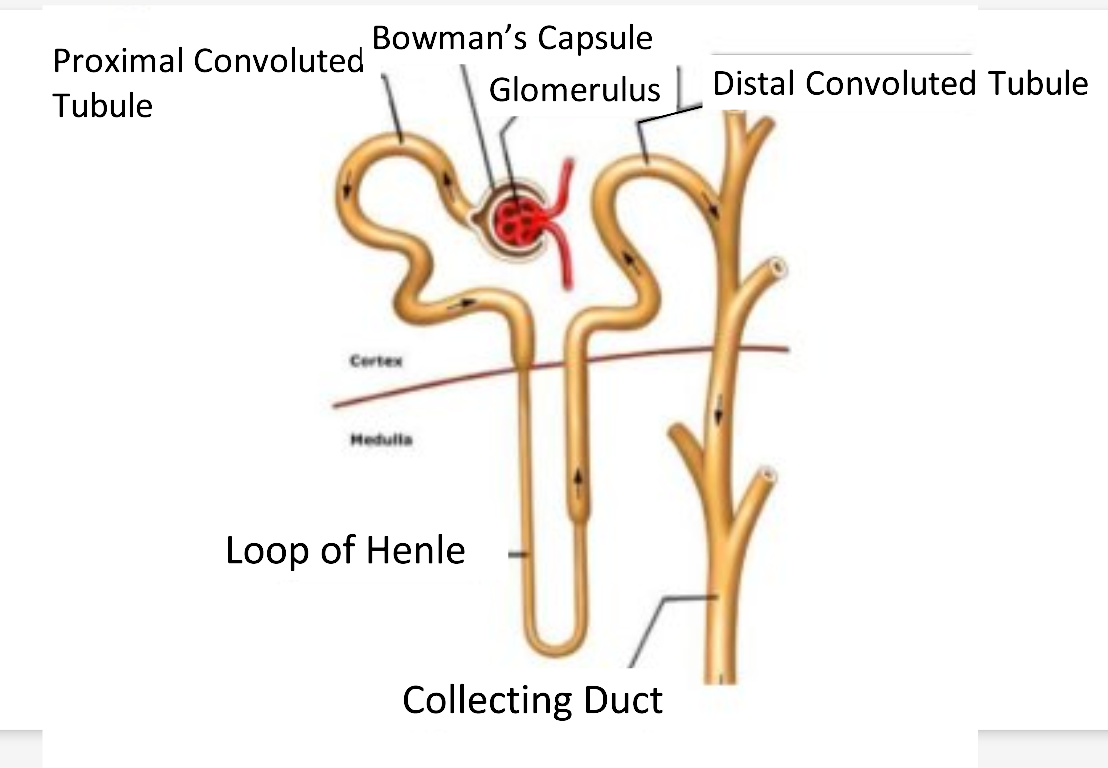
Processes that take place in the nephron
Ultrafiltration (takes place in the bowman’s capsule) - describe the process
Blood enters the glomerulus in the afferent arteriole
Water & small dissolved molecules and ions (amino acids, glucose urea, ions) are pushed out of capillary and into bowman’s capsule
This is due to high blood pressure
Walls of capillaries in the glomerulus are very porous so allow this
Blood cells and large molecules cannot leave capillary due to being too big to fit through pores
Blood leaves glomerulus in the efferent arteriole
Processes that take place in the nephron
Selective reabsorption (takes place in PCT) - What is it?
Substances that were filtered out of blood in ultrafiltration that are needed by the body are reabsorbed back into the blood
Processes that take place in the nephron
Selective reabsorption (takes place in PCT) - describe the process
Amino acids and glucose are reabsorbed into the blood, in the PCT
There should be no glucose or amino acids excreted out in the urine, so all G & AA should be reabsorbed by ACTIVE TRANSPORT AND FACILITATED DIFFUSION
Why does the body need to reabsorb glucose or amino acids?
glucose is needed for aerobic respiration
amino acids are needed for building proteins

How are the cells lining the PCT adapted for reabsorbing glucose and amino acids?
MICROVILLI:
Provide a large surface area for increased diffusion
MITOCHONDRIA:
Produces ATP from aerobic respiration for active transport, close to capillary, short diffusion pathway
What substances are reabsorbed back into the bloodstream and why?
Which substances are now left in the filtrate?
Glucose (for respiration), amino acids (produces proteins)
Water, urea and ions
Processes that take place in the nephron
Processes that take place in the nephron
Loop of Henle (osmoregulation) - Describe the process
Ions diffuse out of the ascending limb by FD and AT, into the fluid around loop of Henle and into the blood
This lowers the water conc in the fluid in the medulla
This means that water leaves the nearby descending limb of the loop of Henle by osmosis and is reabsorbed back into the blood
The collecting duct also runs nearby to this where water is further reabsorbed into body by osmosis
Processes that take place in the nephron
Loop of Henle (osmoregulation) - What does this mean in terms of urine produced?
It is more concentrated because there is less water
What is the advantage of having a very long loop of Henle?
More ions pumped out of ascending limb by AT
So lower water con in medulla
So more water leaves descending limb and collecting duct by osmosis
Processes that take place in the nephron
Selective reabsorption (DCT) - Describe what happens
Reabsorption happens in the DCT
Sodium ions can be reabsorbed into blood at DCT, which encourages more water to be reabsorbed by osmosis
This can be controlled by a hormone called aldosterone
Processes that take place in the nephron
Osmoregulation - Describes what happens
Water reabsorption in the collecting duct is controlled by ADH
Water & ion content of blood is detected by the osmoreceptors, triggering ADH to release from POSTERIOR PITUITARY GLAND if needed
It travels in the blood to kidney
How does ADH work?
Works by changing the number of aquaporins in the membranes of the collecting duct to make them more/less permeable to water
Controls this by changing the permeability of collecting duct walls by moving aquaporins in and out of cell surface membrane
What happens when it is a hot day?