Chapter 7: The Cell Cycle and Cell Division
 Call Kai
 Learn
Learn Practice Test
 Spaced Repetition
 Match
Match Flashcards
 Knowt Play
1/55

Name | Mastery | Learn | Test | Matching | Spaced | Call with Kai | Chat |
|---|
No analytics yet
Send a link to your students to track their progress
56 Terms

Cell division
The process by which one cell gives rise to two cells; can be:
Asymmetrical (mother cell is unchanged and has several differences, like in yeast, plants, or animals)
Symmetrical (cells are identical to each other, like in bacteria)
Multicellular organisms may exhibit both types, ranging from reproduction to replenishment
Asexual reproduction
Reproduction through the cloning of a parent organism, with occasional variation arising from mutations
Binary fission
The division of a parent cell to form two identical daughter cells; is a type of asexual reproduction in single-celled prokaryotes
Similar to mitosis in eukaryotes
Sexual reproduction
Reproduction through cells called gametes that fuse together and create a genetically distinguishable offspring
Requires that gametes have half the amount of DNA required
Only occurs in eukaryotes
Meiosis
Cell division that results in the production of gamete daughter cells, with only half the DNA of the original cell
Somatic cell
Any cell in the body of a multicellular organism not specialized for reproduction, derived by mitosis
Are typically diploid, containing two paired sets of chromosomes
Diploid cells
Cells that contain two paired sets of chromosomes (one from each parent), containing homologous pairs made of homologs
Has a chromosome number denoted by 2n, containing two sets of n chromosomes
Homologous pairs
A set of two chromosomes nearly identical in length and sequence, with one set coming from the mother, and the other set coming from the father
In human somatic cells with 46 chromosomes, 23 come from each parent
Homologs
The two chromosomes in a homologous pair, with corresponding (but not identical) genetic information
Haploid cells
Cells that only contain a single set of chromosomes, not containing homologs
These include gametes
Has a chromosome number denoted by n, containing one set of n chromosomes
Zygote
A diploid cell formed out of the fusion of two haploid gametes through fertilization
This then undergoes several mitotic cell divisions, resulting in a mature organism
Has a chromosome number denoted by 2n, containing two sets of n chromosomes
Fertilization
The process of fusing two haploid gametes into one diploid zygote

Sexual life cycle
In organisms, these are diverse, but essentially break down to one of the two homologs of each diploid chromosome pair to create a haploid gamete for fusion
Some have gametes that develop immediately after meiosis, and then fuse in fertilization
Others have haploid cells from meiosis dividing and developing into a haploid organism, that eventually produces gametes by mitosis for fertilization and a diploid life stage

Haplontic life cycle
A type of sexual life cycle where the diploid zygote immediately undergoes meiosis and essentially all of the life cycle is haploid

Diplontic life cycle
A type of sexual lifecycle where the haploid gametes immediately undergo fertilization and essentially all of the life cycle is diploid

Haplo-diplontic life cycle
A type of sexual life cycle where the organism spends significant time in both haploid and diploid stages
Cell division events
Requires:
Cell division signals (initiated from any source)
DNA replication (for each cell)
DNA segregation (to ensure correct copies)
Cytokinesis (division of cells with membrane)

Binary fission
Type of cell division found in prokaryotes, involving growth, replication, then separation and segregation
Often triggered by good external conditions
Prokaryotic chromosome sites
Sites associated with chromosome replication before segregation, these include
Ori (the origin of replication)
Ter (the terminus of replication)
Prokaryotic DNA segregation
This starts with replication, with the ori regions moving towards opposite ends of the cell as proteins are bound and ATP is hydrolyzed for support
Prokaryotic cytokinesis
This occurs with DNA segregation, as the cell pinches in with a ring of fibers called the Z-ring primarily made of tubulin
Z-ring
A ring of fibers that aids in prokaryotic cytokinesis through the pinching of the membrane

Cell cycle
The phases through which a single eukaryotic cell passes to produce daughter cells as needed, broken into:
G1 phase (growth and normal functioning awaiting signals)
S phase (active replication)
G2 phase (preparation for mitosis)
M phase (DNA segregation for mitosis and cytokinesis)
Mitosis
The cell division process in eukaryotes, giving rise to two daughter nuclei that each contain the same number of chromosomes as the parent nucleus
Generally consists of five stages
Chromatin
The heavily compacted combination of DNA and its associated proteins for binding, such as the positively-charged histones
This condensation varies by region and time, with more condensation during M phase

Centromere
A structure that holds two replicated chromosomes together

Chromosome arm
The portion of the DNA molecule in each side of the centromere
Unreplicated chromosomes have 2
Replicated chromosomes have 4

Sister chromatids
The set of two essentially identical replicated DNA molecules, joined together before being separated in mitosis for chromosome distributions
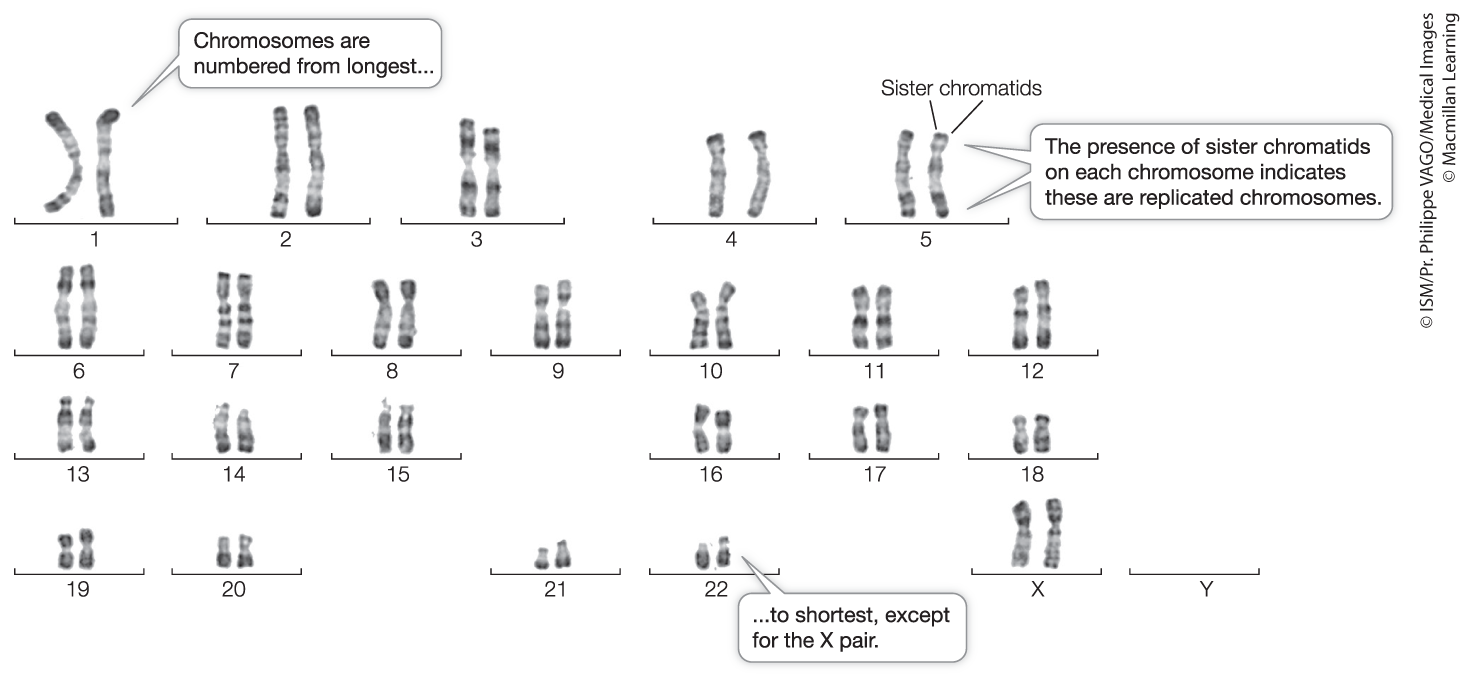
Karyotype
The number and sizes of the condensed chromosomes in a cell’s M phase
Eukaryotic DNA replication
This occurs at numerous origins of replication during a specific part of the cell cycle, not overlapping with segregation or cytokinesis
Eukaryotic DNA segregation
Due to multiple chromosomes, DNA must be highly condensed before this process after which it is moved by a spindle that aids in movement
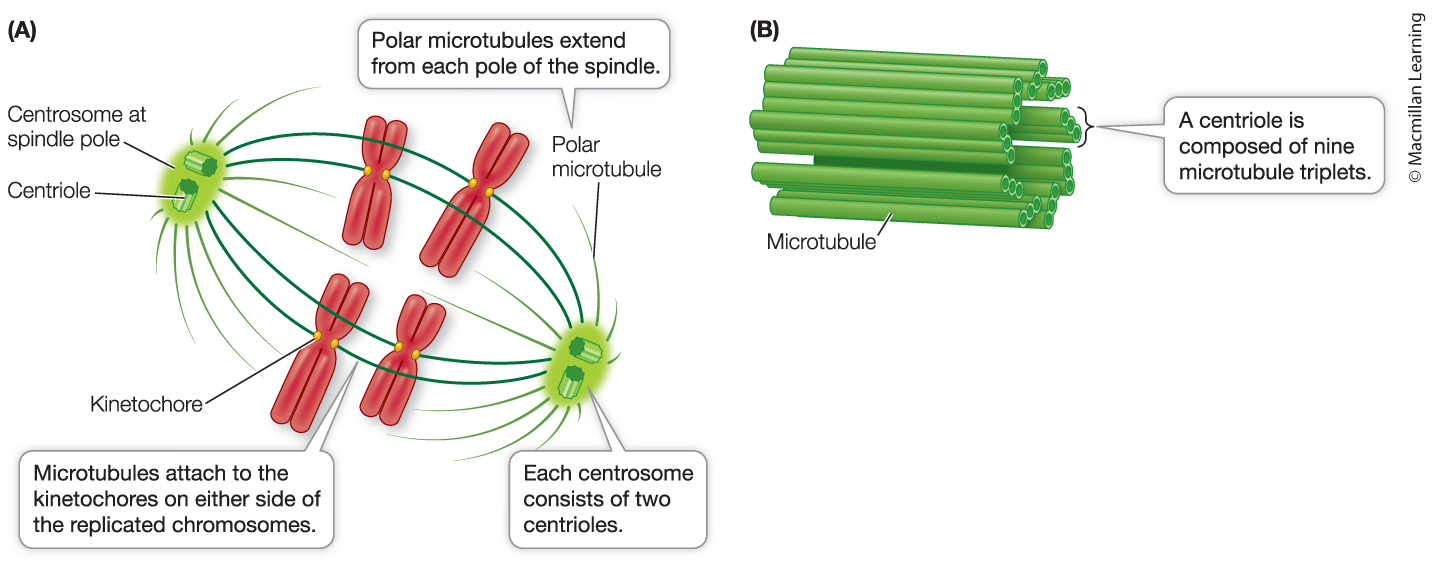
Prophase
The first stage of mitosis, where:
Chromosomes condense
Kinetochores appear on centromere sides, one per chromatid, for movement
Microtubule-comprised centrosomes and spindles form and self-orient
Centrosomes
Structures that orient themselves at the poles of the cell during prophase
Made up of a pair of centrioles, comprised of microtubules
One is duplicated during the S phase for use later on
Spindle
The microtubules that begin attachment to the kinetochores during prophase and prometaphase as they gain stability and the nuclear envelope breaks down
Metaphase
The third stage of mitosis, where chromosomes are aligned at the midline of the cell by kinetochores
Anaphase
The fourth stage of mitosis, where sister chromatids are separated into separate chromosomes as kinetochores are pulled apart
Telophase
The fifth stage of mitosis, where:
A nuclear envelope forms after separation
Chromosomes become less compact
The spindle disappears
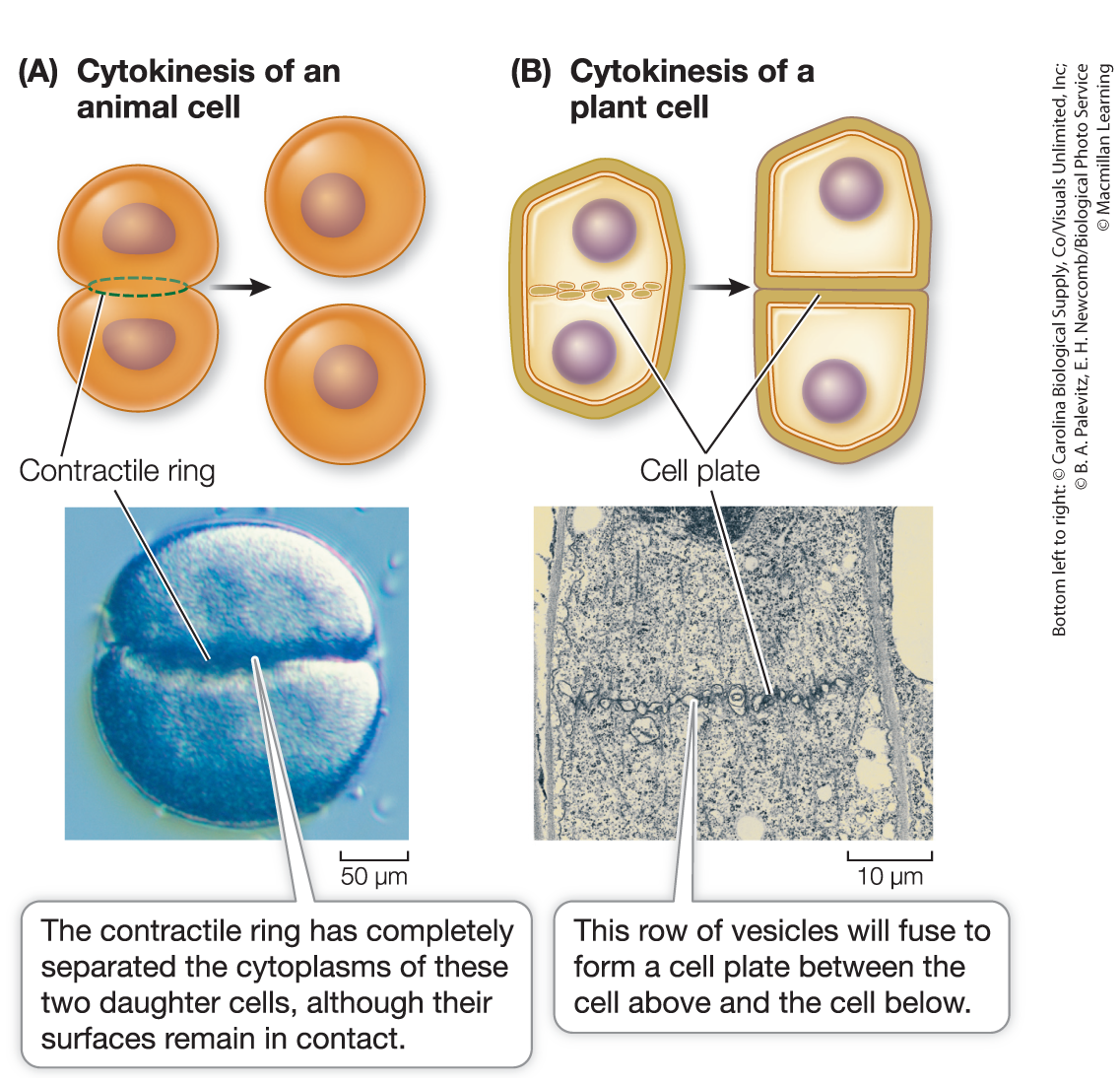
Cytokinesis
The division of the cell’s cytoplasm that occurs after mitosis, resulting in completely-formed daughter cells
In animals, a contractile ring forms under the cell membrane, forming a cleavage furrow
In plants, vesicles from the Golgi apparatus appear along the plane of cell division, forming a new cell membrane and cell wall from a plate

Meiosis
The type of cell division occurring through two nuclear divisions labeled I and II, together producing four genetically distinguishable haploid gamete cells
Can take from weeks to years in humans
Meiosis I
The first nuclear division of meiosis, where:
Entire replicated homologous chromosomes pair with each other along their entire lengths for exchanges (unlike mitosis, where no pairing takes place)
Homologous chromosome pairs separate and move to opposite poles (unlike mitosis, where only sister chromatids separate)
Chromosome numbers are halved, as Anaphase I divides genetic material into two nuclei without corresponding homologs
Meiosis II
The second nuclear division of meiosis, where:
Chromosomes are not replicated, but condense and attach to kinetochores
Sister chromatids align and separate
The nuclear envelope forms, and chromosomes uncondense
Cytokinesis occurs, forming four distinguishable cells
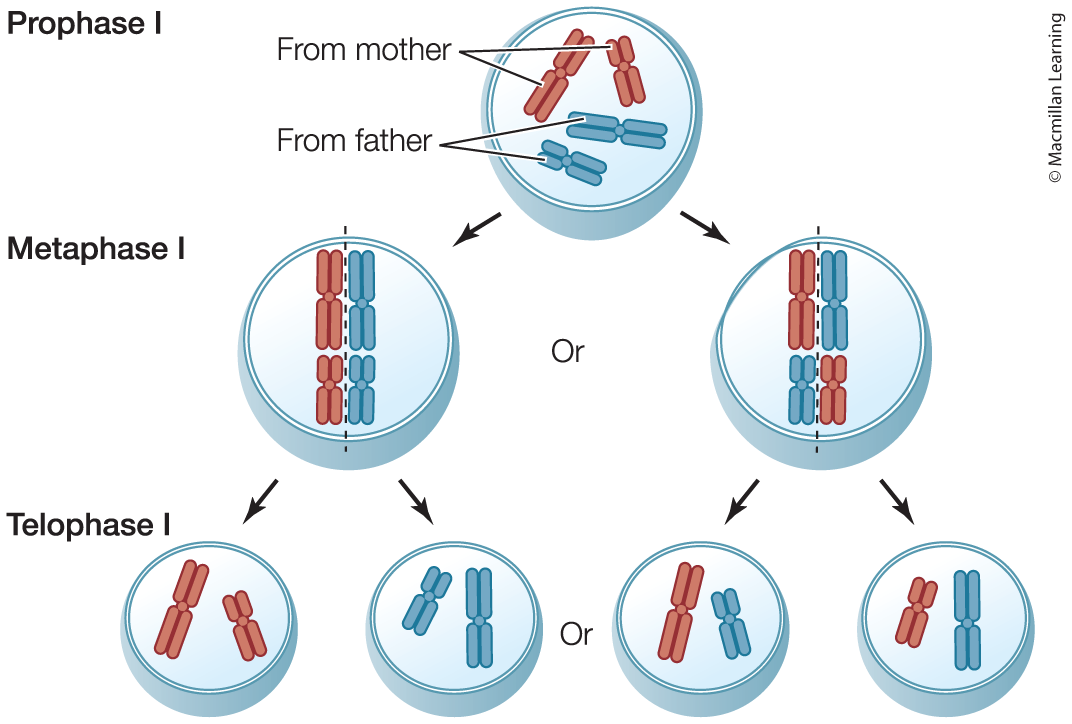
Independent assortment
The independent movement of each of the paternal and maternal chromosomes in a cell for diversity among chromosomes, resulting in:
A 50% chance that a chromosome will face a particular pole
A very high chance of new combinations of genes in gametes
The chance of a gamete having the same chromosomal makeup as one of the parental gametes being (1/2)(n-1), where n is the number in a haploid set

Crossing over
The exchange of genetic information between non-sister homologous chromatids from prophase I to anaphase I
Occurs at X-shaped attachment points called chiasmata

Chiasmata
The points on two non-sister homologous chromatids where crossing over occurs; these can appear in different numbers at any point on a chromosome
Recombinant chromatids
Chromatids that are genetically different from the chromosomes present in the parental gametes, formed as a result of crossing over

Nondisjunction
A cell division error where a chromosome fails to separate, resulting in an unequal number of that specific chromosome in the daughter cells (aneuploidy)

Aneuploidy
The condition of a cell, or organism, having an unequal number of copies of each chromosome; this is often harmful for cells
Numbered according to the number of chromosomes present:
0: nullisomic
1: monosomic
3: trisomic
4: tetrasomic
Polyploidy
The possession of more than two entire sets of chromosomes, often caused by errors during the M phase of mitosis or meiosis:
Spindle formation failure and thus no cytokinesis resulting in tetraploidy (4n)
Failure of cytokinesis to occur, also resulting in tetraploidy
Many plants and fungi exhibit this with growth and consumption benefits; however, it is rarely beneficial in animals due to large reductions in fertility
Polyspermy
A common mechanism that causes polyploidy by way of more than one male gamete fertilizing a single female gamete

Prokaryotic cell division
This is primarily triggered by the presence of favorable environmental conditions, at which DnaA protein binds DNA for replication and then forms a Z-ring
Continues as long as sufficient nutrients are available and DNA remains undamaged until completion
Eukaryotic cell division
This is triggered only after successfully completing the cell cycle with no errors and accumulating resources
Growth factors stagger division times according to the needs of the organism
Restriction point (R point)
The point between the G1 and S phase in a eukaryotic cell where internal signals take over to ensure cell cycle completion, after suitable conditions are signaled
Signals within the cell diffuse to ensure correct event handling

Cyclin-dependent kinases (CDKs)
The molecular activators that phosphorylate cell cycle regulator proteins in eukaryotes
Requires the presence of specific cyclins to expose their active sites, which are broken down at different stages of the cell cycle

Cell cycle checkpoints
Points during the cell cycle regulated by specific CDKs that require successful checks to proceed, located at:
The G1 to S transition (no DNA damage)
S phase (no DNA damage or incomplete replication)
G2 phase (no DNA damage)
Metaphase (chromosome attachment to spindles)
Necrosis
Type of cell death that occurs when a cell is damaged or starved of nutrients
Results in bursting or materials that can inflame other tissues

Apoptosis
A genetically programmed series of events that result in cell death, triggered by:
Damaged cell function
Lack of purpose for the host organism
Inability to divide further due to chromosome shortening
Infection control
Resulting material is often broken into membranous lobes or digested for use elsewhere