Science skills
 Call Kai
 Learn
 Practice Test
 Spaced Repetition
 Match
 Flashcards
 Knowt Play
1/67

There's no tags or description
Looks like no tags are added yet.
68 Terms
What is an aim?
A statement outlining the purpose of the investigation
What is a hypothesis?
A testable prediction about the outcome of the experiment.
What is a controlled experiment?
- An investigation in which the relationship between 2 variables is tested in a controlled environment.
Measures the effect of the IV on the DV while controlling all other variables.
Controlled variables
Variables other then the IV that a researcher holds constant (controls) to ensure that changes in the DV are solely due to the IV
Extraneous variables
Any outside or uncontrolled factor in a research study that is not the main focus of the experiment (IV), but could still affect the dependent variable.
To control the effects of these variables, experimenters conduct investigations in a controlled environment, with strict methodologies, to reduce the risk of these variables impacting their results.
Eg: Experimenter effects, situational variables
Confounding variable
Any variable other than the independent variable that HAS had a systematic and unwanted impact on the dependent variable
Eg:
3 types of controlled experiment designs:
Between subjects design
Within subjects design
Mixed designs
Between subjects design
Participants are allocated to only one condition each (one condition per person)
Within subjects design
Participants complete both/all conditions
Mixed subjects design
Participants are in both conditions for part of the experiment, and seperate conditions for a related but different part of the experiment.
Advantages and disadvantages of within subjects design
Advantages:
Less participants needed
Minimises outliers (if there is an outlier they complete both conditions)
Disadvantages
Can produce order effects, as participants may get practise at the experiment/task
Can cause fatigue in participants
Advantages and disadvantages of between subjects design
Advantages:
May be less time consuming
Does not create order effects (participants have no practise of the experiment)/prior knowledge)
Disadvantages
Requires more participants
Outliers will effect the results more dramatically (if an outlier is participating, they only complete one comdition)
Advantages and disadvantages of mixed design
Advantages:
Allows experimenters to compare results both across conditions and across participants.
Allows multiple conditions to be compared to a controlled group.
Disadvantages
Can be costly, and more time consuming
Demanding for researchers to be across multiple methods.
What is a case study?
An investigation of an individual or groups behaviours, that was observed in real world conditions, without manipulating any variables.
Highly detailed information
Often rare events (most case studies involve a real situation that is either rare/unethical to do experiments on.)
Eg: Studying people with brain injuries due to playing soccer (we did not manipulate any variables, we observe people as they are.)
What is a correlational study?
A study where the RELATIONSHIP between two or more variables are studied, without attempting to control or manipulate variables. Eg: If A increases, B generally increases.
Eg: Investigation into whether studying improves test scores, results show that there is a positive correlation between lots of hours studied and test scores.
Positive correlation
+1 means there is a very strong relationship between two variables (both increase/decrease)
Negative correlation
1 means there is an opposite relationship (as one increases, the other decreases)
0 correlation
0 means there is no relations
Types of correlations

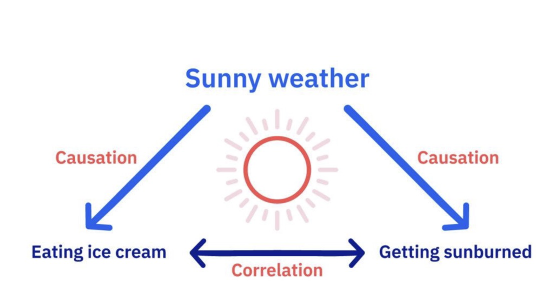
Correlation vs causation study
Correlation: Strength of a relationship between 2 variables
Causation: A change in one variable causes a change in the other.
Both Correlation and Causation CAN occur together BUT Correlation does not always equal Causation.
Population
Population (or research population) is the group of people who are the focus of the research and from which the sample is drawn.
Eg: Year 10 students in Metropolitan Melbourne may be the focus of a study about how quantity of sleep effects grades at school.
15 schools across Metropolitan Melbourne may be selected to make up the sample.

Sample
Sample (research participants) – are a subset of the research population who participate in the study.
A sample is used because it is often not possible to test everyone in the population of interest.
For example testing every year 10 student in Metropolitan Melbourne would be difficult and very time consuming SO INSTEAD, a select group of the population are used.
Generalised results
As it is impossible to test the entire of a population, the researcher can then make conclusions about the wider research population.
Generalised results: – the ability for a sample’s results to be used to make conclusions about the wider research population
Representative vs unrepresentative sample
A highly representative sample would reflect the research population accurately (correct demographics, characteristics)
Eg: In a study on Australian fathering styles, the sample should contain similar proportions of fathers to the population, such as ages, jobs, etc.
An unrepresentative sample may only select 40 year old fathers, with a Greek background who have 2 children.
If the sample is unrepresentative the results would NOT be able to be generalised
3 sampling techniques
Stratified, random, convenience
Stratified sampling
Involves selecting people from the population in a way that ensures that it’s subgroups are proportionally represented. (ages, genders, backgrounds are equally represented)
Random sampling
Uses a procedure to ensure every member of the population has the same chance as being selected
Convenience sampling
Selecting readily available members of the population, rather than using a random or systematic approach
Advantages and limitations of convenience sampling
Advantages:
Time and cost effective
Disadvantages:
Likely to produce an unrepresentative sample, making it harder to generalise results to the population
Advantages and limitations of random sampling
Advantages
•More representative than convenience sampling
•Reduces experimenter bias
•If the sample is large it is likely it will be fairly representative
Disadvantages
Time consuming
If the sample size is small is may not be highly representative
Advantages and disadvantages of stratified sampling
Advantages:
The most likely to produce a highly representative sample
Disadvantages:
Time consuming, expensive
Demanding on the researcher to select the most appropriate participants.
What is allocation
The process of assigning participants to the experimental conditions of groups
●A common type of allocation is random allocation, which ensures every participant in the sample has an equal chance of being allocated to any group within the experiment (control or experimental)
Participant related variables
Characteristics of the participants that may affect the results
Eg: Age, intelligence, education
Order effects
The tendency for the order in which participants complete each condition of the experiment to have an effect on their behaviour and therefore the results
Occurs primarily in within subjects designs
Eg: Practise effects, fatigue effects
Placebo effect
When participants respond to an inactive substance or treatment due to their expectations
Placebo: an inactive substance or treatment
Rather than the IV having an impact on the participant’s behaviour it is their expectations about how they should feel or act that impacts their behaviour
Experimenter effects
Experimenter Effects - when the results (DV) are impacted by the expectations of the researchers.
Eg: -If an experimenter has a strong belief in what the results will be they may accidentally bias the way they interact with the participants or how they collect, record or interpret data.
Situational variables
Situational Variables - environmental factors that may impact the results
-Eg. temperature, lighting, noise levels, weather, time of day
Non-Standardised Instructions and Procedures
Occurs when the procedures or instructions differ across participants or conditions.
Eg: 2 groups are sitting a test, one group is provided with more information on how to complete the questions.
Demand characteristics
Demand characteristics are cues in the experiment that may indicate the intention of the study to the participant having an impact on their behaviour.
-Participants are more likely to conform to the study’s hypothesis and meet the study demands if they know what the intention of the study is.
Ways to reduce extraneous variables
Larger sample size (more representative of the population)
Use within subjects design.
Counterbalancing (reducing order effects)
Switch to giving the control group the placebo
Single or double blind procedures
Ensure that each participant receives the same instructions and follows the same procedures.
Control variables (Other than IV)
What is primary data? (strengths and weaknesses)
Data collected directly by the experimenter, for their own purpose.
Strength: Offers tailored information sought by the researcher to test a hypothesis on a topic of their choosing
Limitation: It can be time-consuming to collect and process primary data
What is secondary data? (strengths and weaknesses)
Data that has been collected by someone other than the original person for their own purpose.
Strength: It tends to be readily available
oIt can usually be accessed in less time
Limitation:
Can be uncertainty about its quality because it was collected for another purpose.
Time consuming to comb through.
What is qualitative data (strengths and weaknesses)
Quantitative data: data that is numerical and collected via systematic and controlled procedures.
E.g. Running speed, height of a child or number of siblings someone has
Strength: Quick and easy to statistically analyse (and can be easily compared with other data)
Limitation: Participants are not able to elaborate on their behaviour/responses so there is less detail
What is quantitative data?
Qualitative data: data that describes changes in the quality of behaviour and is often expressed in words. Open to personal, observer or researcher biases and are difficult to statistically analyse
E.g. observations, interviews – each individual differs in reports.
Strengths: More detail provided – gives insight into person’s opinions, beliefs and experiences
Limitations:
oDifficult to statistically analyse
oOpen to biased because it requires personal information be given.
oDifficult to compare with other data
Objective data (strengths and weaknesses)
•Objective data: Data that is collected through direct observation or measurement and should obtain the same results regardless of who is conducting the measurement.
•It does not rely on the interpretation of the experimenter.
•E.g When you measure a person’s high in CMs, complete a true or false quiz
•Strength: It does not rely on experimenter interpretation, and so there is more chance that the data is valid.
•Limitation: Does not allow the researchers to understand the perspectives of the participants, which might provide more insight into the research area they are trying to understand.
Subjective data (strengths and weaknesses)
Subjective data: Data that concerns the individual or personal experience of participants
EG: When you collect data through a participant’s self-report on a questionnaire about their experience of an event.
Strength: Allows for experimenters to better understand the perspective of participants.
It provides researchers with an insight into unobservable phenomena (eg, beliefs, feelings, consciousness)
Limitation: Response bias: Participants may respond with what they think experimenters want to hear, rather than what they truly believe.
More difficult to systematically analyse and compare compared to objective data.
What is standard deviation?
Measures the spread of scores (variability) around the mean. The higher the standard deviation, the greater the range of values within the sample.
What is a true value?
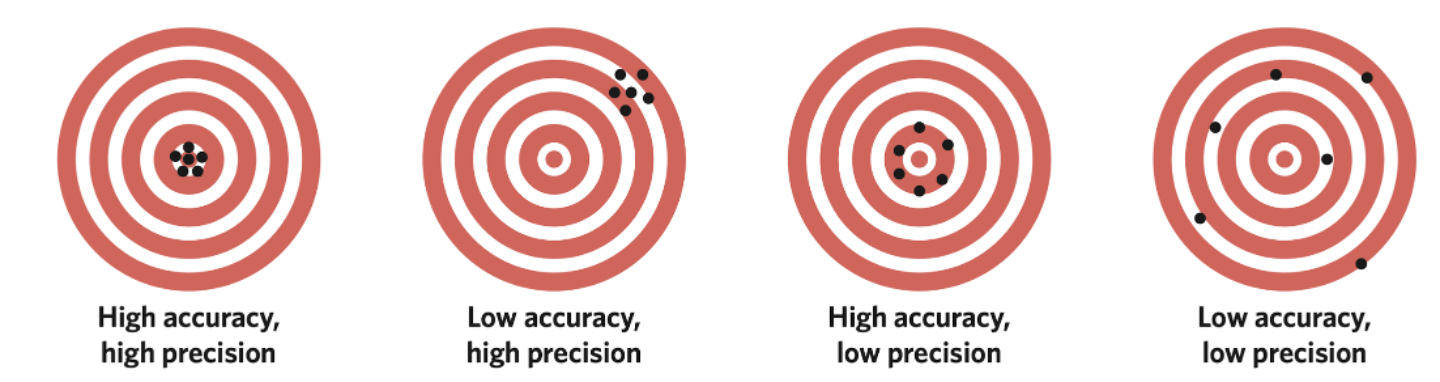
The value of something if it could be measured perfectly.
What is accuracy?
How close a measurement is to the ‘True Value’ of what is being measured.

What is precision?
How closely a set of measurement values agree with each other.
What is repeatability
The extent to which successive measurements or studies produce the same results when carried out under identical conditions within a short period of time.
(Same procedure, setting, researcher)
What is reproducibility
The extent to which successive measurements or studies produce the same results when carried out under different conditions.
(Different participants, time, researcher)
What is validity?
The extent to which the results (DV) are directly linked to the IV.
A valid measure is one that measures what it intends to measure.
Internal validity
The extent to which an investigation truly measures what it claims to.
Externally valid
The extent to which results can be applied to similar individuals in
different settings. Can the results be ‘generalized’?
Ethical concepts
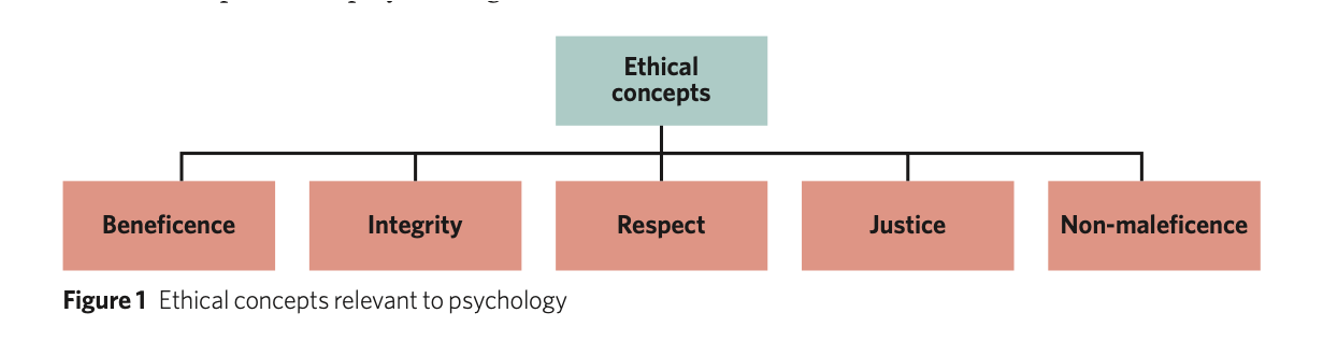
What is beneficience?
Commitment to maximising benefits and minimising risks and harms involved in an experiment.
What is integrity?
The act of ensuring all honest reporting of results, whether unfavourable or favourable.
What is justice?
Obligation to ensure that there is fair consideration of all demographics, and that every participant is treated fairly regardless of who they are.
What is non- maleficence?
The principle of avoiding causing harm to participants in an experiment.
What is respect?
The understanding that each and every participant has value, and has traditions, beliefs, and perceptions, to others.
Ethical guidelines

What is confidentiality?
Refers to the privacy, protection, and security of a participants results, personal information, and details.
What is informed consent?
A process that ensures that participants understand the true nature of the experiment, including potential ricks, before participating in the experiement.
What is deception?
The act of intentionally misleading participants about the true nature of the experiement.
What is debriefing?
A procedure that ensures, at the end of the experiment, the participant leaves with an understanding of the experimental aim, results, and the true nature of the experiment.
What is voluntary participation?
A principle that ensures that there is no pressure put on participants to participate in the experiment, and that they freely choose to be involved.
What is withdrawal rights?
the right of participants to be able to discontinue their involvement in an experiment at any time, during, or after an experiment, without any penalty.