muscle adaptation, damage and repair lecture (NMSK3)
 Call Kai
 Learn
 Practice Test
 Spaced Repetition
 Match
 Flashcards
 Knowt Play
1/36

There's no tags or description
Looks like no tags are added yet.
37 Terms
Describe the mechanisms of hypertrophy and atrophy in skeletal muscle
Describe the mechanisms of repair and regeneration in muscle fibres
Describe the major causes and consequences of disease in skeletal muscle
Outline the causes and effects of:
congenital and inherited myopathies
endocrine and nutritional factors in myopathies
exertional myopathies
Describe what is meant by sarcopenia
LO1: what happens when a limb grows/ becomes immobilised?
they dont undergo hyperplasia - number of cells stay the same
disease atrophy
contraction can be permanent
cells (fibres) can become longer or wider but not more numerous
LO1: how can you reduce likelihood of muscle tearing?
warm up muscles before exercise - allows them to stretch rather than snap
LO1: hypertrophy/ hyperplasia meaning
hypertrophy = calls increase in size
hyperplasia = increase number of cells
LO1: Aplasia meaning
incorrect cell number
LO1: hypertrophy details
muscle fibre increases in size
myofibrils size increase
myofilament size increase
muscle circumference = muscle mass indicator
LO1: Atrophy meaning
reduction in muscle volume/ mass - may be generalised/ limited to certain muscles
LO1: what happens if you overtrain one muscle area/ skill?
increase mass of that muscle only
increase one type of fibre - not a good range of skill
LO1: what muscle type is specific to humans?
2
LO1: factors that cause hypertrophy and atrophy
anabolic factors (growth hormones)
building up the muscle (some damage = good - leads to inflammation → increase fibrils, late onset muscle soreness = good)
catabolic factors
breaking down muscle
disuse
denervation (nerves active during rest, activity = increase frequency. loss of background noise may cause muscle to shut down - can be fixed with physio)
disease
malnutrition
LO1: how does mechanical stimulus produce increase in fibre size?
stimulated by growth hormone
IGF-1 (insulin-like growth factor 1)
LO2: Trauma’s impact on muscle tissue
cause inflammation
all soft tissues can scar
LO2: what are satellite cells
most common skeletal muscle stem cells
LO2: When are satellite cells activated?
following damage
proliferate + differentiate to form muscle cells and daughter cells
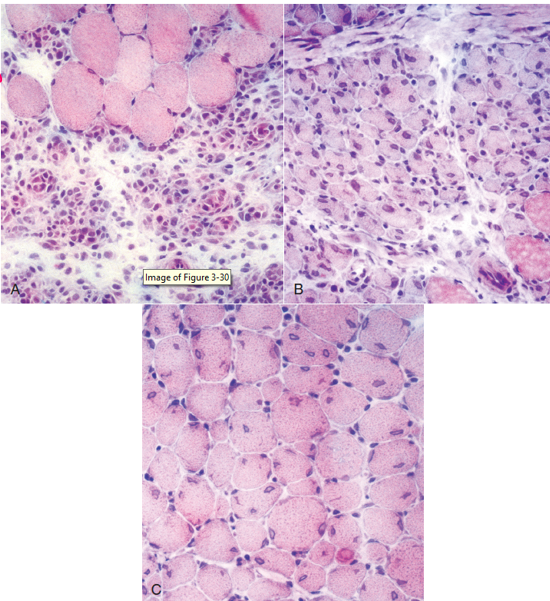
LO2: stages of repair of canine muscles
1: 3 days after injury
lost muscle cells
clusters of activated satellite cells
2: 5 days after injury
myotubes formed - can go on to differentiate into muscle cells
3: 7 days after injury
regenerating fibres back to normal size
LO2: impact of nerve damage?
motor nerve damage
lack of innervation of muscle
muscle undergoes atrophy
LO2: example of nerve damage
stringhalt - excessive flexion in 1/ both hindlimbs
severe cases - muscles can tetanise
can lead to muscle atrophy

LO2: recurrent laryngeal nerve
L – Recurrent laryngeal Nerve courses round aortic arch
R – Recurrent laryngeal Nerve runs around subclavian artery

LO2: detection of muscle damage?
Myoglobinuria:
O2 binding protein in muscle
excessive amounts of myoglobin in urea
too much can cause kidney damage - myoglobin leaks into kidney
creatine kinase:
enzyme used by muscles
increased levels can indicate muscle damage/ wasting
creatine = like energy battery
LO3/4: polymyositis
inflammatory disease
generalised inflammatory myopathy
muscle damage thought to result of cell-mediated immunity
LO3/4: Masticatory muscle myositis (MMM)
inflammatory disease
focal inflammatory myopathy - selectively affects muscles of mastication (2M fibres)
clinical signs:
Trismus (lock jaw)
fox like contour of the head
prominence of zygomatic arch
LO3/4: congenital + inherited myopathies
not inflammatory
duchenne muscular dystrophy
mutation in gene coding for membrane protein dystrophin (x linked recessive disorder)
leads to degeneration/ regeneration resulting eventually in failure of respiratory muscles

LO3/4: endocrine myopathies examples
hypothyroidism
cushings disease (hyperadrenocorticism)
LO3/4: hypothyroidism
Clinical signs of weakness, stiffness, reluctance to move decreased exercise tolerance and muscle wastage
Muscle biopsies show atrophy of type II fibres
Problems with carbohydrate metabolism which interferes with glycolytic metabolism
LO3/4: cushings disease
Clinical signs of muscular weakness, stiff gait, muscle atrophy and inability to walk in dogs
Selective atrophy of type II fibres
Break down of muscle proteins & inhibition of muscle protein synthesis
LO3/4: nutritional myopathies
usually large animals
E.g. Selenium/vitamin E deficiency
Clinical signs:
Still birth
Weak calf – stiffness and inability to stand
Disease of calves, lambs, swine and foals
Doesn’t often affect carnivores
LO3/4: exertional Myopathies
“Myofiber damage occurring as a result of exercise stress as the primary cause”
Exertional rhabdomyolysis in the horse (sporadic or recurrent)
Clinical signs include:
muscle injury, myoglobinuria, weakness, recumbency in heavy horse breeds
Episodic muscle pain, sometimes swelling and reluctance to move in light horse breeds
Can occur with minimal exercise in susceptible individuals
Unknown etiology – possibly due to a metabolic myopathy
LO3/4: metabolic myopathy
Equine Polysaccharide storage myopathy
Abnormal accumulation of glycogen in the muscles
Glycogen synthase 1 mutation
Clinical symptoms, recurrently exertional rhabdomyolysis (tying up or painful muscle cramps)
LO5: What is a motor unit?
A single α-motor neuron and all of the corresponding muscle fibres it innervates.
inter-dependent

LO5: motor unit sizes
vary
eye muscles→ 3: 1 | muscle: nerve
hamstring→ 300: 1 | muscle: nerve
LO5: why are there different motor neurone sizes?
depends on how specific the movements need to be.
eye = very specific movements
LO5: sarcopenia
Atrophy associated with aging is known as Sarcopenia:
Loss of motor axons
Denervation
Degeneration/regeneration
Loss of motor fibres/axons
Motor-unit size
Fibrosis
IGF-1?
summary: most important aspects
Mechanisms of hypertrophy and atrophy
Investigated what happens when there is repair and regeneration following injury
Looked at some major causes and consequences of disease in skeletal muscle
Looked at what is meant by sarcopenia