CH 4 The Forebrain
 Call Kai
 Learn
 Practice Test
 Spaced Repetition
 Match
 Flashcards
 Knowt Play
1/20

There's no tags or description
Looks like no tags are added yet.
21 Terms
What can damage to the forebrain cause?
Hormonal imbalances, temperature regulation issues, altered emotions and behaviors, sensory perception issues, voluntary motor movement impairments, and impairments in memory, judgement, and speech.
What is the most common vascular lesion in the nervous system?
Capsular strokes, which occur deep in the forebrain.
What are the two main components of the forebrain?
The Telencephalon and the Diencephalon.
What functions are integrated by the cerebral hemispheres?
Self-awareness, sensations, emotions, learning/memory, intelligence, creativity, and language.
Which cranial nerve provides sensory input to the telencephalon?
The Olfactory nerve (CN I).
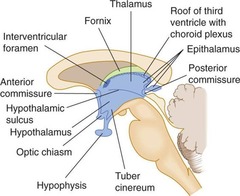
What does the diencephalon consist of?
The Thalamus, Hypothalamus, Subthalamus, and Epithalamus.
What is the role of the thalamus?
It integrates all information passing from the brainstem and spinal cord to the cerebral hemisphere.
Which cranial nerve provides sensory input to the diencephalon?
The Optic nerve (CN II).

What are the three regions of the hypothalamus?
Mamillary region, Chiasmatic region, and Tuberal region.
What is located in the tuberal region of the hypothalamus?
The infundibulum, which is the stalk of the pituitary gland.
Where is the subthalamus located?
Ventral to the thalamus and lateral to the hypothalamus.
What does the epithalamus contain?
The pineal gland and the Habenular nucleus.
What are the main parts of the cerebral hemisphere?
Cortical (grey matter), Medullary (white matter), and Telencephalic Nuclei.
What separates the frontal and parietal lobes?
The Central Sulcus.
What is the function of the corpus callosum?
It connects both hemispheres of the brain.

What is the homunculus?
A visual representation of the brain's map, identifying which region of the cerebral cortex is responsible for specific sensory and motor functions.

What is the significance of the internal capsule?
It is a huge white matter area of nerve fibers located in the forebrain.

What does the mamillary region of the diencephalon relate to?
The mamillary bodies.
What structures border the third ventricle?
The two egg-shaped masses of the thalamus.

What are the subdivisions of the thalamus?
Anterior, Medial, and Lateral subdivisions.

What separates the frontal/parietal lobes from the temporal lobe?
The Sylvian (lateral) Fissure.
