CHEM Ex 2
 Call Kai
 Learn
Learn Practice Test
 Spaced Repetition
 Match
Match Flashcards
 Knowt Play
1/53

Earn XP
Description and Tags
CHEM 1030, Priya Matthew
Name | Mastery | Learn | Test | Matching | Spaced | Call with Kai | Chat |
|---|
No analytics yet
Send a link to your students to track their progress
54 Terms
ionic compounds
metal-nonmetal bond
electrostatic attraction between cation & anion
lattice energy
energy released when ionic solids form
empirical formulas
lowest whole # ratio of atoms
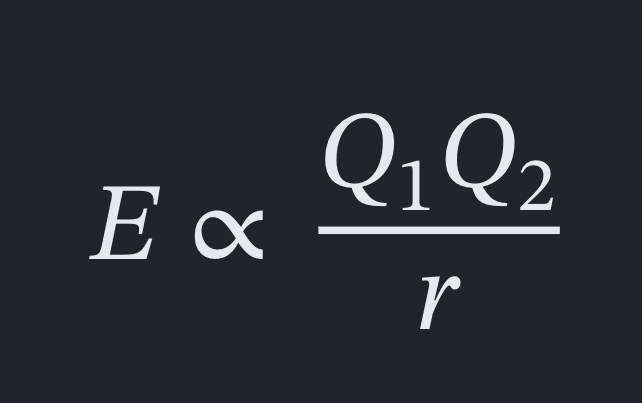
Coulomb’s law
shows lattice energy depends on ion charge and size
(formula)
Ag+, Zn2+, Cd2+
known transition metal charges
Hg2 2+, O2 2-
unsimplified cations
anhydrous
no water present
hydrated
when water is present
covalent compound
nonmetal-nonmetal bond
sharing of e- pair
molecular fornmula
gives ACTUAL numbers of atoms in a molecule
empirical formula
gives RELATIVE numbers of atoms in a molecule
(lowest whole number ratio)
covalent bonds & hydrates
when prefixes are used
molecular mass (MW)
sum of masses of all elements in a compound
electronegativity
increases from left → right
increases up^ from a group
polar bonds
unequal sharing of e- in a bond
due to electronegativity differences
isomerism
same molecular formula with different arrangement of atoms
4 bonds, 0 lone pairs
Carbon’s bonding (C)
3 bonds, 1 lone pair
Nitrogen’s bonding (N)
2 bonds, 2 lone pairs
Oxygen’s bonding (O2)
1 bond, 3 lone pairs
Halogens bonding (if no octet expansion)
valence e- — (sticks + dots) or (bonds + lone pairs)
Formula Charge equation
resonance forms (hybrid)
structures w/ the same arrangement of atoms, but dif. arrangement of bonds & lone pairs
B, Al, Be
electron-deficient atoms (2 w/ 3 bonds, 1 w/ 2 bonds)
free radicals (img, ch. 5)
odd-electron molecule with an unpaired e- in its structure
bond energy
avg. energy required to break a covalent bond
bond energy increases as
bond length decreases
multiple bonds form
trend in bond energy
VSEPR Theory
shape minimizes e- pair repulsion
i.e. e- groups are as far apart as possible
steric number (SN)
number of lone pairs + atoms bonded to central atom
a double bound = ONE e- group
Find e- geometry (e.g.)
Find MG by considering only atoms (not lone pairs)
how to find Molecular Geometry (MG)
linear → trigonal planar → tetrahedral → trigonal bipyramidal → octahedral
e.g. order from SN: 2 → 6
(img) how to draw tetra, trig bi, octa, + angles
make these flashcards (flip)
compression (img)
lone pairs distort bond angles due to ___
trigonal planar → bent (img)
trigonal planar M.G. (decreasing)
tetrahedral → trigonal pyramidal → bent (img)
tetrahedral M.G. (decreasing)
trigonal bipyramidal → seesaw → T-shaped → linear (img)
trigonal bipyramidal M.G. (decreasing)
octahedral → square pyramidal → square planar → T-shaped → linear (img)
octahedral M.G. (decreasing)
Any polar bonds?
Electron Geometry (e.g.)?
Do dipoles cancel due to shape?
steps to predict polarity