Thermodynamics
 Call Kai
 Learn
 Practice Test
 Spaced Repetition
 Match
 Flashcards
 Knowt Play
1/32

There's no tags or description
Looks like no tags are added yet.
33 Terms
Thermal expansion
ΔL=αL0ΔT ; L=length, alpha=Coefficient of linear expansion, T=Temperature
ΔA=γA0ΔT;2α=γ ; gamma=Coefficient of areal expansion
ΔV=βV0ΔT;3α=β ; beta=Coefficient of volumetric expansion
How do holes expand?
Holes in materials expand in the same way as they were filled with the surrounding material.
Internal energy
Total KE of all particles in a system
“u” measured in Joules
Heat
transfer of energy by random process (motion) (collisions, radiation)
“Q” measured in J
Work
Transfer of energy by bulk (i.e many particles moving the same way) motions.
Temperature
The average KE of a single particle
“T” measured in K
Process variables
Quantities that describe a process (way) taking a thermodynamic system from some initial state to some final state.
For example, Q, W
State variables
Quantities that describe the state of the thermodynamic system.
For example, T, P, V, n, N, S, u
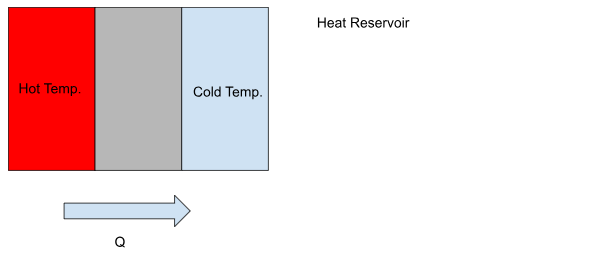
Conduction
Transfer of KE of particles through random collisions (need material)
TH,TC,ΔtQ ; these are constant if a thermodynamic system is in steady state
P=ΔtQ=dkA∣ΔT∣ ; Q=Heat, t=Time, k=Coefficient of thermal conduction, A=contact area, T=Temperature, d=Distance
Radiation
heat conduction through electromagnetic radiation (photons)
P=eAσT4 ; e=Emissivity coefficient, A=area, sigma=Stefan-Boltzmann’s constant, T=Temperature
0≤e≤1
If e=0, no power leaves; if e=1, all power leaves.
Heating curves
Q=mcΔT ; equation for single phase; m=Mass, c=Specific heat, T=Temperature
Q=Lm ; equation needed for 2 phases; L=Latent heat, m=Mass

Different ways to equate internal energy
u=23PV=23nRT=23NKBT=NKavg=21Nmvrms2
Thermal Equilibrium (between two thermodynamic systems) (Part of 0th Law)
No heat flows between them when they are in contact.
Thermodynamic Laws
0th Law: If two systems are in thermal equilibrium, then their temperatures are the same.
TA=TB
1st Law:Q+W=ΔU ; Q=Heat added, W=Work on gas
Wbygas=−Wongas ; Work on gas is the default in our class
2nd Law (v1): In the absence of external W, heat flows from hot to cold
2nd Law (v2): The most efficient engine is the Carnot engine, working between hot temperature and cold temperature reservoir
e=THTH=TC
0≤e≤ec<100%
2nd Law (v3): A fridge needs to be plugged in. Q can flow from cold to hot, but only in the case of inputted work
2nd Law (v4): Systems undergo processes that take them from highly unlikely states to very likely states (probability wise).
2nd Law (v5-official): Entropy in a closed system can either increase or stay the same; it can never decrease.
Translating between Microscopic quantities and Macroscopic quantities
Microscopic quantities: m,v,J,Δp,Δt,F,Kavg
Macroscopic quantities: P,V,T,N,n ; N=Number of particles, n=Amount
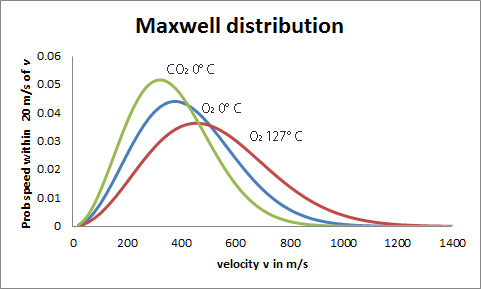
Maxwell’s Distribution
Nv of particles moving at v
Area=N=const.
As Temperature decreases, the peak velocity decreases, the height increases, the width decreases.
Width and entropy have a proportional relationship.
Think of this as a histogram
Equation of State
PV=nRT
Isovolumetric/Isochoric process
V=const; n=const
P2P1=T2T1
W=0J
Δu=23VΔP=Q

Lab design for Isovolumetric/Isochoric process
For Isochoric process with increasing pressure: Heat up gas in closed container

Isobaric process
P=const; n=const
V2V1=T2T1
W=−PΔV
Δu=23PΔV
Q=25PΔV

Lab design for Isobaric process
For Isobaric process with increasing volume: Heat up cylinder with piston attached. Add Mass to the top of piston (using sand). Apply heat.

Isothermal process
T=const; n=const
P1V1=P2V2
Δu=0J
Q=−W

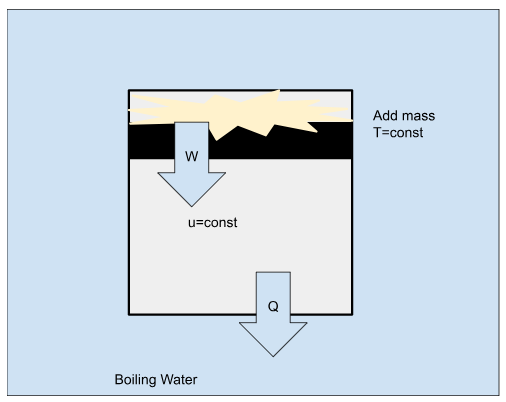
Lab design for Isothermal process
For Isothermal process with decreasing volume and increasing pressure: Put container (w/piston) in boiling water/cold water. Add Mass to the top of piston (using sand).
Isoentropic/Adiabatic process
S=const; n=const
Q=0J
Δu=W
The slope of an Adiabatic graph is always steeper than an isothermal one

Lab design for adiabatic process
For adiabatic process with increasing volume and decreasing pressure: Surround container (w/piston) with a blanket (to prevent heat transfer). Remove Mass to the top of piston (remove sand).

Generic (applies to all previous PV graphs) process
W=area on PV graph; “+” when change in volume<0 (gas is compressed) and “-” when change in volume>0 (gas is expanding).
Δu=23(PfVf−PiVi)
Q=Δu−W

Engine Efficiency
e=Q+∣Wcyc∣=∣Q+∣∣Q+∣−∣Q−∣=∣Wcyc∣−∣Q−∣∣Wcyc∣=P+P+−P−
Carnot Engine
Isothermal Expansion—>Adiabatic Expansion—>Isothermal Compression—>Adiabatic Compression (cycle repeats)

Entropy
a state variable that grows when the probability of finding a system in that state grows. S tells how many microstates compared to a given
Symbol: S
Most likely state=Thermal equilibrium
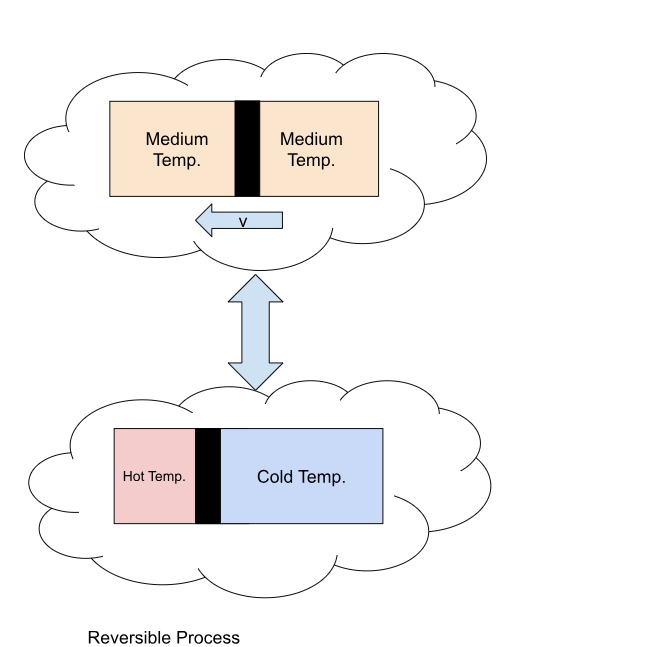
Irreversible process
ΔSTot>0

Reversible process
ΔSTot=0
Microstate
State of the gas as described at the microscopic level (displacement, velocity) for all particles.
Macrostate
State in terms of Macroscopic quantities, such as P, V, T, n