Anatomy Lecture Test #3 Pearson Questions
 Call Kai
 Learn
 Practice Test
 Spaced Repetition
 Match
 Flashcards
 Knowt Play
1/139

There's no tags or description
Looks like no tags are added yet.
140 Terms
What is a membrane potential?
a voltage or electrical charge across the plasma membrane
Which of the following is FALSE regarding the membrane potential?
The resting membrane potential is maintained solely by passive transport processes

What cellular event is indicated by A?
Exocytosis

What event directly triggers the release of neurotransmitter shown in A?
diffusion of Ca2+ into the axon terminal?

An enzyme known as acetylcholinesterase is present in the synaptic cleft. What is its role?
to break down acetylcholine

Which statement accurately describes the event indicated by B?
Binding of acetylcholine to a receptor triggers the opening of an ion channel

A toxin released by certain bacteria can block the release of neurotransmitters into a neuromuscular synapse. What would result from such a block?
the loss of ability to contract the muscle
What part of the sarcolemma contains acetylcholine receptors?
motor end plate
Myasthenia gravis is a disease that is believed to be caused by autoimmune disorder, resulting in the loss of ACh receptors at the motor end plate of muscle fibers. Which of the following is likely to be a symptom of myasthenia gravis?
weakness of muscle

Which protein is indicated by the letter A?
actin

Which protein is indicated by the letter E?
myosin

The molecular interaction described as a cross bridge involves the binding od which two proteins?
A and C
If the cell could no longer produce ATP, what would be the effect on the sarcoplasmic reticulum?
It would be unable to concentrate Ca++ in the sarcoplasmic reticulum
Which step precedes all the other listed steps?
ACh is released by the motor neuron
Identify the correct sequence of the following events.
a. Myosin generates a power stroke.
b. Ca++ binds to troponin.
c. ATP recharges the myosin head.
d. Troponin removes tropomyosin from G actin.
e. The sarcomere shortens.
f. Myosin binds to actin.
b, d, f, a, e, c
Cross bridge formation between myosin heads and actin molecules is promoted by the elevation of calcium ion concentration in the cytosol. During rigor mortis, this elevation of calcium ion concentration in the cytosol is permanent because ________.
mitochondria stop producing ATP molecules required by the sarcoplasmic reticulum's calcium ion pumps
If a muscle fiber were to suddenly and permanently stop producing ATP the fiber would no longer be able to actively transport calcium out of the cytoplasm (sarcoplasm) and the intracellular calcium concentration would rise. Which of the following would you expect to happen?
Myosin would be able to bind to the exposed binding sites on thin filaments but it would not be able to detach

Consider how the action potential that initiates contraction is delivered to the muscle cell.
Which of the choices below correctly describes how an action potential generated at the neuromuscular junction (NMJ) is converted to excitation in the muscle fiber?
An action potential in the motor neuron causes ACh to be released into the synaptic cleft. Binding of ACh to sarcolemma receptors initiates graded potentials

The action potential propagates along the sarcolemma. As the action potential spreads down the T tubules of the triads, voltage-sensitive tubule proteins change shape.
How does the shape change of these proteins lead to contraction?
It allows calcium to exit the sarcoplasmic reticulum and enter the cytosol

What are the purple dots?
Calcium ions

What are the purple squares on the T tubule?
Voltage-sensitive tubule protein

What is the channel thing in the center?
T tubule
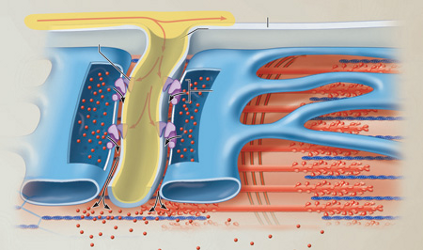
What is the blue called?
Terminal cistern

What is the surrounding white border?
Sarcolemma

Which selection correctly describes the role of calcium in coupling?
Calcium binds to troponin, which moves tropomyosin and exposes the myosin-binding sites on actin

Which selection best describes the initial event in contraction?
Myosin heads bind to the newly xposed myosin-binding sites on actin to form cross bridges
The swollen chamber of an organelle that lies on either side of a T tubule
Cistern
A protein that changes shapes as a direct result of an action potential
Voltage-sensitive tubule protein
A protein with heads that attach in cross bridging
Myosin
A structure that forms a path from the membrane to the cell interior
T tubule
The protein that binds calcium
Troponin
Which of the following choices best summarizes excitation-contraction coupling?
A series of events in which an electrical stimulus is conveyed to a muscle fiber to enact contraction
The cross bridge cycle starts when _________.
Ca2+ from the sarcoplasmic reticulum binds to troponin
The cross bridge cycle is a series of molecular events that occur after excitation of the sarcolemma. What is a cross bridge?
A myosin head bound to actin
What structure is the functional unit of contraction in a skeletal muscle fiber?
The sarcomere
Calcium ions couple excitation of a skeletal muscle fiber to contraction of the fiber. Where are calcium ions stored within the fiber?
Calcium ions are stored in the sarcoplasmic reticulum
After a power stroke, the myosin head must detach from actin before another power stroke can occur. What causes cross bridge detachment?
ATP binds to the myosin head
How does the myosin head obtain the energy required for activation?
The energy comes from the hydrolysis of ATP
What specific event triggers the uncovering of the myosin binding site on actin?
Calcium ions bind to troponin and change its shape
When does cross bridge cycling end?
Cross bridge cycling ends when sufficient calcium has been actively transported back into the sarcoplasmic reticulum to allow calcium to unbind from troponin
The energy reserves for which of the ATP regenerating pathways will be depleted first during an extended period of light to moderate exercise?
direct phosphorylation of ADP by creatine phosphate
Which of the following statements is NOT true regarding ATP production in muscles during periods of prolonged energy use, such as exercise?
In the absence of oxygen, creatine phosphate can drive aerobic respiration pathways for a few minutes
Creatine phosphate functions in the muscle cell by?
storing energy that will be transferred to ADP to resynthesize ATP
During vigorous exercise, there may be insufficient oxygen available to completely break down pyruvic acid for energy. As a result, the pyruvic acid is converted to ________.
lactic acid
An anaerobic metabolic pathway that results in the production of two net ATPs per glucose plus two pyruvic acid molecules is ________.
glycolysis
Which of the following would be recruited later in muscle stimulation when contractile strength increases?
motor units with larger, less excitable neurons
Which of the following is true?
Skeletal muscle fibers contain sarcomeres; smooth muscle fibers do not
Which type of muscle is found in the body wall of hollow organs?
unitary smooth muscle
The mechanism of contraction in smooth muscle is different from skeletal muscle in that?
the site of calcium binding site differs
Which of the following describes the cells of the unitary smooth muscle?
they exhibit spontaneous action potentials
Smooth muscle is characterized by all of the following EXCEPT?
there are more thick filaments than thin filaments
Although there are no sarcomeres, smooth muscle still possesses thick and thin filaments
True

Each neuron shown in this figure innervates a group of muscle fibers. What is the term for a group of muscle fibers and the single neuron that innervates them?
motor unit

If both motor neurons shown in this figure were to develop action potentials and stimulate muscle fibers, would all the muscle cells shown here contract?
No, because neurons in this figure do not innervate every muscle cell shown

If both of the neurons in the figure were activated, more muscle fibers would contract than if either neuron alone were active. This mechanism for control of the force of muscle contraction is known as ____.
recruitment
A motor neuron and all the muscle cells that is stimulates are referred to as a motor end plate
false
All of the following are true of smooth muscle EXCEPT _________.
multinucleated
What division of the nervous system is most specifically responsible for voluntary motor control?
somatic nervous system
Nerve impulses leading to the brain carry information about cell temperatures in the skin. The nerve fibers sending these signals will most likely belong to which division of the nervous system?
sensory (afferent) division
Nerve impulses leading to the skeletal muscle carry information to direct movement. The nerve fibers sending these signals will most likely belong to which division of the nervous system?
somatic nervous system
Cranial nerve II, the optic nerve, sends nerve impulses to the brain carrying information about the things we see. These nerve fibers most likely belong to which division of the nervous system?
sensory (afferent) division
Which of the choices below describes the ANS?
motor fibers that conduct nerve impulses from the CNS to smooth muscle, cardiac muscle, and glands
Which of the following describes the nervous system integrative function?
analyzes sensory information, stores information, makes decisions
Which of the following is NOT a characteristic of neurons?
They are mitotic
Which of the following is NOT a function of the autonomic nervous system?
innervation of skeletal muscle
The term central nervous system refers to the
brain and spinal cord
Which of the following peripheral nervous system (PNS) neuroglia form the myelin sheaths around larger nerve fibers in the PNS
Schwann cells
Schwann cells are functionally similar to?
oligodendrocytes

What is the structure at A?
dendrite

Which of these materials or structures would be found in greatest amounts of numbers at E?
vesicles containing neurotransmitter

In which area of the neuron is an action potential initially generated?
C
Which is the main receptive portion of the neuron?
the dendrite
In myelinated axons the voltage regulated sodium channels are concentrated at the nodes of Ranvier
True
In the motor division of the PNS, the effector organs consist of the three types of muscle tissue and glands. Which of these effector organs would be under voluntary control and thereby fall into the somatic nervous system?
Skeletal Muscle
Which of the following statements is correct regarding the polarization of a neuronal membrane and the formation of a resting membrane potential?
Sodium/Potassium pumps maintain concentration gradients; sodium and potassium move down their concentration gradients through leakage channels.
More Na+ than K+ leaks through neurons membranes because of the properties of the non-gated leak channels
False
The interior surface of a neuron’s plasma membrane at resting membrane potential will have a?
negative charge and contains less sodium than outside of the cell
Ions are unequally distributed across the plasma membrane of all cells. This ion distribution creates an electrical potential difference across the membrane. What is the name given to this potential difference?
Resting membrane potential (RMP)
Sodium and potassium ions diffuse across the plasma membrane of all cells because of the presence of what type of channel?
Leak channels
On average, the resting membrane potential is -70mV, What does the sign and magnitude of this value tell you?
The inside surface of the plasma membrane is much more negatively charged than the outside surface
The plasma membrane is much more permeable to K+ than to Na+. Why?
There are many more K+ leak channels than Na+ leak channels in the plasma membrane
The resting membrane potential depends on two factors that influence the magnitude and direction of
Na+ and K+ diffusion across the plasma membrane. Identify these two factors?
The presence of concentration gradients and leak channels
What prevents the Na+ and K+ gradients from dissipating?
Na+-K+ ATPase
Which of the following correctly describes a graded potential?
It can have amplitudes of various sizes
Which of the following is NOT true of graded potentials?
They increase amplitude as they move away from the stimulus point
During depolarization, the inside of the neuron's membrane becomes less negative
True
You are working on a new medication to selectively kill cancer cells. You test the drug on a culture of normal neurons to check for any side effects. Despite the presence of the drug, a normal resting membrane potential of minus 70mV is maintained. Look at each of the figures below to analyze how the drug might be affecting the neuron. Figure A shows neuron activity under normal, or control, conditions (without the drug). Figure B shows neuron activity that has been altered due to exposure to the drug. Based on these results, the drug is most likely __________
preventing Na gated channels from opening

At which point of the illustrated action potential would voltage-gated Na channels be mostly open but voltage-gated K channels be mostly closed?
B
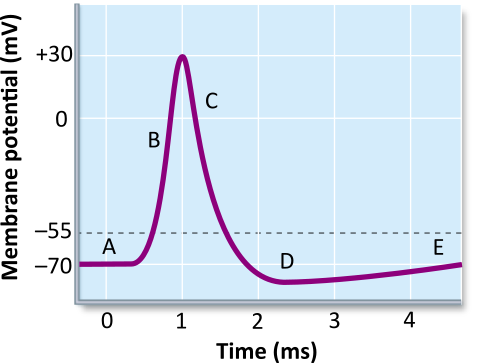
Which of the following correctly states the direction followed by the specified ions when their voltage-gated channels open?
Na ions move into the axon; K ions move out
What type of event is required for an action potential to be generated?
a threshold level depolarization
Which of the following is NOT a difference between graded potentials and action potentials?
The magnitude of action potentials decrease as the impulse travels further away from the start of the impulse while graded potentials do not decrease in magnitude
Which ion channel opens in response to a change in membrane potential and participates in the generation and conduction of action potentials?
voltage gated channel
Immediately after an action potential has peaked, which of the following channels will open?
voltage gated potassium channels
Where in the neuron is an action potential initially generated?
axon hillock
The depolarization phase of an action potential results from the opening of which channels?
voltage gated Na channels
The repolarization phase of an action potential results from __________
the opening of voltage-gated K channels
Hyperpolarization results from __________
Slow closing of voltage gated K channels
What is the magnitude (amplitude) of an action potential?
100 mV
During the action potential of a neuron, which ion is primarily crossing the membrane during the depolarization phase, and in which direction is the ion moving?
Na is entering the cell

What is happening to voltage-gated channels at this point in the action potential?
Na channels are inactivating, and K channels are opening