CEM 141 - Chapter 1: Atomic Structure, Forces, and Energy
 Call Kai
 Learn
Learn Practice Test
 Spaced Repetition
 Match
Match Flashcards
 Knowt Play
1/34

Earn XP
Description and Tags
Vocabulary practice flashcards covering fundamental chemistry concepts including scientific methods, atomic theory development, forces, energy, and atomic interactions based on Chapter 1 lecture slides.
Name | Mastery | Learn | Test | Matching | Spaced | Call with Kai | Chat |
|---|
No analytics yet
Send a link to your students to track their progress
35 Terms
Emergent Properties
New properties produced when atoms and molecules interact that differ from the sum of the individual reactants.
Scientific Question
A question that can be answered through experiments, observations, and measurements, all of which must be reproducible by others.
Scientific Claim
A proposed answer or statement addressing a scientific question that must be supported by empirical evidence.
Scientific Evidence
Data, measurements, or established scientific principles obtained from experiments that are used to support or refute a claim.
Scientific Model
A visual, mathematical, physical, or mental representation (such as a diagram, graph, or equation) used to explain mechanisms and make testable, quantifiable predictions.
Scientific Explanation
A complete response explaining a phenomenon that consists of three essential components: a claim, evidence, and reasoning linking the evidence to the claim.
Scientific Theory
The best available, falsifiable explanation of existing data and evidence that explains how and why a phenomenon occurs and makes testable predictions.
Scientific Law
A statement that describes a natural phenomenon (what happens) without providing an explanation of why it happens.
Atom
The smallest unit of an element, typically around 0.1 nanometers (0.1×10⁻⁹ m) in diameter, consisting of a dense nucleus surrounded by an electron cloud.
Element
A macroscopic substance composed of a single type of atom characterized by a specific number of protons, with 118 known elements arranged on the periodic table.
Molecule
A distinct particle formed when two or more atoms stick together or bind chemically.
Compound
A substance formed when atoms of two or more different elements interact and combine in fixed ratios, with its smallest representative unit being a molecule.

Atomic Force Microscopy (AFM)
A microscopic technique capable of imaging and manipulating individual atoms and surface structures at the atomic scale.
Scanning Tunneling Microscopy (STM)
An advanced imaging technique that provides atomic-level visualization of surfaces by detecting electric tunneling currents between a tip and the specimen.

Cathode Ray Tube
A sealed glass tube containing two electrodes under low pressure that emits a stream of negatively charged particles from the cathode toward the anode when high voltage is applied.
Electron
A subatomic particle carrying a −1 charge and a mass of approximately 20001 of a hydrogen atom (∼1/1800 amu), discovered by J.J. Thomson.

Plum Pudding Model
An atomic model proposed by J.J. Thomson depicting the atom as a positively charged sphere ("blob") containing embedded negatively charged electrons.
Alpha Particle
A positively charged particle consisting of 2 protons and 2 neutrons (the nucleus of a helium atom, possessing a +2 charge) emitted from radioactive sources.
Nucleus
The small (∼2×10⁻¹⁵ m), dense central core of an atom containing positively charged protons and neutral neutrons, discovered by Ernest Rutherford.
Neutron
A neutral subatomic particle discovered in 1932 residing in the atomic nucleus that carries 0 charge and is slightly heavier than a proton.
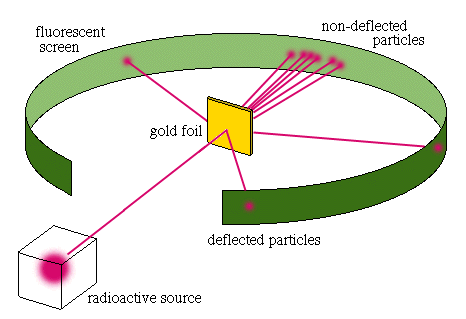
Rutherford's Gold Foil Experiment
An experiment where alpha particles were beamed at thin gold foil; while most passed through un-deflected, a few bounced back, showing that atoms possess a small, dense, positive nucleus and are mostly empty space.

Planetary Model
An atomic model proposed by Ernest Rutherford in 1909 where electrons move in circular orbits around a central nucleus, though classical physics predicted such electrons would radiate energy and spiral into the nucleus.
Electrostatic Force
The attractive or repulsive force between charged particles described by Coulomb's Law as F∼r2q1q2.
Newton's Law of Universal Gravitation
An equation modeling attractive gravitational force between masses, showing force is proportional to the product of masses and inversely proportional to distance squared (F∼r2M1M2).
Kinetic Energy
The energy associated with the motion of an object or particle, calculated using the formula KE=21mv2.
Potential Energy
Energy associated with the position of a system of two or more interacting objects within a force field (such as a gravitational or electrostatic field).
First Law of Thermodynamics
The principle of conservation of energy stating that total energy in the universe remains constant; energy cannot be created or destroyed, only transferred or transformed.
System and Surroundings
In thermodynamic studies, the system refers to the specific part of the universe being studied, while the surroundings comprise everything else in the universe.
London Dispersion Forces (LDFs)
Weak attractive intermolecular forces present between all neutral atoms and molecules caused by instantaneous, temporary fluctuations in electron density inducing dipoles in adjacent atoms.
Instantaneous Dipole
A momentary, uneven distribution of electron density in a nonpolar atom or molecule that creates temporary partial positive (δ+) and partial negative (δ−) charges.
Induced Dipole
A temporary separation of charge created in a neighboring atom or molecule when an adjacent instantaneous dipole distorts its electron cloud.
Thermal Energy
A measure of the total sum of kinetic energies (21mv2) of all atoms or particles present within a system.
Temperature
A property directly proportional to the average kinetic energy (21mv2) of the particles in a system.
Van der Waals Radius
Half of the distance between the nuclei of two non-bonded interacting atoms at their potential energy minimum.
Covalent Bond
A strong chemical interaction formed between atoms when electron clouds overlap, requiring significantly higher thermal energy to break (∼6000 K for H2) compared to London dispersion forces (∼14 K for He).