Unit 3 - Plant Anatomy Lecture (ch. 26, 19, 12)
 Call Kai
 Learn
 Practice Test
 Spaced Repetition
 Match
 Flashcards
 Knowt Play
1/27

There's no tags or description
Looks like no tags are added yet.
28 Terms
Describe determinant growth and what organisms it occurs in
Cells that differentiate and form tissues with a pre-programmed body plan, stops after a certain age (common in animals)
Describe indeterminant growth and what organisms it occurs in
Areas of rapidly dividing undifferentiated cells throughout life with a feature called meristems, without a pre-programmed body plan (common in plants).
What are the two lateral meristems that causes secondary growth?
vascular cambium and cork cambium
Describe vascular cambium.
Lateral meristems that produces secondary xylem inward and secondary phloem outwards
Describe cork cambium (phellogen)
Lateral meristems that produces cork (phellem) and phelloderm, which together forms the periderm
What are the two types of initials that form meristematic cells?
Fusiform initials and ray initials
Describe fusiform initials
Vertically elongated meristematic cells in the vascular cambium that gives rise to the axial system of secondary vascular tissues
Describe ray initials
Cuboidal meristematic cells in the vascular cambium that gives rise to the radial system for horizontal transport
Describe anticlinal division
Cell divisions perpendicular to the organ surface that allow the vascular cambium to expand in circumference
Describe periclinal division
Cell divisions parallel to the organ surface produce secondary xylem inwards and secondary phloem outwards

Describe the wood dynamics of sapwood
Outer, youngest layers of secondary xylem containing living parenchyma cells responsible for water and mineral conduction
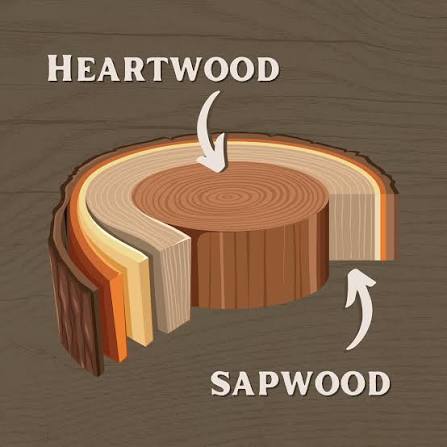
Describe the wood dynamics of heartwood
Inner, oldest layers of secondary xylem with no living cells that stores reserves, accumulates resins, and provide structural strength
Describe the wood dynamics of early wood (spring wood) vs late wood (summer wood)
Early wood has larger, wider cells formed early in the growing season for rapid water transport, while late wood has smaller, thick-walled cells formed later in the season for structural support.

Describe the difference of Ring-Porous Wood vs. Diffuse-Porous Wood
Ring-porous wood has large vessels concentrated in early wood (e.g., oak); diffuse-porous wood has vessels distributed evenly across the growth ring
Describe periderm
Protective tissue layer replacing the epidermis in woody stems, consisting of cork, cork cambium, and phelloderm
Describe bark
All plant tissues located completely outside the vascular cambium (includes living and dead phloem plus periderm layers)
Describe lenticels
Porous, unregulated aerating openings in woody bark that replace stomata to allow gas exchange
Describe systematics
Scientific study of biological diversity and evolutionary history, combining taxonomy and phylogeny
Describe cladogram
A branching diagram that represents an estimate of phylogenetic relationships based on shared derived characteristics
Describe the difference between Homologous vs. Analogous Features
Homologous features share a common evolutionary origin, while analogous features share a similar function but different origins
What is the binomial system of nomenclature
A formal naming system created by Carl Linnaeus consisting of a capitalized Genus name and a lowercase specific epithet
Describe the features of monocots vs dicots
Monocots: scattered vascular bundles, parallel leaf venation, floral parts in multiples of 3, one cotyledon, fibrous roots, absent secondary growth.
Dicots: ring-arranged vascular bundles, net leaf venation, floral parts in multiples of 4 or 5, two cotyledons, taproot, secondary growth present in woody plants.

Describe the difference of complete vs incomplete flowers
Complete flowers contain all four floral whorls (sepals, petals, stamens, and carpels); incomplete flowers lack one or more whorls
Describe the difference between monoecious and dioecious plants
Monoecious plants have separate male and female flowers on the same individual plants; dioecious plants have them on separate individual plants
For seed development, a mature ovary turns into a BLANK
fruit
For seed development, a mature ovule turns into a BLANK
seed
Describe the difference of a perfect flower vs imperfect flower
Perfect flower contains both androecium (stamens) and gynoecium (carpels), while an imperfect flower lacks one of these parts
Describe the fertile parts of a flower and what organs are featured in each part
Stamens (male organs: anther and filament); Carpels (female organs: stigma + style + ovary)