OB Week 3 + 4 -- Newborn Care + Complications
 Call Kai
 Learn
Learn Practice Test
 Spaced Repetition
 Match
Match Flashcards
 Knowt Play
1/103

There's no tags or description
Looks like no tags are added yet.
Name | Mastery | Learn | Test | Matching | Spaced | Call with Kai | Chat |
|---|
No analytics yet
Send a link to your students to track their progress
104 Terms
Neonatal period
The time from birth through first 28 days of life

Nursing priorities for the neonate
Maintain body heat, maintain respiratory function, lower risk of infection, assist parents in hydrating/providing nutrition

How does the respiratory system chance after birth?
Compression of thorax during labor + mild hypoxia --> respiratory center is stimulated --> first breath --> crying clears more fluid --> lungs function more normally --> surfactant is produced
Where does the lung fluid go after the first breath?
It is absorbed by the blood/lymph system and excreted by the kidneys
Surfactant
A chemical in the lungs that maintains the surface tension of the alveoli and keeps them from collapsing --> maybe decreased in premature birth/maternal diabetes
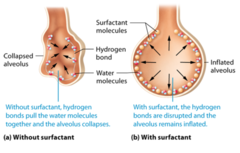
Why does maternal diabetes pose a risk for low surfactant levels?
Insulin inhibits surfactant production
Gestational diabetes leads to preterm birth
Signs of respiratory distress
• Central cyanosis
• Tachypnea
• Apnea
• Grunting
• Flaring of nostrils
• Retractions of the chest wall
• Hypotonia (late sign)
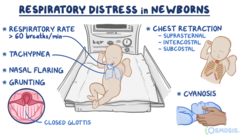
Respiratory distress syndrome
A life-threatening condition --> underdeveloped alveoli and insufficient levels of pulmonary surfactant --> atelectasis

Transient tachypnea of the newborn
Respiratory distress symptoms --> incomplete reabsorption of fetal lung fluid in full term newborns --> usually disappears within 24 to 48 hours

How does the circulatory system chance after birth?
Decreased pulmonary resistance to blood flow --> increased pulmonary blood flow
Cord clamped --> less blood flow/pressure in RA --> increased systemic vascular resistance

Ductus venosus
Connects the umbilical vein to the inferior vena cava, bypassing the liver --> closes when blood flow from the placenta stops

Foramen ovale
Connects the two atria in the fetal heart --> closes due to increased systemic vascular resistance

Ductus arteriosus
Connects the pulmonary artery to the aorta, bypassing the lungs --> closes within 15 hrs of birth

Patent ductus arteriosus
Failure of the ductus arteriosus to close after birth --> abnormal opening between the pulmonary artery and the aorta --> heart murmur, tachycardia, increased work of breathing, increased O2 demand --> heart failure in not managed
How do neonates thermoregulate?
Increased metabolic rate, increased O2 consumption, increase in muscle activity (tensing up), metabolism of brown adipose tissue

Factors that prevent thermogenesis
Decreased subcutaneous fat, decreased brown fat in preterm infants, large body surface, loss of heat from convection, radiation, conduction, and/or evaporation

Evaporation
Surface liquid evaporates into a vapor --> heat loss

Convection
Movement of heat from the body's surface to drafts/movement of cooler air --> heat loss

Conduction
Direct contact with a cold surface --> heat loss

Radiation
Movement of heat from a body to a cooler surface that is close to the newborn but not touching --> heat loss

Cold stress
Excessive loss of heat --> increased respirations and non-shivering thermogenesis to maintain core body temperature
Environmental temperature ↓ , body temperature ↑, heart and respiratory rates ↑, O2 consumption, depletion of glucose and ↓ surfactant --> respiratory distress

Risk factors for cold stress
1. Prematurity
2. SGA/LGA
3. Hypoglycemia
4. Prolonged resuscitation efforts
5. Sepsis
S+S of cold stress
Low temp, cool skin, restlessness, acrocyanosis, tachypnea, grunting, hypoglycemia, ineffective feeding

Sudden unexplained postnatal collapse
An otherwise healthy newborn experiences a sudden cardiorespiratory collapse within the first week of life --> usually due to airway problems
Newborn hypoglycemia
Glucose < 45 mm/dL
Signs and symptoms of neonatal hypoglycemia
Irritability, jitteriness, hypotonia, hypothermia, and seizures

Risk factors for neonatal hypoglycemia
1. Maternal DM
2. Preemie
3. LGA or SGA
4. Stress at birth (hypothermia or hypoxia)

How does the hepatic system transition to extrauterine life?
Indirect bilirubin
Unconjugated, water insoluble (byproduct of RBC breakdown BEFORE liver)

Direct bilirubin
Conjugated, water soluble (byproduct of RBC breakdown AFTER liver)

Transcutaneous bilirubinometer
Measures the concentration of bilirubin in the blood

Pysiological jaundice
Appears 24-48 hours after birth, TcB < 7

Pathological jaundice
Present at birth or within 24 hours

Breastfeeding jaundice
Appears 2-4 days after birth due to limited intake/output
Why are neonates at risk for hyperbilirubinemia?
Due to their underdeveloped livers --> unable to process the bilirubin from RBC breakdown

Why do neonates need vitamin K?
Many neonates are vitamin K deficient at birth due to immature intestinal flora --> vitamin K is needed to prevent hemorrhage and promote blood clotting
How often do newborns void/stool?
For the first 4 days, 1 stool and 1 void per days baby has been alive
For day 5 and beyond, 6-8 voids and 3-4 stools
Meconium
The first stool of the newborn (greenish-black)

Meconium aspiration syndrome
Asphyxia in utero --> relaxation of anal sphincter --> meconium is passed --> abnormal inhalation of meconium --> respiratory distress

Transitional stool
Thin, slimy, brownish green stool that is passed on the 3rd-6th day

Breastfed stool
Yellow and semi formed --> then it becomes golden yellow with a pasty consistency and has a sour odor

Formula fed stool
Drier and more formed that breastfed stools, paler yellow or brownish yellow and has an unpleasant odor

Diarrhea stool
Loose, watery, and green stool
Feeding cues
Sucking motions, rooting, mouthing, hand to mouth
Crying is NOT a feeding cue

Breastfeeding positioning
Body should face mom's, skin-to-skin, baby prone on mom's chest, nose toward nipple

How to latch
Stroke nipple on newborns lips, WHOLE areola should go into mouth, newborn should have fish lips, shin touches breast

How often should babies feed?
Breastfed: every 2-3 hours for 15 min each feed
Formula fed: every 3-4 hours

Formula feeding important points
Warm formula by setting it in warm water, do NOT microwave, throw away formula after an hour, NEVER prop a bottle

Passive immunity
An individual does not produce his or her own antibodies, but rather receives them directly from another source, such as mother to infant through breast milk

Active immunity
A form of acquired immunity in which the body produces its own antibodies against disease-causing antigens

Neonatal assessment components
1. APGAR scores
2. Vital signs
3. General survey
4. Head to toe
When are APGAR scores taken?
1 minute after birth and 5 minutes after birth
APGAR scores
-Activity (muscle tension)
-Pulse (HR over 100)
-Grimace
-Appearance/Color (Pink, acrocyanosis)
-Respiratory

What APGAR scores are normal?
7-10 is normal
4-6 needs re-evaluation
< 3 requires intervention (code)

Newborn vital signs
Respiratory rate: 30-60
Heart rate: 110-160
Temperature: 36.5-37.5 C
Pain score: NIPS or NPASS
Blood sugar: >45

Newborn weight
Breast fed babies lose 7-10% of their weight, formula fed babies can lose 5% of their weight
Why do newborns lose weight?
Babies lose weight due to fluid reduction, passing of meconium, and the breakdown of brown adipose tissue
Excessive weight loss (> 10%) complications
Jaundice, hypoglycemia, dehydration --> renal failure, thrombosis, shock, seizure
Newborn posture: normal and abnormal
Normal: Flexed, symmetric movement
Abnormal: Flaccid, hypertonic, asymmetric movement

Newborn skin: normal and abnormal
Normal: Pink, acrocyanosis, milia, lanugo, vernix, erythema toxicum, cafe au lait spots, blue nevus, port wine stain, strawberry hemangioma, stork bite
Abnormal: Cyanosis, jaundice, pallor, mottling, harlequin sign

Newborn head: normal and abnormal
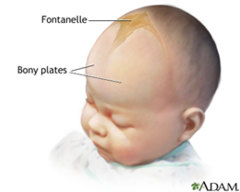
Normal: Fontanels soft and flat, suture lines, caput succedaneum, molding
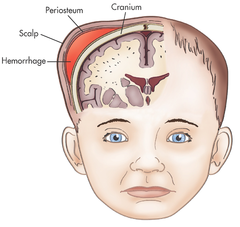
Abnormal: Cephalohematoma, bulging or sunken fontanels
Newborn face: normal and abnormal
Normal: Symmetric size + shape, movement
Abnormal: Asymmetry
Newborn eyes: normal and abnormal
Normal: Symmetric, clear sclera, blue/grey iris, PERRLA, transient crossed eyes
Abnormal: Conjunctivitis, drainage, hemorrhage, yellow sclera, tears

Newborn nose: normal and abnormal
Normal: Patent nares
Abnormal: Nasal flaring

Newborn mouth: normal and abnormal
Normal: Pink, moist membranes, movable tongue, intact hard/soft pallets, Epstein pearls
Abnormal: Cleft palate, thrush, protruding tongue, teeth

Newborn ears: normal and abnormal
Normal: Firm pinna, quick recoil
Abnormal: Low set ears, skin tags, hearing loss

Newborn neck: normal and abnormal
Normal: Short, creased, moves freely
Abnormal: Webbing, torticollis

Newborn chest: normal and abnormal
Normal: Barrel shaped, symmetrical, breast engorgement
Abnormal: Respiratory distress, retractions, grunting, clavicular fracture

Newborn abdomen: normal and abnormal
Normal: Round, soft, 3 vessel cord, BS present
Abnormal: BS absent, distended, bowel loops, visible peristalsis

Moro reflex
Infant reflex where a baby will startle and splay our their arms and legs in response to a loud sound or sudden movement

Tonic neck
Infant reflex where a baby stretches its arms out into a fencing position when its head is turned to the side

Rooting reflex
Infant reflex where a baby will turn its head and open its mouth when its cheek is stroked

Sucking reflex
An infant reflex in which the infant starts sucking when its lips are stroked

Palmar grasp
An infant reflex in which the infant grasps an object when the object is placed in the infant's palm

Plantar grasp
An infant reflex where toes curl downward when pressure is applied to the ball of the foot

Babinksi reflex
An infant reflex in which the toes spread when the lateral side of the foot is stroked

Stepping/dancing reflex
An infant reflex in which the infant steps up and down when held upright
SGA
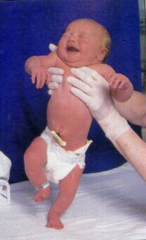
Small for gestational age (

IUGR
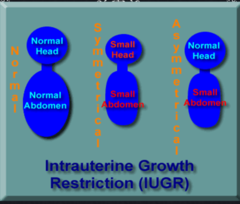
Intrauterine growth restriction
IUGR causes
Infection, malnutrition, substance abuse, hypertension, medication, etc

AGA
Appropriate for gestational age

LGA
Large for gestational age (above 90th percentile)
Caused by maternal diabetes, postmature

Postmature baby
Pregnancy of 42+ weeks --> good flexion, skin dried out, more wrinkled, scrawnier, less subcutaneous fat because baby uses up glycogen stores
Intraventricular hemorrhage
Hemorrhage located within the ventricles of the brain --> more common in premature/IUGR newborns --> apnea, bradycardia, pallor or cyanosis, weak sucking ability, a high-pitched cry, seizures, lethargy, stupor, or even coma

Necrotizing enterocolitis
Serious inflammatory condition of the intestines --> most common in premature newborns --> abdominal pain and swelling, changes in vital signs, bloody diarrhea, green or yellow vomit, lethargy, and a refusal to eat, often resulting in poor weight gain

N-PASS
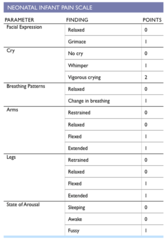
Neonatal pain, agitation, and sedation scale
0 is normal

Neonatal Infant Pain Scale (NIPS)
Newborn and infant pain score
0 is normal
Initial period of reactivity (the golden hour)
30 minutes post birth --> APGAR scores, dry + stimulate newborn, secure ID bands and HUGS tags, feed, skin-to-skin contact

Period of relative inactivity
30 min - 2 hrs after birth --> newborn is quiet, HR and RR will decrease

Second period of reactivity
2 to 8 hours after birth in which the newborn awakens and shows an interest in stimuli

Composition of milk
87% water
3.7% fat
4.9% carbs
3.5% protein

How do hormones control milk release?
Colostrum
Transitional milk
Mature milk
Contraindications for breastfeeding
- Maternal HIV
- Active tuberculosis
- Drug abuse
- Certain medication (e.g., tetracycline, chloramphenicol, *chemotherapy* agents)
- Baby with galactosemia
Erythromycin Ophthalmic Ointment
A medication that is put into the eye of all newborns as prophylactic to treat neonatal blindness

Hepatitis B Vaccine
If the birth giver has a Hep B surface antigen that is unknown or positive, give HB IGs within 12-hours of birth

How to put a baby to sleep safely?
Alone, on their back, in a crib

Care of the circumcised penis
Keep Vaseline gauze on wound, wash with soap and water
