KPE260 Introduction to Human Physiology
 Call Kai
 Learn
 Practice Test
 Spaced Repetition
 Match
 Flashcards
 Knowt Play
1/67

Earn XP
Description and Tags
Week 1
68 Terms
Physiology
The study of biological functions and how the body works
Cell differentiation
the biological process where generic, unspecialised cells become specialised cell with distinct shape and function
4 major categories of cells
muscle cells
neurons
epithelial cells
connective cells
example of muscle cells
muscle tissues: heart, legs
examples of neurons
nervous tissue: brain, spinal cords
examples of epithelial cells
epidermis, digestive system
examples of connective tissue
bone, blood, fat (adipose)
neurons
specialised in the NS to intiate, integrate, and conduct electrical signals to other cells, over long-distances too
neurons are fundamental to:
our consciousness and perception
epithelial cells
specialized for selective secretion, absorption, and protection
3 shapes of the epithelial cells and feature
shapes: cuboidal, columnar, squamous
feature: ciliated
Connective cells
to connect, anchor, and support structures of the body
3 types of connective cells
collagen fibers
elastin fibers
reticular fibers
collagen fibers
rope-like structural protein to provide strength, support, flexibility to connective tissue
elastin fibers
act like rubber bands allowing organs to expand and recoil as well as support
reticular fibers
form a supportive internal network in soft organs
3 fluid compartments
intracellular
plasma
interstitial
intracellular fluid
within all cells of the body; 67% of all the water in the body
plasma
fluid portion of blood where blood cells are suspended; 7% of total-body water
Interstitial fluid
lies around and between cells in the space called interstitium
extracellular fluid of the body
Plasma + Interstitial
Homeostasis
self-regulating process that biological systems use to maintain stability while adjusting conditions best for survival
key processes of homeostasis
feedback and feedforward
when homeostasis is disruored
compensatory mechanisms restore it towards the stable or static internal environment
homeostatic control system
self-regulating biological network that keeps internal body conditions despite changes in the external environment
negative feedback
change in the body is detected by receptors —> body triggers a response that reverses or sloe down that change —> bringing body back to a stable internal environment
positive feedback
initial change —> even greater response in the same direction —> pushes system away from the normal baseline
Hierarchy of importance
implemented so that certain variables may be alatered markedly to maintain others within normal range
Efferent Pathway
Nerve circuit that carries motor and regulatory signals away from the CNS to muscles, organs, and glands
Body temperature increases above normal
efferent pathway would turn off or reverse
shivering will not occur
blood vessels would dilate to bring warm blood to the skin surface where heat could leave the body across the skin
heat loss brings the body internal temperature back to normal
4 categories of chemical messengers
hormones
neurotransmitters
paracrine substances
autocrine substances
Function Hormones
released in the blood, produced by endocrine glands, distributed to most organs (growth reproduction, metabolism, etc.)
Function Neurotransmitters
released in synaptic cleft, to other neurons, muscles, and glands
Function of Paracrine substances
chemical messenger in local response, communication between cells, released extra cellular fluid, diffuse to neighbour cells
Function of Autocrine Substances
released into extracellular fluid and acts on the same cell
Body pool of a chemical substance
The central available quantity of a substance in the extracellular fluid that receives inputs and supplies outputs/storage.
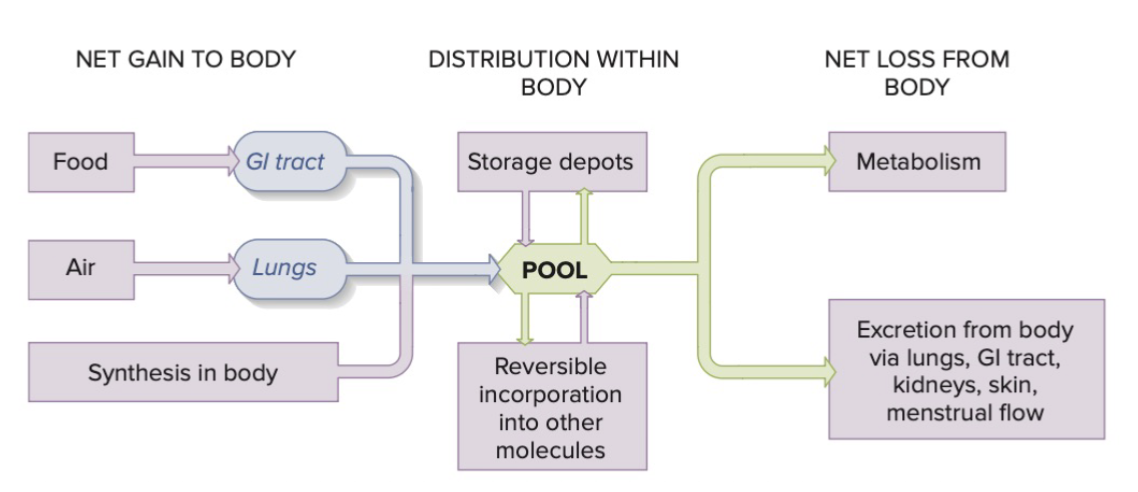
Positive Chemical Balance
State in which total gain (ingestion/synthesis) exceeds total loss (excretion/consumption), resulting in an increased body pool.


Negative Chemical Balance
State in which total loss (excretion/consumption) exceeds total gain, resulting in a net decrease in the body pool.
General Principal of Physiology
Physiological functions are controlled by multiple regulatory systems, often working in opposition
2 function states
absorptive and post-absorptive
Absorptive State
Ingested nutrients enter the blood via GI Tract
Postabsorptive State
GI tract is empty of nutrients and the body’s own stores must supply energy
Major energy supplying food group of the absorptive state
carbohydrate, fats, and proteins
Absorptive State- Carbohydrates
carbohydrates —> glucose —> gets absorbed into the blood leaving the GI tract —> glucose enters cell and is broken down into CO2 and water
Major consumer of glucose and secondary consumer
skeletal muscles and adipose-tissue cells
Absorptive state - protein
Absorbed as amino acid into the blood leaving the GI tract —> some are transported into liver, and used to synthesize carbohydrate-like intermediate tissue
Chylomicrons
lipoprotein particles that transport dietary fats and cholesterol from intestines to the rest of your body
Absorptive state of lipid into adipose tissue
diffused into adipocytes and synthesized in the adipocytes from glucose metabolites to form triglyercides
Cholesterol
made by the liver and found in blood that is needed to build cells and make hormones.
Cholesterol Homeostasis
liver ensures there is no excess of cholesterol by either removing it from the blood or secreting it into bile or metabolizing it to bile salts.
Three sources of blood glucose to supply energy in the post-absorptive state
Glycogenolysis, Lipolysis, Gluconeogenesis
During post-absorptive state for muscles
the muscle decrease glucose uptake and utilization
net glycogen catabolism
net protein catabolism
net amino acid release
fatty acid uptake and utilization
During post-absorptive state for liver
increase in glucose release due to removal of inhibitory effects on glycogen catabolism and gluconeogenesis
increase in ketone synthesis and release
During post-absorptive state for adipocytes
decrease glucose uptake and utilisation
net triglyercide catabolism and release of glycerol and fatty acids
Glycogenolysis
the hydrolysis of glycogen from proteins and fats to monomer of glucose 6-phosphate
where does glycogenolysis occur
primarily in the liver and the kidneys, but also in the skeletal muscles
hydrolysis
when water molecule breaks one or more chemical bonds in a substance
the limit of glycogenolysis
this can only supply yhe body’s requirement for several hours before it is nearly depleted
How does skeletal muscles use products of glycogenolysis
it gets further broken down via glycolysis within muscle cells to yiels ATP, Pyruvate, and lactate
location of lactate synthesized to glucose
liver
lipolysis
breakdown of the triglyercerise in adipose tissues which yiels glycerol and fatty acids —> then the glycerol will be diffused into the blood and into the liver to create glucose
Gluconeogensis
synthesis of glucose from amino acids, lactate and glycerol
Process of Gluconeogenesis
Protein breakdown —> amino acids —> enter to blood and taken up by liver —> metabolised by a-keto acid pathway to glucose
Glucose sparing
fat utilization
why is glucose sparing importanr
essential step in lipolysis
gluconeogenesis cannot supply all the energy demands of the body during fasting
most of the energy supply is used by the brain
Glucose sparing in the liver
most of the acetyl-coA from fatty acid during post-absorptive state is processed into ketones
these ketones inhibit liver gluconeogenesis, while maintaining stable insulin and glucagon levels
Glucose Sparing - Brain
Ketone bodies serve as an alternative energy source for the brain and the liver, which can be redirected to the pentose phosphate pathway allowing an increase in biosynthesis
why is glucose sparing vital for the brain
The net result of fatty acid and ketone utilization during fasting is the provision of energy for the body while at the same time sparing glucose for the brain and nervous system