14 - Transfection
 Call Kai
 Learn
 Practice Test
 Spaced Repetition
 Match
 Flashcards
 Knowt Play
1/13

There's no tags or description
Looks like no tags are added yet.
14 Terms
What is transfesction?
The process of introducing nucleic acids into eukaryotic cells. Transfection methods overcome the electrostatic barrier between negatively charged DNA and negatively charged host cell membranes
What is the difference between transformation and transfection?
Transformation - introducing foreign DNA into bacteria
Transfection - introducing DNA into eukaryotic cells
What is the difference between transient and stable transfection?
Transient transfection: short term expression of DNA, with no genomic expression
Stable transfection: long term expression of DNA, with integration into the host chromosome/maintained as an episome
Methods of chemical transfection
Cationic polymers
Cationic lipids
Calcium phosphate
Pros/Cons of Chemical Transfection
Pros:
Relative ease of use
Relatively inexpensive
Cons:
Variable transfection efficiency
Toxicity to cells by some chemical compounds
May be difficult to transfect certain cell types
Methods of physical transfection
Direct injection
Biolistic particle delivery
Electroporation
Laserfection
Pros and Cons of Physical Transfection
Pros
Can be used for hard-to-transfect c ells
May allow single-cell transfection
May allow precise insertion of nucleic acids into subcellular compartments
Cons
Toxicity to cells
May require specialized equipment and operator skill
Biological transfection method
Virus-mediated
Pros and Cons of Virus-mediated transfection
Pros:
High Transformation efficiency
Can be used for difficult to transfect cells
Cons:
Requires biosafety-standard lab space
Risk of insertional mutagenesis
DNA insert size limit
Steps of DEAE Dextran Transfection
Mix nucleic acids with DEAE Dextran
Add DNA/DEAE dextran to eukaryotic cells
Induce uptake of DNA by osmotically shocking cells
Wash cells and allow them to recover
Assay cells for DNA expression
What is DEAE dextran
Polycationic dextran that negates the charge of DNA, allowing for DNA uptake into cells

Use of DMSO in transfection
Used to osmotically shock eukaryotic cells to allow for DNA uptake + Increases efficiency of endocytosis by disrupting osmosis
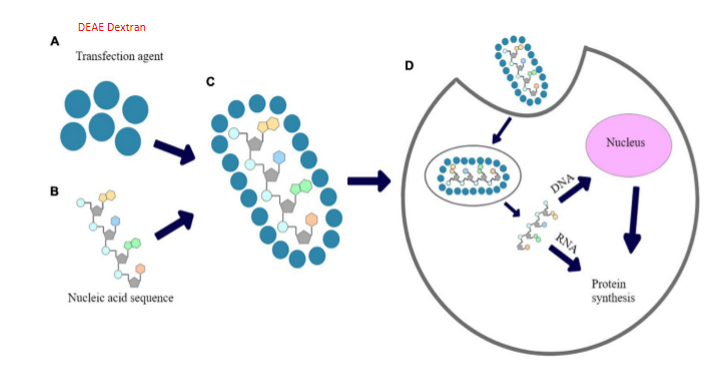
What are the steps of this image?
DEAE Dextran coats the nucleic acid, imparting a positive charge
Complex comes into contact with the negative cell membrane
Cells are osmotically shocked with DMSO and glycerol to induce endocytosis
Chloroquine prevents acidification of the endosome and promotes release of complex
DNA travels and enters nucleus
Use of Chloroquine
Used to prevent acidification of endosomes and to promote the early release of nucleic acids from endosomes