Medical therapies
 Call Kai
 Learn
 Practice Test
 Spaced Repetition
 Match
 Flashcards
 Knowt Play
1/46

There's no tags or description
Looks like no tags are added yet.
47 Terms
What is chemotherapy?
genotoxic (i.e. damaging to DNA) treatment of disease by the use of chemical substances, especially the treatment of cancer by cytotoxic and other drugs
What are the different ways chemotherapy can be used?
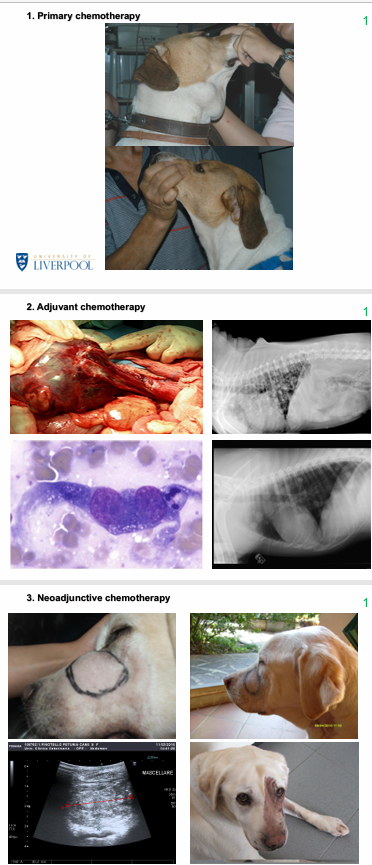
Primary chemotherapy - sole anti-cancer tx, common with lymphoma
Adjuvant Chemotherapy - after surgery to remove any mets (/microscopic residual dz)
Neoadjuvant chemotherapy - given before surgery to shrink tumour and increase chance of successful resection (mast cell tumour, mammary carcinoma)
How does chemotherapy work?
Active against rapidly proliferating tissues
(Does not specifically target cancer cells —> Cannot tell the difference between a cancer cell and a normal cell)
What cells are relatively chemo resistant?
Cells that are not actively dividing (those in G0)
At what time point is chemotherapy most likely to be effective?
Before a mass can be identified - the more cells the more likely there is going to be a resistant one

What are the factors that affect chemotherapy success?
Tumour cell heterogeneity (evolution of resistance) – linked to tumour size
Inherent tumour sensitivity
Origin tissue (e.g. eye quite resistant)
Growth fraction
Drug dosage
Tumour blood supply/oxygenation
Interval between treatments
Other drugs (steroids when treating a lymphoma)
How does tumour heterogenicity effect chemotherapy success?
Sub-clones have multiple mutations
If there are sufficient cells a resistant clone is very likely therefore chemo less effect
Stem cells may also pay a role
Mass physical structure also relevant
How can drug resistance of cancer cells be minimised?
Treat as early as possible
Follow properly evaluated protocols
Use correct doses
Avoid pre-treatment with drugs that induce resistance (selects for resistant cell population)
At relapse, act ASAP
What considerations need to be made about drug pharmacology?
Administration - ability of oral drugs to get in blood stream
Distribution - ability get to target
size drug
vasculature
necrosis
blood barriers (blood brain barrier)
Metabolism - drug activation/deactivation
glutathionine
Excretion - abnomral GFR?
(issues with animals with hepatic and renal problems)
How do you dose obese patients?
Estimating lean weight?
What are some problems that can affect dosing?
obesity
drug sensitivities
Animals with hepatic functional compromise
Animals with reduced renal function
What drug sensitivity is common in collies?
MDR1 (ABCB1) mutations
When is single agent chemotherapy used?
Sensitive tumours - Transmissible venereal tumour (TVT)
OR when second effective agent unknown
Tends to select rapidly for drug resistance
Selection pressure high leading to rapid dominance of resistant cells
How does the risk of toxicity differ between sequential and combined polychemotherapy?
combined > sequential
What are the 2 types of polychemotherapy approach?
Sequential —> Several drugs given at different times
Combined —> Several drugs given at the same time
With polychemotherapy, what should each agent do and what should be avoided?
Should:
have proven efficacy against the tumour
have different modes of action
affect different stages of the cell cycle
have non-overlapping dose limiting toxicities
not interfere with each others actions
Avoid:
Arbitrarily excluding one of the drug from the protocol
Arbitrarily reducing a drug dose
Toxicity to one drug is not always indicative of toxicity to another
What routes of administration are used for chemotherapy?
Oral
Intravenous
Bolus (rapidly)
Infusion (slowly)
IM/SC
Intracavitary
(always wear appropriate PPE when doing this and consider environmental risk)
avoid topical + intratumoral
How is dosing worked out for patients?
High dose chemotherapy has a narrow therapeutic window
Start at the maximum tolerated dose (will be the dose listed in protocol) - reduce/adjust if there are adverse effects
Dosing based on body surface area
Correlate with liver/kidney blood supply (metabolism) better than weight
For smaller patients (<10kg) some drugs are administered on mg/kg
Carboplatin, doxorubicin, epirubicin
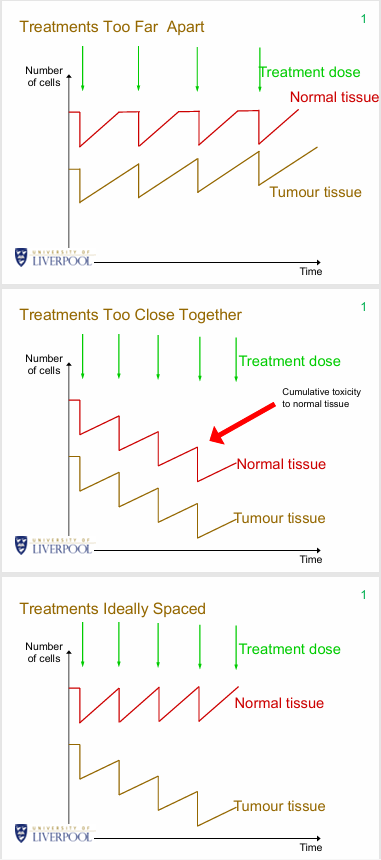
What is the interval between treatments for?
Dose density
Allow recovery of normal tissues
Bone marrow + GIT capacity to repair rapidly
These tissues tend to repair more rapidly than most tumours (treatments too close together leads to toxicity of normal tissue)
What is the first line chemotherapy protocol for lymphoma in dogs and cats?
Lymphoma (dogs): CHOP (vincristine, doxorubicin, cyclophosphamide and prednisolone) or CEOP (epirubicin vs doxorubicin) or COP (high dose)
Lymphoma (cats): high dose COP (high grade) or chlorambucil/pred (low grade)
What is the first line chemotherapy protocol for mast cell tumours?
Mast cell tumours: vinblastine/prednisolone. Use a TKI if have c-kit mutation. If owner cant afford mutation testing is better to use vinb/pred
What is the first line chemotherapy protocol for osteosarcomas?
carboplatin q3w for 4-6 doses (after amputation)
What needs to make up Pre-chemotherapy assessment?
Discuss tolerance of any previous treatment
Assess patient
Assess tumour status
Biochemistry (preprotocol, every few mths)
Haematology prior to each treatment
neutrophils (most important for patient to fend off infec)
platelets
Urinalysis start or treatment, prior to cyclophosphamide
What are the different responses you can have to the therapy?
Complete remission CR - all lesions gone, no new lesions (assoc. with improved outcome)
Partial remission PR - ≥ 30% reduction in size, no new lesions
Stable disease SD - between PR and PD
Progressive disease PD - ≥20% increase or new lesions
(can only monitor this for primary and neoadjuvant chemo)
How common are side effects from chemotherapy?
30 – 50 % of patients have some side effects during treatment course
Most side effects are transient and self resolving
<10 % have side effects that lead to hospitalisation
1 – 2 % chance of death (usually sepsis)
What immediate toxicities can you get (<24hrs)?
What treatment would you use for these?
Anaphylaxis/hypersensitivity - tx w. steroids, antihistamines
esp caused by L-asparaginase (especially repeat doses), anthracyclines, cisplatin, cytosine
IVFT, dex iv, H1 blocker, adrenaline
Cardiac arrhythmia
esp caused by Doxorubicin (epirubicin)
Emesis - tx w. maropitant, Metaclopromide (short t1/2), ondansetron
esp caused by Platinum compounds, actinomycin-D
What is acute tumour lysis syndrome?
Rapid destruction of cancer cells in patients with large tumour burdens
lymphoma
24-48 hrs
Electrolyte abnormalities
Hyperkalaemia
Hyperphosphatemia
Hypocalcemia
Acute kidney injury
How would you deal with a patient with high tumour burdens?
Careful monitoring of at risk patient - keep in the hospital for 24-48 hours
Early IVFT if you see signs
Management of AKI
What longer term side effects can you see?
Bone marrow - Low WBC count (7-10 days)
Alopecia - uncommon, specific breeds
Gastrointestinal – does not usually lasts longer than the first 4 days
(Rapidly dividing cells most affected)
What signs will you see with GI toxicity?
direct damage to enterocytes
Anorexia, nausea, vomiting, diarrhoea
Disrupted mucosal barrier with neutropenia increases risk of sepsis (…bacterial translocation)
1-5 d post-tx
What chemo drugs can cause GI toxicity?
doxo cytarabine /epi, vincristine, cyclophosphamide (in cats), infusion, platinum compounds
How can you manage GI toxicity initially?
Maropitant – dispense for home use to prevent vomiting
Pre-treatment fasting reduces diarrhoea
Consider dispensing smectite in case of diarrhoea (VBS clay)
What do you do if signs of GI toxicity last longer than 24 – 48 hours (more severe)?
IVFT
Anti-emetics – metoclopramide (great for nausea), ondansetron
Diarrhoea – maropitant, smectite, benefit of abs unclear
incr risk sepsis if neutropenia
Why may toxicity occur 7-10d post chemotherapy?
Damage to emerging haematopoetic cells
Dip in neutrophil counts for 48 – 96 hours typically
Timing varies a little by drugs and patient (most 7 days)
Some reduction in neutrophil counts is associated with improved outcome.
Too low leads to a risk of sepsis
<0.75 x 10⁹/L if assymptomatic
Or up to 1.5 x10⁹/L if pyrexi
Why are patients presenting 7-10d post chemotherapy with pyrexic neutropenia a medical emergency?
may be septic
Translocation of bacteria from patient’s own GI flora
Hospitalisation- until systemically well
Stop all cytotoxic drugs- dose reduce next time
Barrier nurse and aseptic techniques
Supportive therapy
Bactericidal antibiotics (aerob/anaerob continue for 3-7d after recovery). Ideally IV (cefuroxime 20mg/kg IV q8hr)
How does you approach differ depending on the amount of neutrophils?
Neutrophil count <1x10⁹/L
Antibiotics (amox/clav 20mg/kg bid 7d or TMOS)
Drug discontinuation (if on tablets)
Check temperature
Subsequent dose reduction
Neutrophil count 1-1.5x10⁹/L
If next dose due will need to be delayed
No abs unless good reason
Neutrophil count 1.5-2.5x10⁹/L
Dose may require postponement/modification depending on schedule.
What other drug associated complications can occur?
Cumulative cardiotoxicity (DCM)
Doxorubicin (+/- epirubicin?!- thought to be less cardiotoxic) (dogs)
Sterile haemorrhagic cystitis
Cyclophosphamide (dogs)
Hepatotoxicity
Lomustine (dogs)
Nephrotoxicity
cisplatin, doxorubicin (cats), lomustine (dogs)
Fatal non-cadiogenic pulmonary oedema
cisplatin (cats)
Fatal CNS signs
5-FU (cats)
dihydropyrimidine dehydrogenase activity
What can be done to prevent sterile haemorrhagic cystitis?
Furosemide
Increase drinking
Frequent outdoor access
What can reduce the risk of hepatotoxicity?
SAM-E
What is being shown here?
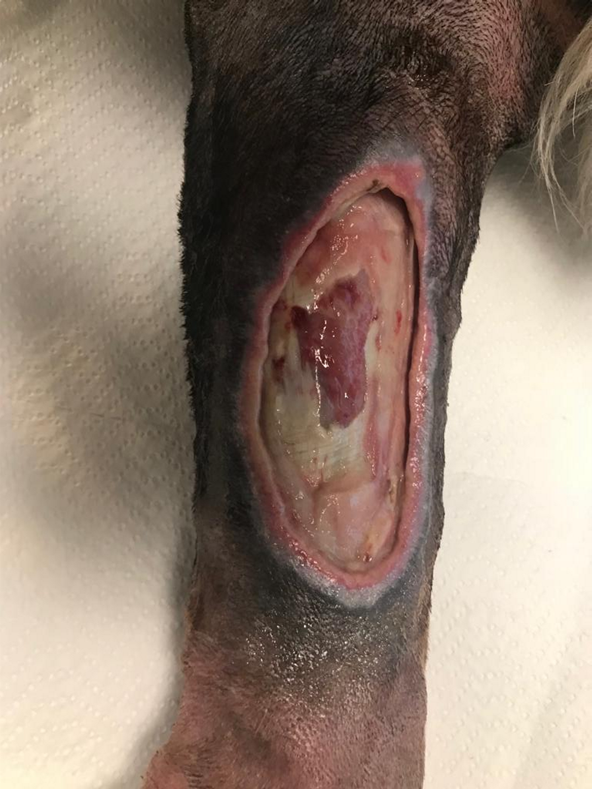
Extravasation
ALWAYS use a cleanly placed first stick catheter, never leave unsupervised and flush before removal
Monitor for any swelling, discomfort, changes in resistance to injection or rate of infusion
Do not use a syringe driver or pump (pressure can go quite high before alerted)
Flush catheters appropriately before catheter removal
What chemotherapy drugs are perivascular irritants?
Vincristine and vinblastine are perivascular irritants
Doxorubicin, epirubicin, Actinomycin D are catastrophic perivascular irritants
How can extravasation be treated?
If you suspect an extravasation, do not flush!
Raise vein and draw back
Doxorubicin/ Epirubicin /Actinomycin D
Apply COLD packs
Dexrazoxane
Topical DMSO
Consider (immediate) surgical debridement
Vincristine/Vinblastine
Apply WARM compresses
Topical DMSO
Hyaluronidase (not recommended)
What are the features of metronomic chemotherapy?
Daily low dose chemotherapy
Main target is angiogenesis
Direct action on tumour cells and stim immune response
Prevent local recurrence STS
Slow metastatic disease HSA
What is commonly used for metronomic chemotherapy?
low dose cyclophosphamide with piroxicam (or other NSAIDs)
monitor haem + urine dipstick
What is MOA of Receptor Tyrosine Kinase?
Inhibit the activation of specific signalling pathways involved in specific types of cancer
have an effect on angiogenesis (eg via VEGF)
Two oral drugs targeting the RTK KIT (toceranib and masitinib) licensed for treatment of mast cell tumours in dogs
More effective in presence of KIT mutation
used for metastatic disease

What side effects can be seen with receptor tyrosine kinase inhibitors?
Diarrhoea and anorexia
35 – 45 %, but only severe in 10%
Many owners report soft stools
Usually managed by treatment pauses
Bone marrow suppression
Around 10 % not typically severe
side effects may be delayed 4-6w
What are some more rare adverse effects of receptor tyrosine kinase inhibitors?
Masitinib - Protein losing nephropathy and haemolytic anaemia (both rare)
Toceranib – Epistaxis (nose bleeds), elevated blood pressure, muscle pain / weakness