BMS 503 - Exam 4 Key Topics
 Call Kai
 Learn
 Practice Test
 Spaced Repetition
 Match
 Flashcards
 Knowt Play
1/79

There's no tags or description
Looks like no tags are added yet.
80 Terms
What is the lysogenic cycle?
A cycle where the phage genome replicates without destroying the host.
What are temperate phages?
Phages that use both the lytic and lysogenic cycles.
What is a prophage?
Integrated viral DNA within the host cell's chromosome.
What is the function of restriction endonucleases?
They cleave foreign DNA at specific sites to defend against bacteriophages.

How do prokaryotes protect their own DNA from restriction endonucleases?
By modifying their nucleotides, usually through methylation.
What is recombination in genetics?
The process of breaking and joining genetic material, allowing incorporation of foreign DNA.
What is homologous recombination?
Recombination that requires a considerable stretch of homologous DNA sequences.
What is site-specific recombination?
Recombination that requires very little sequence homology and is used by lysogenic phages.
What is horizontal gene transfer?
DNA transfer between organisms that is not due to bacterial reproduction.
What are the three mechanisms of horizontal gene transfer?
Transformation, Conjugation, and Transduction.

What is transformation in bacteria?
The process of importing free DNA into bacterial cells.

What is generalized transduction?
Infection of a host strain with a lytic bacteriophage that can package host genomic material.

What is specialized transduction?
Transduction that occurs with temperate phages and results from aberrant excision of prophage.
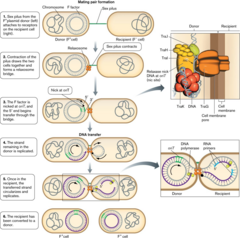
What initiates conjugation in bacteria?
Contact between a donor F+ cell and a recipient F- cell.
What is the outcome of contact with microorganisms?
Transient colonization, permanent colonization, or production of disease.
What is dysbiosis?
Changes in the microbiome that lead to disease.
What is commensalism?
A relationship where the host provides benefits to bacteria without harming or benefiting the host.
What is mutualism?
A relationship where both the bacteria and the host benefit from colonization.
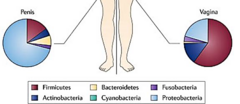
What is the microbiome?
The population of microorganisms currently colonizing your body.
What are the main bacterial species in the upper respiratory tract?
Corynebacterium sp., Staphylococcus aureus, Streptococci sp., Neisseria sp., and Haemophilus sp.

What is the composition of the GI tract microbiota?
Diverse community of bacteria, with the mouth heavily populated and the stomach sparsely populated.

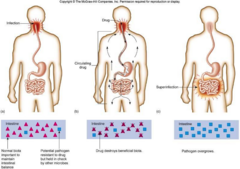
How do antibiotics influence gut microflora?
They kill normal flora, allowing pathogenic microorganisms to multiply and potentially cause disease.
What is the role of Lactobacillus acidophilus in the vagina?
Ferments glycogen to produce lactic acid, maintaining an acidic environment.
What is the difference between infection and disease?
Infection is the entry of a pathogen, while disease occurs when the interaction leads to damage and interruption of normal function.
What is pathogenicity?
The ability of a pathogen to cause disease.
What is virulence?
The degree of pathogenicity or the severity of disease caused by a pathogen.
What are bacterial toxins?
Substances produced by bacteria that can cause damage to the host.
What is biofilm?
A structured community of bacteria adhering to surfaces, often protected by a matrix.
What is the definition of infection?
Entry of a pathogen or parasite.
Does infection always lead to disease?
No, most infections are eliminated by the immune system.
What is disease in the context of infection?
Damage or loss of tissue or organ function due to infection.
What factors affect the severity of disease?
The importance of the affected organ and the amount of damage caused by the infection.
What are primary pathogens?
Non-normal flora organisms that can infect a host and cause disease.
What are opportunistic pathogens?
Normal flora organisms that can cause disease if the host is compromised.
What does ID50 represent?
The infectious dose needed to colonize 50% of hosts.

What does LD50 represent?
The lethal dose needed to kill 50% of hosts.

What is the infection cycle?
The route of dissemination of pathogens from person to person.
What is direct transmission?
Person-to-person dissemination of an organism.

What is indirect transmission?
Dissemination via an intermediate, such as fomites.
What are the common routes of entry for pathogens?
Inhalation, ingestion, injury, and sexual contact.
What is phagocytosis?
The process by which specialized immune cells engulf and destroy invading bacteria.
What is the complement system?
A system of proteins that binds to bacteria, causing lysis or promoting phagocytosis.
What are pili (fimbriae)?
Hollow fibrils that bind host cell sugar residues, aiding bacterial attachment.

What are exotoxins?
Proteins secreted by bacteria that damage the host.
What are endotoxins?
Bacterial components released that elicit an immune response.
What is the role of the lymphatic system?
It maintains fluid balance, absorbs fats, and transports immune cells.
What are neutrophils?
Immune cells that phagocytose and kill bacteria.
What are antigen presenting cells (APCs)?
Cells that present antigens to T-cells and initiate immune responses.
What is the function of B-cells?
To produce antibodies and present antigens to T-cells.
What is the role of CD-4 T-cells?
To control, suppress, and activate immune responses.
What is the role of CD-8 T-cells?
To recognize and kill virally infected cells and tumor cells.
What are natural killer cells?
Innate immune cells that kill antibody-decorated, virus-infected, or tumor cells.
What is the role of eosinophils?
Involved in defense against parasites and allergic responses.
What is the significance of fever in the immune response?
It can enhance immune function but may also have disadvantages.
What are the five cardinal signs of inflammation?
Redness, warmth, pain, edema (swelling), and altered function.
What is the initial response to an invader called?
Innate Immune Response.
What are PAMPs?
Pathogen Associated Molecular Patterns, repetitive structures of microbial surfaces or genomes.
What is the role of the Complement System?
Promotes inflammation, opsonizes invaders, and lyses cells.
What is the difference between innate and adaptive immunity?
Innate immunity is a general response to invaders, while adaptive immunity is specific to particular pathogens and retains memory.
What is an immunogen?
A protein or carbohydrate that elicits an immune response.
What are the two types of adaptive immunity?
Humoral immunity (antibody production) and Cellular immunity (T cells).
What is the primary role of B-cells?
To manufacture antibodies to specific antigens.
What is clonal expansion?
The process where activated T-cells grow and divide to increase the number of T-cells recognizing a specific antigen.
Where does T cell development occur?
In the Thymus.
What is the function of MHC I?
Presents proteins from the cytoplasm, including viral and intracellular bacterial proteins.
What is the definition of an epidemic?
An occurrence of a disease in a larger number of people than typically expected in a population.
What is a pandemic?
An epidemic that is widespread, usually distributed worldwide.
What is an endemic disease?
A disease that is constantly present in a population at low incidences.
What is the difference between incidence and prevalence?
Incidence is the number of new cases divided by the number at risk, while prevalence is the total number of cases in a population.
What is the role of antigen presenting cells (APCs)?
To present antigens to T cells using MHC II.
What triggers the adaptive immune response?
Specific antigens recognized by the immune system.
What are the two types of antibodies produced by B-cells?
IgM (default) and other classes upon interaction with T-cells.
What is the role of perforin in the immune response?
Forms pores in the membranes of infected cells.
What are granzymes?
Proteolytic enzymes released into the cytoplasm of infected cells via perforin-formed pores.
What is the significance of memory T-cells?
They allow for a quicker immune response upon re-exposure to the same antigen.
What is the role of cytokines in B-cell activation?
They influence the class of antibody produced by B-cells.
What is the function of the Golgi Complex in immune cells?
Involved in processing and packaging proteins, including antibodies.
What is the purpose of the chain of infection concept?
To understand and control the transmission of infectious diseases.
What is the role of physical barriers in the innate immune response?
To prevent infection by blocking pathogen entry.
What are antimicrobial molecules?
Substances that inhibit the growth of or kill pathogens.