2.4 Bioeconomy Resources
 Call Kai
 Learn
 Practice Test
 Spaced Repetition
 Match
 Flashcards
 Knowt Play
1/81

There's no tags or description
Looks like no tags are added yet.
82 Terms


Plants and animals produce a handful of building blocks such as:
Structural polymers: proteins and polysaccharides
Energy Storage polymers: starch
Energy storage molecules: triglycerides aka fats
Defense compounds and pigments: terpenoids, natural rubber, carotenoids
Examples of biomass composition (dry matter)
lignin
starch
cellulose
protein
hemicellulose
oil/fats
ash (minerals)
sugar
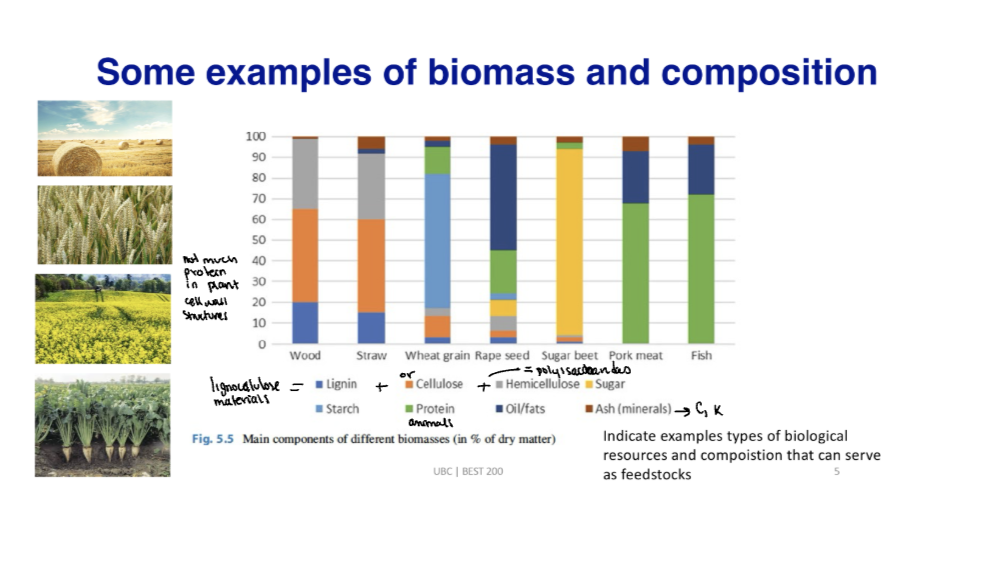
Estimation of the relative composition of different biomass in the biosphere top 3 (part of lignocellulose >90%)
50% is cellulose→polymer of glucose
24% is hemicelluloses
20% lignin

Estimation of the relative composition of different biomass in the biosphere that consist of the <10% in the food category
Starch
sugar
vegetable oils
proteins, other ingredients

Chemical composition of wood
Carbon 50%
Oxygen 43%
Hydrogen 6%
Nitrogen 1%
What type of material is wood?
A lignocellulosic material composed of cellulose, hemicelluloses and lignin
Most sources of lignocellulose materials come as what?
Most sources of lignocellulose materials come as polymers.
poly
meros
meaning
many
parts
=
polymers
Another name for polymers
macromolecules because they consist of extremely large molecules
Simple definition for polymers
large molecule composed of “simple” repeating units
Large molecule made up of many smaller building blocks called monomers.
molecular weight/molar mass is an important parameter impacting properties
degree of polymerization
number of repeating units
How do you get the degree of polymerization?
Adding the total number of repeating units and chain ends.
eg. if there are 6 chains, the DP= 6
Molecular weight
mass of one mole of molecules, g/mole
for small molecules or monomers
1 mole of water = 18g
1 mole of NaCl= 58.44g
1 mole of glucose = 180g
For polymers
Molecular weight = Mw of repeating unit x degree of polymerization
Molecular weight— Distribution
Average molecular weight
A way to describe the polymer sample as a whole.
Molecular weight— Distribution
Polydispersity
Different chain lengths and molecular weights
How are repeating units in a polymer chain linked?
linked by covalent bonds (sharing electrons; intermolecular interactions); process of forming polymers = POLYMERIZATION

Water bottle: polyethyline terephthalate (PET)
Water: no
Glass: no

dough yes (gluten)
Sucrose no → small molecule
cellulose → yes
Monomers
“Mono” + “mer” means “one” + “part”
Small molecules that can react (form covalent bond) to form polymers
The small molecule that joins with other molecules to form a polymer.

Monomers
Can one polymer contain only one type of monomer?
No, you can react 2 compounds together to have a monomer
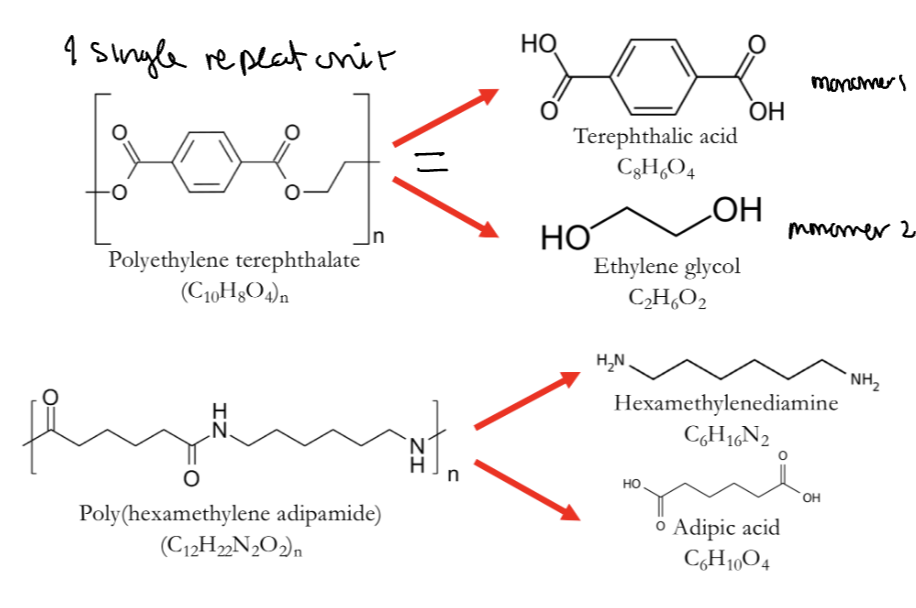
What happens when monomers join together?
They form a polymer through chemical bonds.
Repeating unit
The group of atoms that repeats along the polymer chain.
The structural unit that repeats along a polymer chain.
Think of it like building a necklace:
Monomers = individual beads.
Polymer = the entire necklace.
Repeating unit = the pattern of beads that repeats.

Multiple polymer chains entangle together to form:
“stuff” at a molecular level
What is the difference between homopolymers and copolymers?
Homopolymers contain one monomer type; copolymers contain two or more.
Classification of copolymers
Random copolymer
Alternating copolymer
Block copolymer
Graft copolymer

What does stereochemistry describe in polymers?
The 3D arrangement of atoms and groups along polymer chains.
What is polymer topology?
Polymer architecture

polymer topology
Linear

polymer topology
branched
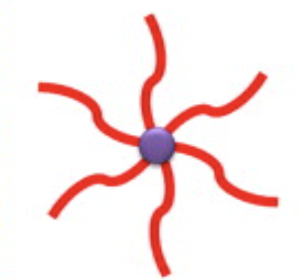
polymer topology
star

polymer topology
comb

polymer topology
ladder
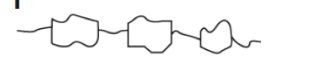
polymer topology
semi-ladder

polymer topology
network or crosslinked
polymer topology—Branching affect physical properties
examples of linear polymer plastics
higher density

polymer topology—Branching affect physical properties
examples of branched polymer plastics
less density, more flexible, little crystallinity due to spacing of the branches

Polymer Morphology
What is an amorphous polymer?
A polymer with no long-range order or regular molecular packing.
Polymer Morphology
What happens to polymer chains when a melt cools?
Molecular movement slows down until the chains become frozen in place.
Polymer Morphology
What does atactic mean in polymer structure?
irregular microstructure
Polymer Morphology
Why are atactic polymers generally amorphous?
Random side groups prevent chains from packing regularly
Polymer Morphology
What is the difference between crystalline and amorphous regions?
Crystalline regions are ordered; amorphous regions are disorganized.
What is a semi-crystalline polymer?
A polymer containing both ordered crystalline and disordered amorphous regions.
Crystalline polymers
2 types:
StereoREGULAR polymers → can crystallize, eg. polyethaline
StereoIRREGULAR polymers → cannot crystallize eg. atactic polystyrene, polycarbonate
What are polymer additives? Give an example.
Substances that change polymer properties. Plasticizers increase flexibility.
Examples of polymer terms
Molar mass and dispersity
Polymer architecture “topology”
Polymer morphology — internal packing of chains
Polymer chemistry — co-polymers; block and random
Some analogies

examples of polymers
DNA & RNA
polyethaline
Polyesters
PET
PLA
Classification of polymers — Natural polymers
Polymers produced by living organisms, including plants and animals.
Classification of polymers
What are polysaccharides made of?
Many monosaccharides (simple sugar units) joined together.
Classification of polymers
What is the difference between homo- and heteropolysaccharides?
Homo = one sugar type;
hetero = two or more different sugar types.
Classification of polymers
What are the functions of cellulose and starch?
Cellulose provides structural support; starch stores energy in plants.
Classification of polymers
Name three hetero-polysaccharides found in plant cell walls.
Hemicelluloses, pectins and xyloglucans.
Classification of polymers
What are chitin and alginate, and where are they found?
Chitin: insect exoskeletons and fungi.
Alginate: brown seaweeds.
Classification of polymers
What are proteins made of?
Amino acids connected by peptide bonds.
Classification of polymers
Match natural proteins to their sources.
Collagen: connective tissue;
Keratin: hair;
Albumin: egg;
Fibroin: silk;
Casein: milk.
Classification of polymers
Match natural proteins to their sources.
COLLAGEN—major amino acids
Glycine
Proline
Hydroxyproline

Classification of polymers
Match natural proteins to their sources.
COLLAGEN—role of glycine in collagen
Glycine's small size allows tight packing and helps form the triple helix.→ gives the helix’s twist.
Classification of polymers
Match natural proteins to their sources.
COLLAGEN—what structure do the three collagen chains form?
A stable, intertwined triple helix.
Classification of polymers
Match natural proteins to their sources.
COLLAGEN—what structure do the three collagen chains form?
Bone, tendons, and soft tissues such as the intestine. Different collagen types (I, II, etc.) occur in different tissues.
Classification of polymers
Match natural proteins to their sources.
SILK PROTEIN (Fibroin)—How many amino acids are found in silk?
approx. 17 different amino acids
Classification of polymers
Match natural proteins to their sources.
SILK PROTEIN (Fibroin)—Which three amino acids make up approximately 86% of silk?
Glycine, alanine, serine
Classification of polymers
Match natural proteins to their sources.
SILK PROTEIN (Fibroin)—How does spider silk compare to silkworm silk?
Spider silk is approximately 2 times stronger than silkworm silk.
Classification of polymers
Match natural proteins to their sources.
SILK PROTEIN (Fibroin)—Which species produces the silk cocoon used in commercial silk production?
Bombyx mori (silkworm)
Classification of polymers
Match natural proteins to their sources.
SILK PROTEIN (Fibroin)—How long can silkworm silk filaments be?
One continuous filament can be 300–900 m long; 1 lb of silk can represent about 1,000 miles of thread.
Classification of polymers
Match natural proteins to their sources.
KERATIN—What is keratin the primary constituent of?
Hair, wool, nails, hooves, horns, and the epidermal layer of skin.
Classification of polymers
Match natural proteins to their sources.
KERATIN—What is the primary structure of keratin?
A superhelix (coiled-coil) made of two alpha-helices bundled together

Classification of polymers
Match natural proteins to their sources.
KERATIN—Which amino acid in keratin contains sulfur?
Cysteine, which contains a sulfur-containing thiol (-SH) group.
Classification of polymers
Match natural proteins to their sources.
KERATIN—What do disulfide bonds do in keratin?
Crosslink chains, making keratin stronger and less soluble (insoluble).
Classification of polymers
Match natural proteins to their sources.
KERATIN—How are alpha-keratin chains strengthened?
Alpha-helical chains are crosslinked through disulfide bonds.
Classification of polymers
Match natural proteins to their sources.
KERATIN—Besides cysteine, which amino acids are abundant in keratin?
Proline and serine.
Protein vs Cellulose
Protein
Monomer → amino acids
Primary Structures → polypeptide chain, Amide/peptide linkage
Secondary structure → alpha helix, Beta-sheet, Intra and inter - molecular H bond
Tertiary Structure → The three dimensional structure, globular structure, hydrophobic interactions
As they go further, they turn into 3D complex structures.
Protein vs Cellulose
Cellulose
Monomer → glucose
Primary Structures → Cellulose chain, ether linkage
Secondary structure → Elementary fibrils, 36 chains Intra- and Inter- molecular H-bond, Van de Walls Interactions
Tertiary Structure → Microfibers
As they go further, they get bigger.
Proteins and Amino Acids
how are proteins composed?
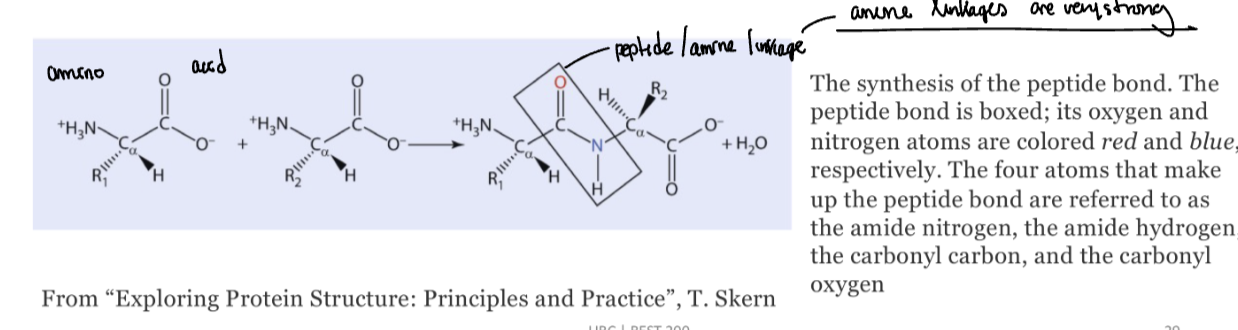
Amino acids are linked to form polypeptides through the peptide bond.
→ The reaction of the formation of the peptide bond, in which a carboxyl group and an amine group are joined together with the exclusion of a water molecule.
Proteins are made up of amino acid building blocks
Proteins and Amino Acids
Some examples of amino acids encoded in proteins
Glycine
Serine
Cysteine

What does it mean for amino acids to be zwitteronic?
Amino acids can be both negatively and positively charged; it may also depend of pH levels.


Amino groups can be either hydrophobic or hydrophilic
What types of structures can polypeptides and proteins form?
helices and sheets
What determines the properties and characteristics of helices and sheets?
amine and carboxyl acid

alpha helix

B sheets

polypeptides
aminoacids, dipeptide, tripeptide…