MesoAmerica Combined
 Call Kai
 Learn
 Practice Test
 Spaced Repetition
 Match
 Flashcards
 Knowt Play
1/47

There's no tags or description
Looks like no tags are added yet.
48 Terms

Seated “Baby” Figure, 12th-9th century B.C.E., Ceramic, cinnabar, red ochre, H. 13 3/8 in. (34 cm), Las Bocas, Central Highlands
ageless infant with ambiguous role was common Las Bocas motif
seem to be baby but loose, hanging flesh suggests age
hair in shape of helmet
red cross-bands-and-wing motif runs down back; made by rocker-stamp; associated with an Olmec diety

Las Limas Figure, 1000-600 BCE, serpentine, pyrite, H. 55 cm
“rosetta stone” of Olmec art because it revealed how large the pantheon of Olmec dieties was
4 masks on legs each represent different dieties (placement of each mask implies upper and lower realms)
A youth, neither specifically male nor female holds an infant in its lap (reference to legitimate descent?)
The infant has the monstrous face of the Olmec rain deity
the knees, shoulders, and face of the larger individual are incised with the faces of other supernaturals (this incision may reflect the tradition of body paint, which may have been Mesoamerica's first art form)
Olmecs valued blue/green materials: this is greenstone

Kunz Axe, 1000-400 BCE, jadeite , 30 x 15.2 cm
form of axe head but never functioned as one
blue-green jade precious material (associated with fertility because of water and sky; need water to grow maize)
2D and 3D dimensions combined in single object (hands & feet in lower relief and hands and feet only incied
open, toothless mouth and slanting eyes (howling baby face common); hands in lower relief; hands and feet only incised

Head 5 from the site of San Lorenzo, 1200-900 BCE, basalt, 186 x 144 x 125 cm
one of 10 colossal heads formed from basalt boulders found at San Lorenzo
emphasis on deep eyes and asymmetrical mouth
jaguar paws on forehead

Monument 52 from the site of San Lorenzo, 1000-400 BCE, andesite, 91.9 x 47.9 x 38.5 cm
sculpture of crouching Olmec rain god
hollowed on back to guide waterflow that poured out into a duck at base
cleft head & snarly mouth

Bust from the site of El Manatí, c. 1200 BCE, wood, 50.8 x 17.8 x 20.3 cm
emphasis on human face
representation of an individual

Altar 5 from the site of La Venta, 900-400 BCE, basalt, 155 x 203 x 153 cm
life size 3D figure in niche
central figure holding infant (legitimate descent: ruler displaying heir?)
figures on sides also adults and infants
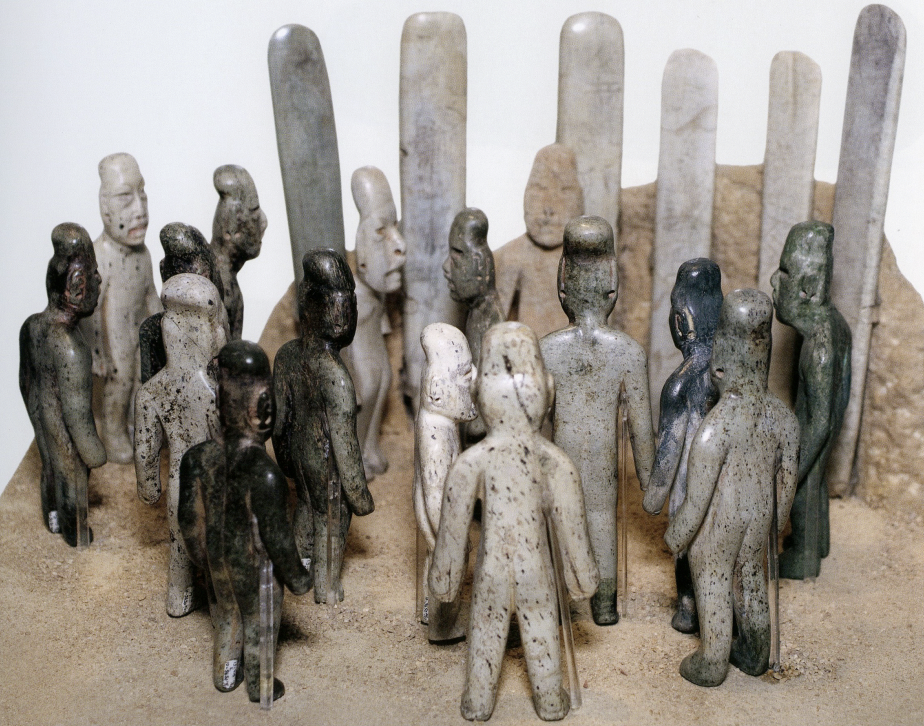
Offering 4 from the site of La Venta, 900-400 BCE, various greenstones, H. 7-9 in
Olmec mastery of jade and serpentine
one granite figure faces group made from precious stones
celts surrounding scene might speak to columns of the La Venta sunken court where offering was found
intentionally arranged ceremony (could be telling specific historical event)
was unconvered and reburied at one point
figures seem to be made by different artists (recycling)

Reconstruction drawing of the ceremonial core of La Venta showing Complexes A and C, original 900-400 BCE
The ceremonial center extends north from the 'fluted cupcake.' Ancient Olmecs placed structures and offerings in bilateral symmetry either side of the north-south axis, in the section of the site known as Complex A.
Mesoamerica
Cultural region extending across parts of modern Mexico and Central America.
Home to major civilizations, including the Olmec, Maya, Teotihuacan, and Aztec.
Shared cultural traditions included the 260-day ritual calendar.
Supported by diverse environments, agriculture, and trade networks.
San Lorenzo
One of the earliest major Olmec centers, located along Mexico’s Gulf Coast.
Known for its monumental earthen platforms, sophisticated drainage systems, and colossal basalt heads.
Olmec rulers were commemorated through monumental portrait sculptures.
Declined around 900 BCE, with many sculptures deliberately destroyed or reused.
La Venta
Important Olmec ceremonial center that rose after San Lorenzo’s decline around 900 BCE.
Located on a small, swampy island near the Tonalá River.
Featured a large pyramid, carefully planned ceremonial spaces, and monumental sculptures.
Known for buried offerings, including jade objects, stone slabs, and mosaic masks.
El Manatí
Olmec archaeological site in a swampy environment.
Wooden sculptures were preserved in the bog, along with rubber balls and polished jadeite celts.
Wooden figures demonstrate early Olmec artists’ skill in depicting individual human faces.
Some figures may have been carved onto staffs and displayed together as a group.

Reconstruction of a three-chambered shaft tomb at the site of El Arenal in Jalisco, Mexico, original 300 BCE-200 CE
A West Mexican burial tomb at El Arenal, in Jalisco, Mexico, dated to approximately 300 BCE–200 CE. It belongs to the shaft-tomb tradition, in which an underground burial chamber was reached through a narrow vertical shaft. Such tombs could hold multiple burials and offerings, including ceramic vessels and figurines.

Pair of Figures, Nayarit area style (Ixtlan del Río), 100 BCE-200 CE, ceramic, 32.1 x 27.3cm
one of the most predominate themes in west mexican ceramics
could be ancestors (maybe actual people, maybe mythological)
unsure of relationship (brother/sister; marriage)
male figure crossed legs, woman figure straight out
close relationship clearly established (physically connected, same patterning on body, same jewelry)
mechanism of power in this context is suggested to be units (LINEAGE)

Model of a tree-climbing ritual, Nayarit area style (Ixtlan del Río), 100-800 CE, ceramic, pigments, H. 9 in.
crowd looking at “flying” figure; ancient version of pole flying ritual that’s still practiced today
narrative scene: totally new visual strategy because everything is fixed in place

Dog, Colima area style, 200 BCE-300 CE, ceramic, 27.3 x 37.1 cm
Anthropomorphic
probably have deeper meaning (Great numbers of native hairless dogs were immortalized in Colima clay sculpture)
Shaft Tomb
A burial structure found in West Mexico, consisting of an underground chamber connected to the surface by a narrow shaft. Usually located 1–6 meters below ground, the chamber could contain multiple burials and offerings added over generations, including ceramic vessels and figurines.
These chambers served as family or lineage mausoleums, housing multiple elite burials over time rather than single-person graves
Preserving and honoring lineage leaders in shared chambers reinforced political legitimacy, social hierarchy, and land or resource rights among emerging chiefdoms.
Ethnographic Analogy
way for archeologists to study what a group of descendant cultures do to learn about what ancient culture in same area may have done
Using observations of living or historically documented cultures to help interpret archaeological evidence from the past.
Purpose: Helps archaeologists develop possible explanations for artifacts, rituals, and cultural practices when direct evidence is limited.
How it works: Archaeologists compare archaeological objects or practices with similar objects or practices in cultures whose meanings or uses are better understood.
Example: If a modern or historically documented community uses animal figures in burial rituals, archaeologists might consider whether similar ancient animal figures also had funerary significance.
Limitation: Similar-looking objects or practices do not necessarily have the same meaning across different cultures or time periods.

Reconstruction of Monte Albán, original 500 BCE-800 CE

Danzantes, c. 500-200 BCE, stone
evidence of violence
eyes closed; head in profile; nakedness sign of humiliation; arms/legs splayed: dead prisoners of war- some show mutilitation
could be individualized: glyphs, earrings OR representation of entire subjugated population

Offering vessel, c. 350-550 CE, ceramic, 18 1/2 × 12 1/2 in.
headdress connected to rain diety
His headgear is large and ornate, often featuring fanning feathers, jade ornaments (signifying water and fertility)
Large circular earspools with dangling feather or stone elements frame the face, and a heavy pectoral (chest ornament) hangs by a thick rope or string around the neck

Reconstruction of Monte Albán Tomb 104, original c. 200-500 CE
colorful murals inside tell visitors how to interact with the space (evidence of repainting is proof of revisiting)
connected with rain diety
body laid out in middle
embedded ceramic urn would’ve held offerings (ex. jewelry) and again connects the dead ancestor AND ritual impersonators to rain diety

The Bazán Slab (Lápida de Bazán), c. 300-500 CE, stone, 49 x 49 x 12 cm
left figure looks like Teotihuacan style; right figure looks Monte Alban
Provides evidence of contact between the Zapotecs of Monte Albán and the people of Teotihuacan.
Zapotecs more fluid and detailed and has headdress
Teotihuacan flat, boxy, geometric
Monte Albán
good environment for agriculture
Built on irregularly shaped mountain overlooking 3 valleys; it was leveled to make huge ceremonial center
Served as a major political and ritual center, with a large central plaza and temples; huge population that grew out of control and happened quickly (urban revolution: empty mountaintop to significant population center was quite unusual)
Known for the Temple of the Danzantes, which features carved stone figures thought to represent dead or captured enemies.
evidence of violence
Mound J
A structure built by the Zapotecs at Monte Albán, probably after 200 BCE.
Located in the central plaza but positioned off the plaza’s main axis; Mound J breaks axial orientation; Likely served an astronomical and calendrical function, marking the passage of time and aligning with bright stars.
incorporates over 40 slabs representing specific conquests; documented through glyphs (record battles, dates, and place names)

Avenue of the Dead at Teotihuacan, completed c. 200 CE
Often thought of as a 'street,' the Way of the Dead changes elevation several times, forcing pedestrians up and down stairs and commanding attention as a two-dimensional architectural feature. This processional requirement recalls the passage in the cave under the Pyramid of the Sun, where supplicants shifted from kneeling and crawling to walking upright.

Pyramid of the Moon at Teotihuacan, construction begun c. 100 CE
Slightly smaller than the Pyramid of the Sun, the Pyramid of the Moon also features a huge open courtyard in the rough configuration of the Mesoamerican completion sign that flows from the smaller talud-tablero structure that abuts the pyramid. Perhaps dedicated to the Great Goddess and her cult, the pyramid appears to possess the mountain and channel her forces to the city, acknowledging and calling upon the greater rainfall and abundance at the still-gurgling volcano once known as Tenan, 'our mother of stone.' The setting of mountain and pyramid is visually compelling at Teotihuacan, as if humans sought to place their works in perfect harmony with the landscape. The concept of oltepetL or 'water mountain" to the later Aztecs, referring to a place of civilization, may have had its first manifestation at Teotihuacan.

Pyramid of the Sun at Teotihuacan, construction begun c. 1st century CE
bigger than moon pyramid and would’ve been painted in bright colors
evokes sacred water mountain; people walking down look like cascade of water

Temple of the Feathered Serpent at Teotihuacan, c. 150–250 CE
WATER & FERTILITY
shells, rattlesnake tail (rebirth association because of shedding skin), elongated sheaths are stylized feathers)
head with lion mane is feathered serpent
important cosmological creature associated with water, fertility, divine creativity, religious realms
other figure (goggle eyes, topknot on head, corn- like scales) is more ambiguous
mirrors decorating it (common in meso america as decorative element)
some shells still have poly chrome on them (would’ve been brightly painted)
burials found here
200 males dressed in military gear with hands tied behind backs, arranged in structured pattern toward cardinal directions, knecklaces of human jaw bones
contrasts previous urban utopia idea

Reconstruction of the Zacuala Palace at Teotihuacan, original c. 350-550 CE
elite apartment compound
generally held kin groups
typically one more elite grave: original ancestor of kin group
one entrance and big walls = hard to access

Mural Painting from the Tepantitla Compound at Teotihuacan, c. 350–650 CE
each living compound had unique mural program
frontal facing figures seems to be reserved for representation of dieties throughout site
murals show little interest in comemorating events; more concerned with nature and dieties
water from mountain makes land fertile
mural is representation of “eden”; sacred fertile ground associated with mountain
very flat and few overlapping elements; no attempt to convey depth
goggle eyed storm god appears again here (super prominent character in Teotihuacan art)
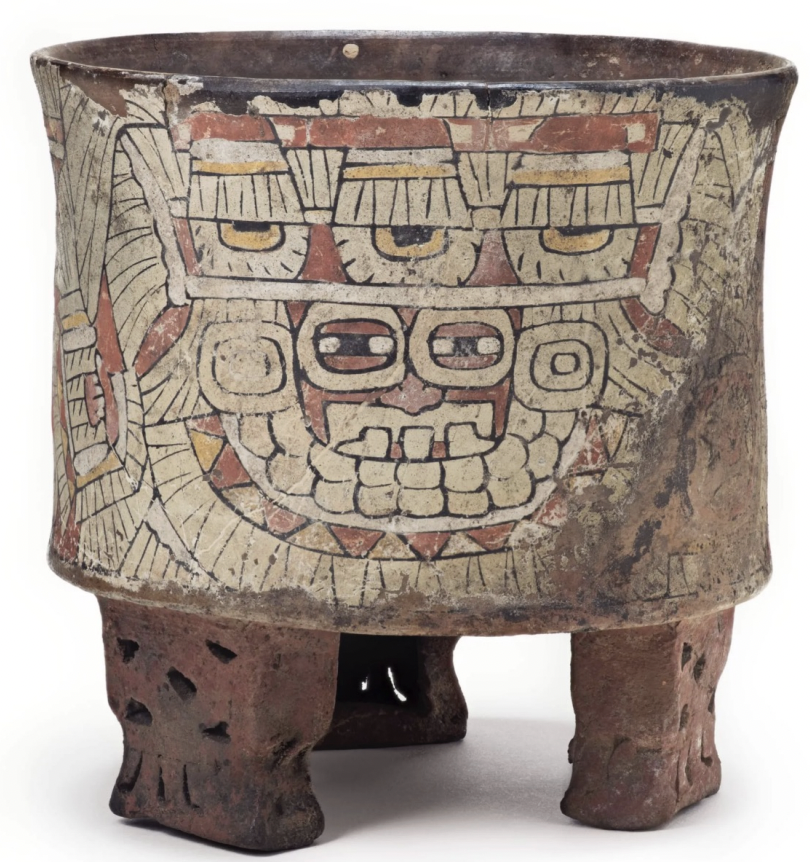
Tripod Vessel, c. 450–550 CE, earthenware with postfire stucco and pigment, 5 5/8 × 5 7/8 in.
goggled eyes
rattlesnakes
black wave represents obsidian
thin orangewear ceramic that was covered in stucco then painted
no images of rulers across most of teo made archaeologists think it was utopia but now analysis of imagery showing warfare/militarism is proof of centralization of power

Teotihuacan “Theater style” censer, ceramic and pigment, c. 400-550 CE
used to contain burning substance
come from residential compound excavations
hourglass bottom with cover

Standing Deity (“Chalchiuhtlicue” or “Great Goddess”), c. 200-600 CE, stone, H. 320 cm
Powerful in her rigid geometry and masked face, the so-called Great Goddess is the largest sculpture found at Teotihuacan. The cavity at her breastbone may have held a jade or obsidian inlay.
cleft recalls olmec
blockiness is unlike plastic 3D quality of olmec sculpture; angular, blocky, geometric=TEOTIHUCAN
frontal figure=god

Xalla Sculpture, c. 500-550 CE, Tecali/Travertine, 4.2 feet
made of rare, imported stone
evidence of having been painted
square hole in torso; jade beam found in back of throat
big grooves along body were for ropes to tie to pole (archaeologists compare it to colonial narrative of ritual in which a captive was hung up and shot to death by arrows)
ring around head was diadem
found broken into 160 pieces scattered throughout compound
radiocarbon dating shows it was destroyed in 550 CE; we know other types of destruction were happening around this time across Teo; apartment compounds burned and waves of movement outside the city center
Talud-Tablero
Although it is often difficult to distinguish palatial or bureaucratic structures from religious edifices or domestic dwellings in ancient Mesoamerica, the distinctive profile known as 'taiud-tabtero delineates much sacred architecture at Teotihuacan, particularly among the smaller structures and within palace compounds [56]. The sloping talud (talus) supports the vertical toblero (entablature), which is often the surface for architectural ornament or stucco paintings. Perhaps more than any other aspect of its culture, talud-tablero architecture marks the presence of Teotihuacan abroad, and the execution of such profiles in adobe at Kaminaljuyu, for example, nearly 700 miles ( 1 125 km) to the south, is a provincial manifestation of the great city.
Obsidian
A dark volcanic glass used to make sharp tools and finely crafted objects. At Teotihuacan, obsidian was an important material for craft production and trade, and it could also be used in ritual objects.
- Obsidian was especially important because it served as a substitute for metal tools and weapons in Mesoamerica.
- At Teotihuacan, obsidian and precious shells were crafted into fine objects, some of which were placed in burials.
so dark it’s reflective (mirror motif, connection to gods)
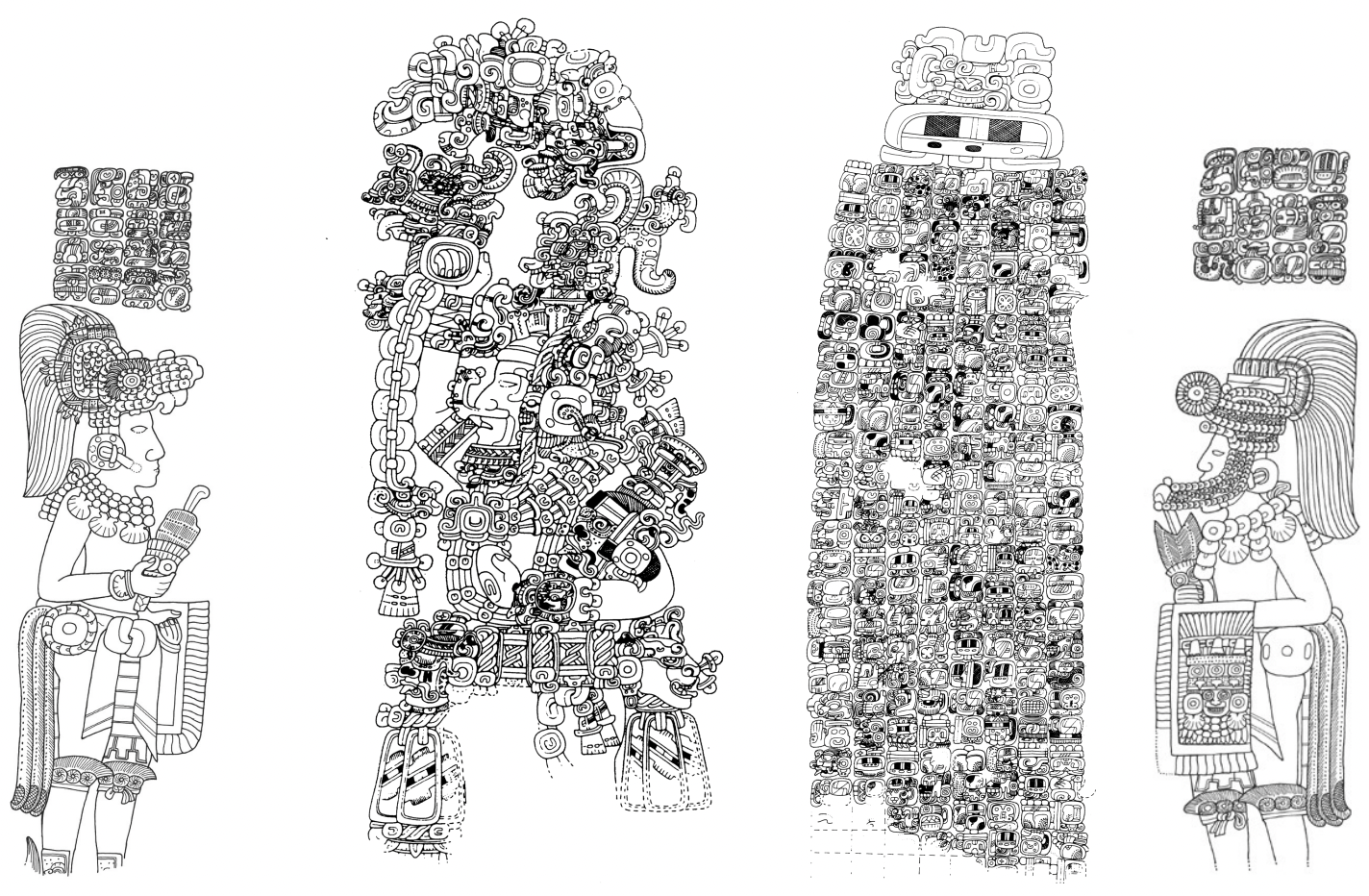
Line drawing of Stela 31 from Tikal, original dedicated 445 CE, limestone, h. approximately 8 ft.
contrast Teotijuacan figure with maya figure
M figure feels more overwhelming and powerful
guy holding chain is portrait of specific Tikal ruler. He is richly attired and holds aloft a headdress. The personal names of ancestors, rulers, nobles, and gods appear in hieroglyphics in various parts of Siyaj Chan K'awiil's costume and in the headdress he holds (lineage theme)
he’s in traditional early classic maya style
two warriors show influence of Teotihuacan style
• Atlatl (Spearthrower): He holds a central Mexican atlatl (spearthrower), a weapon and symbol of authority native to Teotihuacan that was not commonly used by the Maya.
• Tlaloc Shields: He carries rectangular or square shields adorned with the face and iconography of Tlaloc, the Teotihuacan war/storm god.
• Warrior Costumes & Headdresses: The figures wear Teotihuacan-style war garb, plate/tassel headdresses, and square-shaped military shields associated with the central Mexican highlanders

Pyramid I at Tikal, c. 734 CE, h. approximately 154 ft
the funerary monument and burial site for deceased ruler.
the intact tomb deep inside the structure contained rich grave goods, including fine ceramics, carved animal bones, jade ornaments, and shell mosaics.
The pyramid features 9 distinct stepped levels, which correspond to the 9 levels of Xibalba, the Maya underworld

Reconstruction of the Temple of Inscriptions at Palenque, original late 7th century CE
corbel vaults represent levels of upper world
representations in carvings of pakal’s son as royal diety
legitimizing his lineage through divine connection
Pakal buried here

Lid of Pakal’s Sarcophagus from the Temple of Inscriptions at Palenque, c. 683 CE, limestone (dolomite), 12.5 × 7.2 ft
skeleton found wearing lots of jade and jewelry
lid covered in inscriptions and images of specific rulers
face on bottom (snarling mouth)
waves coming up makes image of Pakal being lifted into underworld
pakal in middle realm where people are
cross is the great tree- the tree connecting middle realm into upper world
bird on top of world tree is associated with divine kinship and the heavens
pakal dressed as maize god
sides of sarcophogus has pakal’s ancestors
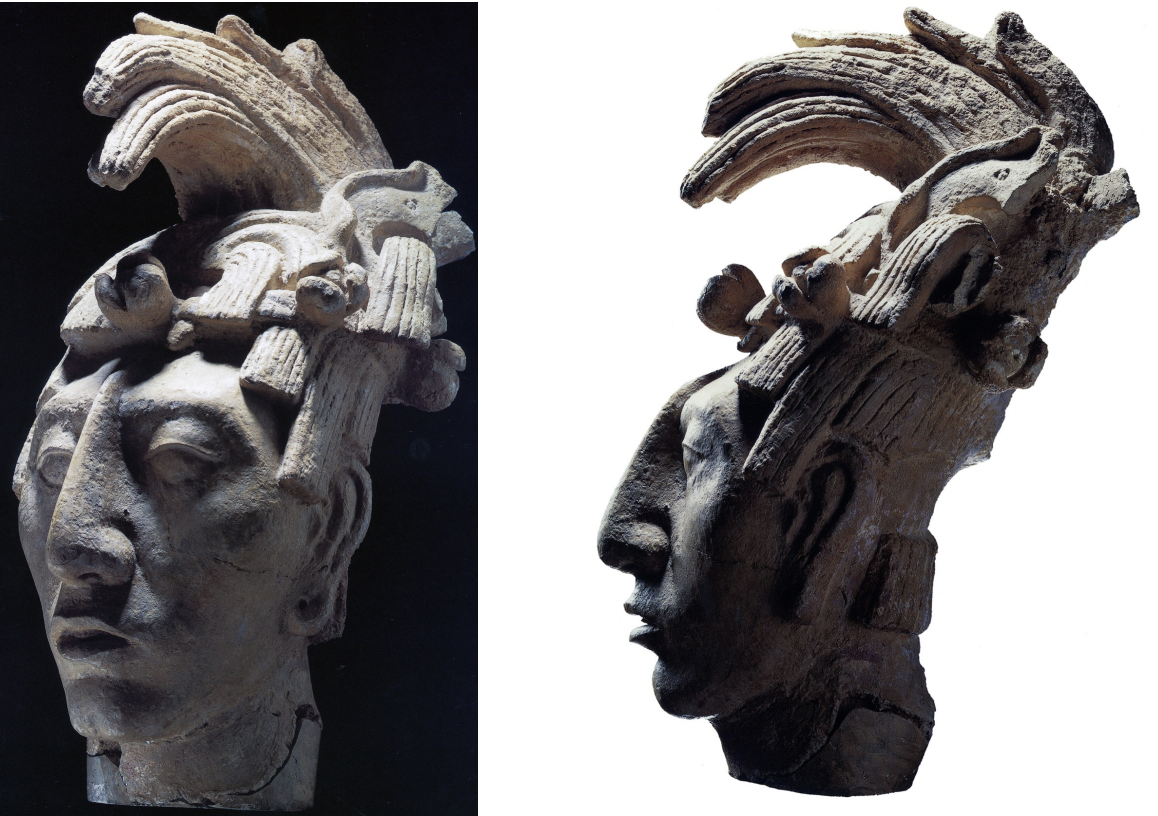
Portrait Head of Pakal from the Temple of Inscriptions at Palenque, c. 683 CE, stucco, h. 16 in
attention to specific physiognomy of Pakal
but also connecting Pakal to maize god (sloping forehead; hair as corn silk; thick neck like corn stalk)

Lintel 24 from Yaxchilán, c. 725 CE, limestone, h. 43 in
carved stone lintels in doorways of royal buildings at Yaxchilan (carving only visible from directly underneath)
A Late Classic Maya carved wooden lintel depicting Lady Xok (Lady Xoc), the wife of ruler Shield Jaguar, performing a bloodletting ritual. It illustrates the importance of royal women and bloodletting ceremonies in Maya religion and rulership.
king standing over her has corn imagery

Cylindrical Vessel, c. 550-900 CE, clay, pigment, slip, h. 9.5 in
dark spot on cheek of one figure and hair on chin of other identifies them as the hero twins
they’re wearing accessories associated with the ball game
ruler depicted in imitation of maya maize god (hair coming off head like corn silk; elongated/sloping forehead imitates corn cob)
exploring ruler’s power through connection to life cycle aka maize god via the ball game
Stela
A tall, upright stone monument carved with Maya rulers, hieroglyphic inscriptions, and important historical events; often erected in plazas.
Popol Vuh
collection of stories recorded in 16th century guatemala that are used to understand the creation story of the Maya (creation of humanity and creation of hero twins are two main stories)
distinct levels of upperworld and underworld
hero twins defeat lord of underworld in ball game which leads to cylindrical cycle of life
maize sustains humanity
Lintel
A horizontal stone beam placed above a doorway, sometimes carved with Maya rulers, rituals, or hieroglyphic texts.