Biology & Biomedical Issues - Exam 2
 Call Kai
 Learn
 Practice Test
 Spaced Repetition
 Match
 Flashcards
 Knowt Play
1/122

There's no tags or description
Looks like no tags are added yet.
123 Terms
What is genetic testing?
A medical test that examines a person's DNA to look for changes or mutations in their genes, chromosomes, or proteins that may be linked to certain diseases or health conditions
What are the different purposes of genetic testing?
Diagnostic: Find the cause of symptoms → “Do I have a disease?”
Predictive/pre-symptomatic: Estimate future disease risk → “Could I have a disease in the future?”
Carrier: Identify gene mutations that could be passed to children
Prenatal: Check for genetic conditions before birth
Newborn screening: Identify conditions early in life
Preimplantation: Test embryos for certain genetic conditions
Pharmacogenomic: a person may need a different medication or dosage because of their genetic makeup
How is a genetic test different from other medical tests
A genetic test analyzes your permanent DNA code to identify inherited changes or risks, whereas traditional medical tests measure temporary, changing bodily states like blood sugar, cholesterol, or infection levels
Carrier status
Has a genetic mutation associated with a disease but usually does not show symptoms of that disease.
- Typically has one mutated copy of a gene and one working copy for autosomal recessive diseases
- Can pass the mutated gene to their children.
- Usually does not have the disease themselves
What is Carrier screening? When might this be done?
A type of genetic test that determines whether a person carries a genetic mutation associated with an inherited disease, even if they do not have symptoms of the disease themselves
Can be done before pregnancy, after pregnancy, or when there is a family history
Afflicted status
Has the genetic disease itself, meaning the genetic changes cause the condition to develop.
- For an autosomal recessive disease, the person typically inherits two mutated copies of the gene.
- May experience symptoms, depending on the disease.
- May pass disease-associated mutations to their children
What is the role of a Genetic Counselor?
A healthcare professional who helps individuals and families understand genetic conditions, genetic testing, and the risk of passing genetic diseases to their children
Non directiveness
A communication approach where the counselor presents balanced, unbiased medical and genetic information without pressuring or coercing the patient toward a specific decision
Prenatal tests conducted during pregnancy
Amniocentesis: A small sample of amniotic fluid surrounding the baby is collected using a thin needle. The fluid contains fetal cells that can be tested for certain genetic and chromosome conditions
Chorionic villus sampling: A small sample of placental tissue is collected and tested for specific genetic conditions or chromosome abnormalities
Prenatal tests before implantation (IVF or other reproductive tech)
Preimplantation genetic testing: Test embryos for selected genetic conditions
What is Pre-implantation testing? Why would someone do this?
A type of genetic testing performed on embryos created through in vitro fertilization (IVF) before an embryo is transferred into the uterus.
People may do this to reduce risk of passing on a disease, identify chromosomal abnormalities
Prenatal ethical concerns
Limited treatment options → A condition is detected, but treatment may be unavailable or limited.
False positive/negatives → A test incorrectly indicates whether a condition is present causing unnecessary stress, false reassurance, or decisions based on inaccurate information
“Perfect baby” → Genetic selection may encourage choosing preferred traits possibly creating discrimination against others, Where should society draw the line between preventing serious disease and selecting preferred traits
Late-onset diseases → Testing reveals a condition that may develop much later in life.
Wrongful birth → Parents claim negligence deprived them of an informed reproductive choice
Wrongful life → A claim made on behalf of a child alleging negligent conduct led to their birth with a serious condition.
General ethical concerns regarding genetic testing
Privacy → Who can see genetic results?
Discrimination → Could genetic information be used unfairly by an employer/insurance company?
Psychological effects → Could results cause emotional distress?
Family implications → Should relatives be informed?
Reproductive choices → How might results affect decisions about having children?
What is population screening?
The process of testing a large group of people, often people who do not have symptoms, to identify those who may have a disease, health condition, or increased risk of developing one
What are examples of population screening?
Newborn screening, blood pressure checks, mammograms, and carrier screening
What are ways to do population screening effectively?
Use an appropriate, accurate test and ensure access to follow-up and treatment.
What are the errors to avoid?
False positives, false negatives, overdiagnosis, poor follow-up, and screening without sufficient evidence of benefit.
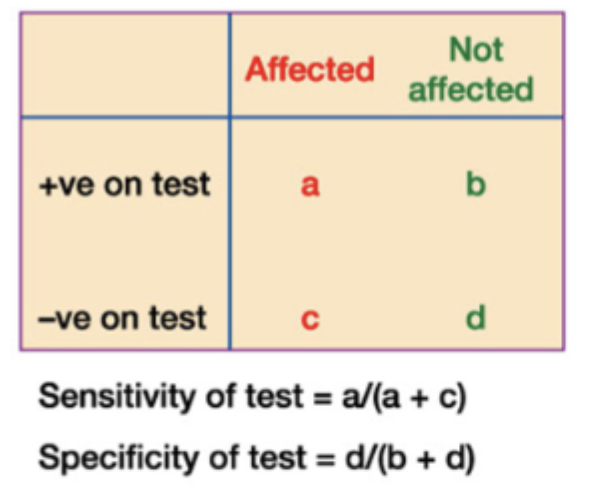
What is Specificity vs. sensitivity in testing?
Sensitivity: How well a test correctly identifies people who have the disease.
You want high sensitivity (fewer false negatives)
Specificity: How well a test correctly identifies people who do not have the disease
You want high specificity (fewer false positives)
How to calculate specificity vs. sensitivity
Sensitivity = True Positive / True positive + False Negative
Specificity = True negative / True negative + False Positive
What is Newborn Screening? When is this done and why?
A group of tests performed on babies shortly after birth to check for certain genetic, metabolic, hormonal, and other medical conditions that may not be obvious when the baby is born
Usually within the first 24–48 hours after birth, depending on the hospital and state requirements
Helps identify conditions that may not cause symptoms immediately but can become dangerous if left untreated
Mandatory screening
Screening that is required by law or an established policy
Usually required, with exceptions depending on the law or policy.
Newborn screening required under state law for certain conditions.
Elective screening
Screening that a person chooses whether or not to undergo.
The individual decides whether to participate
Often aims to assess personal health risks or obtain genetic information
What are the investigational requirements for a new drug/gene therapy?
Clone fully characterized – The gene being used must be thoroughly understood and studied
The gene must be delivered to the appropriate target cells/tissue – Researchers must be able to get the therapeutic gene into the cells that need it.
The gene must be expressed properly in the target cells – The inserted gene must function and produce the needed protein.
The disease must not be treatable by other strategies.
Data available from preliminary studies, human cells – There must be supporting research showing that the treatment has potential.
What are the different stages of Clinical trials? What is the purpose of each stage?
Phase I: Safety → Small group, determines whether the treatment is safe
Phase II: Effectiveness → Tests on a larger group, determines whether the treatment actually works
Phase III: Confirmation → Even larger group, long term, side effects, efficacy, dosing
Phase IV: Available to the public → Goes on the market, post clinical trial, longer term effects
What is gene therapy?
Any procedure intended to treat or alleviate disease by genetically modifying the cells of a patient
Somatic cell gene therapy
Germ line gene therapy
Somatic cell gene therapy
Treats disease symptoms
Non-reproductive body cells, such as those in lung tissue, muscle, or blood
Can still pass down disease to future offspring (non heritable)
What is a vector?
A carrier vehicle—often likened to a microscopic delivery truck—used to transport therapeutic genetic material (such as a healthy gene or gene-editing tool) safely into a patient's target cells
In vivo
A form of somatic gene therapy
Genetic material is transferred directly into cells within a patient
The genetic cargo is packaged inside a vector which navigates the body to find and enter the target cells
Ex vivo
A form of somatic gene therapy
Patient cells are extracted
Modified in a laboratory using the vector
Then reintroduced into the body
What is Kymriah (CAR T-cell therapy)
A type of ex vivo gene therapy
Used to treat certain blood cancers such as leukemia and lymphoma
Takes a patient's own immune cells, genetically modify them so they can recognize cancer cells, and put them back into the patient's body to fight the cancer
How CAR T therapy works
Leukapheresis: Doctors collect the patient's blood and separate out the T cells, which are white blood cells that normally help the immune system fight infections and cancer
Reprograms a patient's T cells to recognize cancer cells more effectively
Reprogrammed Cells: Scientists use an inactive virus (a viral vector) to insert new genetic instructions into the T cells
Expansion: The genetically modified T cells are grown and multiplied in the laboratory to produce enough cancer-fighting cells.
Quality check: Testing occurs before the CAR T cells go back to the patient
Chemo: Lympohodepleting chemo is given to the patient to reduce white blood cells to help the body accept the new reprogrammed CAR T cells
Infusion: CAR T cells are delivered into the patients bloodstream
Cell death: the CAR T cells recognize cancer cells and attach to them leading to cell death

How is the vector used in CAR T cell therapy?
Scientists prepare the gene that contains instructions for making the CAR receptor.
They put that genetic material into a vector.
The vector delivers the genetic material into the patient's T cells.
The T cells use those instructions to produce CAR receptors.
The modified T cells can now recognize and attack cancer cells.
Vector = Delivery truck
How is Kymriah different than the process used for OTC?
Kymriah = Ex vivo (Take cells OUT → Modify OUTSIDE → Put cells BACK IN)
OTC = In vivo (Put the vector INTO the body → Deliver the gene to liver cells → Liver cells produce the enzyme)
Germ line cell gene therapy
Defective genes replaces in germ cells
Reproductive cells (sperm or egg cells) or early-stage embryos
The genetic modifications can be passed down (heritable)
What are the reasons for not doing germ-line?
Most researchers agree that it should not be done in humans
Concerns:
– Risk to future generations
– Reduction of genetic diversity
– Not necessary
– Current technology not ready
Are there other better options available than modifying embryos?
Preimplantation Genetic Testing (PGT)
Third party gametes (donated sperm/eggs)
Somatic gene therapy
What are some of the difficulties with gene therapy?
Getting the gene to the correct cells
The body's immune system may recognize the viral vector as foreign and attack it
Gene inserts into an unintended DNA location
High cost
Unknown or delayed side effects
What makes gene therapy so expensive?
Can cost between $1 million and over $3 million per dose
Massive research investments
Tiny patient populations
Complex, manual manufacturing processes
What is a genetically modified organism?
Any plant, animal, or microorganism whose genetic material (DNA) has been deliberately changed in a laboratory using modern biotechnology or genetic engineering
What is recombinant DNA?
DNA that has been created by combining genetic material from two or more different sources
What is recombinant protein?
A protein produced by a cell (such as a bacterial or yeast cell) that has been genetically modified to contain DNA instructions for making that protein
Produced by using recombinant DNA
How does cloning in bacteria work to make a lot of a product (protein) of interest?
Isolate DNA from 2 sources
Cut both DNAs with the same restriction enzyme
Mix the DNA together
DNA ligase connects the DNA
Put recombinant plasmid into bacterial cell
Bacteria multiply
Identify the bacteria and collect the protein.

Isolate DNA from 2 sources
Scientists collect two things:
A bacterial plasmid (a small, circular piece of DNA found in bacteria).
The donor DNA containing the gene that makes the desired protein.
Think of the plasmid as an empty ring that will carry the new gene.
Cut both DNAs with the same restriction enzyme
Scientists use special enzymes called restriction enzymes to cut the plasmid and the donor DNA.
This creates matching ends so the pieces can fit together, almost like puzzle pieces.
Mix the DNA together.
The desired gene joins with the bacterial plasmid because their matching ends pair together.
Now the plasmid contains the new gene!
DNA ligase connects the DNA
An enzyme called DNA ligase seals the pieces together, creating a complete circular DNA molecule.
This new DNA is called recombinant DNA because it combines DNA from two different sources
Put the recombinant plasmid into a bacterial cell
Scientists insert the new plasmid into a bacterium.
The bacterium now carries the gene that tells it how to make the desired protein.
Bacteria multiply (make clones)
The bacteria reproduce by dividing.
As they multiply, they make copies of the recombinant plasmid, meaning there are many copies of the desired gene.
Identify the bacteria and collect the protein
Scientists identify the bacteria that contain the desired gene.
They then grow the bacteria and collect the protein they produce.
What is the vector for modifying bacteria?
A plasmid
A vector is the carrier that delivers new genetic material
The plasmid carries the new desired gene
What is rBGH?
A genetically engineered hormone given to dairy cows to increase the amount of milk they produce
How is rBGH made?
Use genetically engineered bacteria
Scientists take the gene responsible for producing bovine growth hormone from cow DNA
They insert that gene into bacterial DNA (specifically, a plasmid)
The genetically engineered bacteria produce the bovine growth hormone
Scientists collect the hormone and inject it into dairy cows
The hormone stimulates the cows to produce more milk
Why do we have rBGH ?
Cows naturally produce BGH
If they had more BGH, they would produce more milk
Scientists manufacture more of this hormone which is then called rBGH to differentiate from the natural BGH
Farmers inject additional rBGH into dairy cows so they produce more milk
What is a transgenic organism?
An organism that contains a gene from another organism
contains foreign DNA
GMO vs Transgenic organism
GMO: An organism whose genetic material has been altered
Trangenic: An organism that contains a gene from another organism
All transgenic organisms are genetically modified, but not all genetically modified organisms are transgenic (since it could be your own DNA altered, not something foreign)
What is pharming?
A process where scientists genetically modify plants or animals to produce useful medical proteins.
Instead of using bacteria, scientists use plants or animals as biological factories
farming + pharmaceuticals
Why can’t all recombinant proteins be made in bacteria?
Bacteria are too simple to make certain complex proteins correctly
Instead, scientists use genetically modified plants or animals (pharming)
How was the tomato modified to reduce/slow ripening? How is this a genetic modification?
Pectinase causes ripening in tomatoes and other produce
A gene inserted into tomatoes that prevents pectinase mRNA translation slows ripening
They used genetic engineering to introduce an extra gene that blocked or reduced the production of pectinase
What is anti-pectinase gene?
An engineered, reverse-orientation gene introduced into plants to suppress the production of pectinase enzymes
By blocking this breakdown, the anti-pectinase gene effectively slows down fruit softening, extending shelf life and preventing rapid rotting
Why would a farmer want a plant that has the Bt gene? How does it change how they grow their crop?
It makes the plants resistant to certain insect pests
Plants can protect themselves
Fewer insecticides
Results in better yields
Bt crops still require monitoring and pest management because insects can develop resistance over time
Why would a farmer want to grow Roundup Ready soybeans? How does it change how they grow their crop?
They are genetically modified to survive being sprayed with Roundup, a weed-killing herbicide.
Allows farmers to kill weeds without killing their soybean crops
Farmers can control weeds more easily and efficiently.
Repeated glyphosate use can cause weeds to develop resistance
What are some example plant modifications that are beneficial for the consumer and not just the producer?
Modifications that make food healthier
Golden rice → More vitamin A
Purple tomato → High antioxidants
What agency decides which bioengineered foods need to be labeled?
The USDA (United States Department of Agriculture)
oversees the National Bioengineered Food Disclosure Standard and determines which foods fall under the bioengineered food labeling requirements.
What are 4 reasons that genetically modified animals are made?
Animal “enhancement”
Research
Pharmaceuticals
Xenotransplants
What is Xenotransplantation?
The process of transferring or transplanting living cells, tissues, or organs from one species into another
Scientists genetically modify pigs so their organs are more compatible with the human body.
A pig's heart or kidney may then be transplanted into a human.
Genetic modifications help reduce the chance that the human immune system will reject the animal organ
What is a benefit to having a recombinant protein expressed in chicken egg whites or goat milk?
Provide an easy way to collect and harvest large amounts of recombinant proteins
Scientists genetically modify a chicken or goat by inserting a gene that contains instructions for making a specific human protein.
The animal produces that protein in its egg whites or milk.
Scientists collect the eggs or milk and extract and purify the protein.
The purified protein can then be used to make medicine.
What is the process for getting the recombinant protein to be expressed in your animal of choice for pharming?
Identify the gene
Attach the gene to a promoter
A promoter is a DNA sequence that acts like an on/off switch, controlling when and where the gene is expressed
Insert the gene into the animal's DNA
Create a transgenic animal
Collect protein
Purify the protein
Why was the Atlantic salmon modified? If you eat salmon at a restaurant, would you know if it was AquaAdvantage salmon?
To grow faster than conventional farm-raised Atlantic salmon
Restaurants are exempt from the federal bioengineered food labeling requirement
What are the functions of blood?
Transportation
Protection
Regulation
Clotting
Functions of blood: Transportation
Blood carries important substances throughout the body.
- Oxygen: Carries oxygen from the lungs to body cells.
- Nutrients: Delivers nutrients from food to cells.
- Waste: Carries carbon dioxide and other wastes to organs that remove them.
- Hormones: Transports hormones to different parts of the body.
Functions of blood: Regulation
Blood helps keep the body balanced.
Regulates body temperature.
Maintains proper pH (acid-base balance).
Maintains fluid balance in the body
Functions of blood: Protection
Blood protects the body from infections and diseases.
White blood cells fight bacteria, viruses, and other harmful organisms.
Antibodies help recognize and destroy harmful substances.
Functions of blood: Clotting
Blood prevents excessive blood loss when you get injured.
Platelets gather at the injury.
Clotting proteins help form a blood clot.
The clot seals the wound and helps stop bleeding.
What are the three major components of blood?
Plasma → Trasports substances
Formed elements
Red blood cells (erythrocytes)
White blood cells (leukocytes)
Platelets are also a major component of blood. They help blood clot and stop bleeding
How does plasma help to maintain homeostasis of the body?
Helps keep the body functioning properly by balancing temperature, water, pH, and important substances
distributes heat throughout the body, helping maintain a stable temperature
contains substances called buffers that help keep blood from becoming too acidic or too basic
carries nutrients, hormones, electrolytes, and waste products throughout the body
Where in the body are blood cells (formed elements) produced?
Red bone marrow
Hematopoiesis
The process of producing blood cells
Ensures your body constantly replaces old or dying blood cells with new ones
What are the formed elements of the blood?
Red blood cells (Erythrocytes)
White blood cells (Leukocytes)
Platelets (Thrombocytes)
Red blood cells (Erythrocytes)
Carry oxygen from the lungs to the rest of the body.
Carry some carbon dioxide from body tissues back to the lungs.
Contain a protein called hemoglobin, which binds to oxygen.
White blood cells (Leukocytes)
Protect the body against infections and diseases.
Fight bacteria, viruses, and other foreign invaders.
Help the immune system defend the body.
Platelets (Thrombocytes)
Help blood clot when a blood vessel is damaged.
Gather at an injury to form a platelet plug.
Help stop bleeding and prevent excessive blood loss.
What carries oxygen in the blood? What protein is key to the process?
Red blood cells
They use hemoglobin to pick up and carry oxygen
Oxyhemoglobin
Oxygen is attached
Forms when blood picks up oxygen in the lungs
Carries oxygen to body tissues
Deoxyhemoglobin
Without oxygen attached
Forms after oxygen is released to body tissues.
Travels back toward the lungs to pick up more oxygen.
Why does malaria cause anemia?
The parasite infects and destroys red blood cells.
A malaria parasite enters the bloodstream.
The parasite infects red blood cells and reproduces inside them.
The infected red blood cells burst, releasing more parasites.
This destroys red blood cells, reducing the amount of hemoglobin in the blood.
How is malaria transmitted?
Through the bite of an infected female mosquito
The mosquito bites a person and injects malaria parasites into their bloodstream.
The parasites travel to the liver and multiply.
They eventually enter red blood cells, where they continue multiplying.
The mosquito is the vector since they carry and transmit the disease
Who is the universal donor?
O-negative
Its red blood cells do not have A, B, or Rh antigens on their surface.
This means it can donate red blood cells to all eight common blood types.
Who is the universal recipient?
AB positive
People with AB+ blood have A, B, and Rh antigens.
They do not have anti-A or anti-B antibodies, so they can receive red blood cells from all eight common blood types
What happens if you receive an incorrect blood transfusion?
Your immune system recognizes the donated red blood cells as foreign and attacks them
Can cause a transfusion reaction
Antibodies attack the incompatible red blood cells.
Red blood cells clump together (agglutination).
Red blood cells can burst open (hemolysis).
This can cause kidney damage, shock, organ failure, and potentially death
An Rh- women is pregnant. Why would they give her a RhoGAM shot towards the end of her pregnancy?
To prevent her immune system from attacking her baby's red blood cells if the baby is Rh-positive (Rh+).
The mother has Rh-negative blood, meaning her red blood cells do not have the Rh antigen.
The baby may have Rh-positive blood, meaning the baby's red blood cells have the Rh antigen.
During pregnancy or delivery, some of the baby's blood can enter the mother's bloodstream.
The mother's immune system may recognize the baby's Rh-positive blood cells as foreign and create antibodies against them.
These antibodies could attack the red blood cells of a future Rh-positive baby, causing anemia and other serious complications
What does the RhoGAM shot do?
Prevents the mother's immune system from making antibodies against Rh-positive blood cells.
Helps protect the current and future pregnancies.
Is commonly given around 28 weeks of pregnancy and again within 72 hours after delivery if the baby is Rh-positive.
What are the two stages that occur when a blood clot (coagulation) is formed?
Formation of a platelet plug
Formation of a fibrin clot
Caused by a damage to a blood vessel
Formation of a platelet plug
A blood vessel gets damaged or injured.
The damaged blood vessel releases signals that activate platelets.
Platelets stick to the damaged area and to one another.
They form a temporary platelet plug to help stop bleeding.
Formation of a fibrin clot
A series of chemical reactions activates clotting proteins (clotting factors) in the blood.
These reactions produce an enzyme called thrombin.
Thrombin converts a protein called fibrinogen into fibrin.
Fibrin forms a mesh-like network around the platelet plug.
This strengthens and stabilizes the clot, helping stop bleeding
What diseases interfere with blood clotting?
Hemophilia → a genetic disease that due to mutations in one of the
genes encoding the clotting factors, thus the fibrin clot is not formed
Blood does not clot properly
People may bleed longer than normal
Thrombocytopenia → a person has an abnormally low number of platelets in their blood
Platelets help form the platelet plug during blood clotting so without platelets, the body struggles to form clots to prevent excess bleeding
What is the cardiovascular system composed of?
Heart → pumps blood throughout the body
Blood vessels → Tubes that carry blood throughout the body
Blood → transports oxygen, nutrients, hormones, and waste products throughout the body
Types of Blood Vessels
Arteries
Arterioles
Veins
Venules
Capillaries
Capillary bed
Arteries
Large blood vessels that carry blood away from the heart and toward the body's organs and tissues
They usually carry oxygen-rich blood
Have thick, strong, elastic walls
Arterioles
Smaller branches of arteries that carry blood from the arteries to the capillaries
They help control how much blood flows into the capillaries
Capillaries
Extremely tiny blood vessels with very thin walls.
They allow oxygen, nutrients, and waste products to be exchanged between the blood and body tissues