20: Membrane Transport
 Call Kai
 Learn
 Practice Test
 Spaced Repetition
 Match
 Flashcards
 Knowt Play
1/167

There's no tags or description
Looks like no tags are added yet.
168 Terms
Why do biological membranes require transport mechanisms?
They act as barriers, but cells still need specific substances to cross them.
What must be transported through membranes?
Ions (Na +, K+, Ca 2+, Cl - )
Metabolites
Amino acids
Sugars
Nucleotides
Why is ion transport important for neurotransmission?
Ion movement across membranes contributes to the electrical changes involved in nerve signaling
What is endocytosis?
The process by which a cell takes in larger substances by enclosing them in a membrane-derived vesicle.e4
What does transport across a membrane thermodynamically resemble?
Chemical equilibration, in which substances tend to move toward equilibrium.
What creates a chemical potential difference across a membrane?
A difference in the concentration of a substance on the two sides
What creates an electrical potential difference across a membrane?
A difference in electrical charge between the two sides.
What two factors influence the movement of ions across membranes?
The concentration difference and the electrical potential difference.
What equation calculates the chemical free-energy change of transporting a substance across a membrane?
ΔG = RTln ([A]in/[A]out)
If outside concentration is greater than inside concentration, what is the ΔG for moving A inside?
Negative, because the concentration ratio is less than 1.
If inside concentration is greater than outside concentration, what is the ΔG for moving A inside?
Positive, because the concentration ratio is greater than 1.
What is membrane potential?
The electrical potential difference between the inside and outside of a cell.
How is membrane potential defined?
∆Ψ= (potential inside the cell) – (potential outside the cell)
What does a negative membrane potential indicate?
The inside of the cell is more electrically negative than the outside.
Which cellular region is considered the inside when calculating membrane potential?
The cytosol.
How do you calculate the energy required to transport multiple identical ions?
Calculate the energy for one ion and multiply by the number of ions transported.899
What is electrochemical potential?
The combined influence of chemical and electrical potential on the movement of an ion.
What is the equation for electrochemical free-energy change?
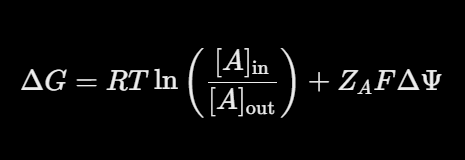
What does ZA represent?
The electrical charge of the ion being transported
ZA of Na:
+1
ZA of Cl:
-1
ZA of Ca:
+2
What is Faraday's constant?
Approximately 96.485 kJ V⁻¹ mol⁻¹
Why must the charge of an ion be included in the electrical term?
Because positive and negative ions respond differently to an electrical potential difference!!!
How is electrochemical potential written using source and destination?
Another way to think of the chemical potential formula!
Source: The location where the substance starts/where it’s coming from.
Destination: The location where the substance is going.

What are the two broad categories of membrane transport?
Non-mediated transport and mediated transport.
What is non-mediated transport?
Simple diffusion across a membrane without a specific transport protein

What two factors influence the rate of non-mediated diffusion?
The concentration gradient and the substance's solubility in the membrane's nonpolar core
What substances are listed as examples of molecules that diffuse readily through a membrane?
Water, oxygen, and steroids.
What is mediated transport?
Transport across a membrane with the assistance of specific carrier or transport proteins.
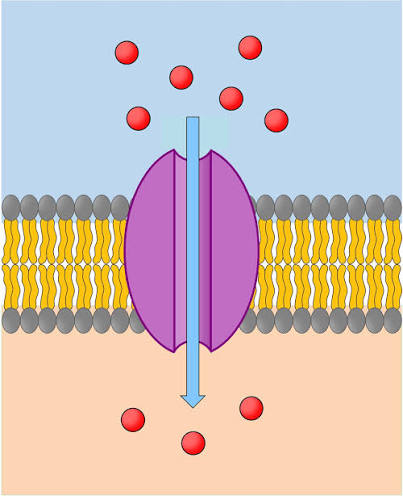
What is passive-mediated transport (facilitated diffusion)?
Passive, protein-assisted transport from high concentration to low concentration, with its concentration gradient
What is active transport?
A specific molecule is transported from low concentration to high concentration, against its concentration gradient in an endergonic process (ΔG > 0).
Unfavorable, so it must be coupled with a thermodynamically favored reaction process

What are the two categories of mediated transport?
Passive-mediated transport (facilitated diffusion) and active transport.
How can a cell make an endergonic, unfavorable transport process occur, like active transport?
By coupling it to a favorable, energy-releasing (exergonic) process.
What five types of transport systems are listed for passive-mediated transport?
Ionophores
Porins
Ion Channels
Aquaporins
Transport proteins
What are ionophores?
Organic molecules that help ions cross biological membranes.
What is the typical origin of ionophores?
They are usually of bacterial origin
What are the two categories of ionophores?
Carrier ionophores and channel-forming ionophores.
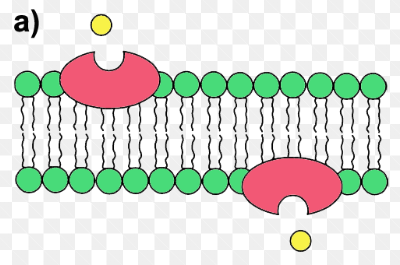
How does a carrier ionophore transport an ion?
It binds the ion, diffuses across the membrane while carrying it, and releases it on the other side
What is valinomycin?
A carrier ionophore that transports K⁺ across membranes.
Approximately how many K⁺ ions can valinomycin transport per second?
Approximately 104, or 10,000, ions per second.
Why is valinomycin selective for K⁺ over Na⁺?
Its octahedral coordination site is optimized for potassium's ionic radius.
How much greater is valinomycin's binding preference for K⁺ than for Na⁺?
Approximately 10,000-fold.
What are channel-forming ionophores?
Molecules that form transmembrane channels so ions can diffuse

What is an example of a channel-forming ionophore?
Gramicidin
What types of ions can pass through gramicidin?
Most monovalent cations
Charge magnitude of 1
What types of ions does gramicidin discriminate against?
Divalent cations and anions.
Charge magnitude of 2
What are porins?
Simple membrane transport proteins that form pores for solute passage.

What is the characteristic structure of a porin?
A β-barrel.
A barrel-shaped protein structure formed by beta strand

What is the maximum solute molecular weight for porins?
Approximately 600 Da.
Where are porins found?
In the outer membranes of bacteria, mitochondria, and chloroplasts.
What determines which substances can pass through a porin?
The pore's size and the amino acid residues lining its wall.
Are porins normally open or gated?
They are always open.
In which directions can substances travel through porins?
In either direction, depending on the relevant gradient.
What is OmpF?
A porin from E. coli that forms a trimer and allows water, ions, glucose, and other nutrients, as well as waste products, to pass.
What is Maltodextrin?
A carbohydrate made of glucose units linked together.
What is Maltoporin?
A porin that permits certain maltodextrin-related molecules to pass through.
What two factors determine the selectivity of maltoporin?
The size and shape of the molecule and its chemical interactions with pore-lining residues
What role does Tyr118 play in maltoporin?
It acts as a steric barrier that restricts which molecular shapes can pass.
Only permits near-planar molecules to pass
How do aromatic residues of maltoporin interact with maltodextrin?
They form stacking interactions with its hydrophobic face by forming hydrogen bonds with maltodextrin's hydroxyl groups.
What is the relationship between maltodextrin and maltoporin?
Maltodextrin is the carbohydrate being transported, while maltoporin is the outer membrane channel that facilitates its entry.

What is the structure of Maltodextrin?
α (1—>4) linked glucose oligosaccharide degradation product of starch
What is the general function of an ion channel?
It provides a pathway for rapid ion movement across a membrane.
Which ions are listed as examples that pass through ion channels?
Na⁺, K⁺, and Cl⁻.
What three functions are ion channels essential for?
Osmotic balance, signal transduction, and changes in membrane potential.
What is a selectively filtered ion channel?
A channel that permits particular ions to pass while restricting others
Ex: KcsA K⁺ channel.
What is a gated ion channel?
A channel that opens or closes in response to a stimulus
What are the typical extracellular and cytoplasmic Na⁺ concentrations?
150 mM extracellularly and 12 mM in the cytoplasm
ION CONCENTRATIONS MUST BE MAINTAINED IN A CELL
What are the typical extracellular and cytoplasmic K⁺ concentrations?
4 mM extracellularly and 140 mM in the cytoplasm
ION CONCENTRATIONS MUST BE MAINTAINED IN A CELL
How selective is a K⁺ channel for K⁺ compared with Na⁺?
It is approximately 10,000 times more permeable to K⁺.
ION CHANNELS ARE SPECIFIC FOR PARTICULAR IONS!
What is the approximate diffusion-limited rate of K⁺ movement through a K⁺ channel?
108 ions per second
ION CHANNELS ARE SPECIFIC FOR PARTICULAR IONS!
What does homotetramer mean?
A protein complex consisting of four identical subunits.
Ex: KcsA K+ channel

How many transmembrane helices does each KcsA subunit contain?
Two, which form a channel pore
What lines the entrance to the internal KcsA pore?
Four negatively charged, or anionic, side chains.
ATTRACTS K+
What is the function of a potassium channel's selectivity filter, TVGYG?
It determines which ions can pass through the channel.
What is the TVGYG signature motif associated with?
The selectivity filter of the K⁺ channel
What part of the selectivity filter coordinates dehydrated K⁺?
Carbonyl groups
What does it mean for K⁺ to be dehydrated?
It has shed the water molecules that normally surround it.
Shed its “hydration shell”
Why must K⁺ shed its hydration shell to enter the selectivity filter?
The filter is narrow, so the ion must lose its surrounding water molecules to fit.
How do carbonyl groups help K⁺ pass through the selectivity filter?
They interact with and coordinate the dehydrated potassium ion.
Process of K+ entering the selectivity filter, TVGYG:
To enter the narrow selectivity filter, potassium must lose some of these surrounding water molecules.
The carbonyl groups in the filter then interact with the potassium ion, helping compensate for the loss of its hydration shell.

What is gating in ion channels?
The regulated opening and closing of an ion channel in response to a stimulus.
What is the typical state of a gated ion channel before stimulation?
It is normally closed.
Four examples of stimuli that can open a gated channel:
Mechanosensitivity
Ligand-gated
Signal-gated
Voltage gated
What is mechanosensitivity?
The ability of a channel to respond to physical stimuli such as touch, sound, or pressure.
What causes a ligand-gated channel to open?
Binding of a specific ligand, such as a neurotransmitter.
What are signal-gated ion channels?
They are channels that open due to the binding of a signaling molecule, like Ca2+
What causes voltage-gated channels to open or close?
Changed in membrane potential
What are aquaporins?
Membrane proteins that facilitate the rapid movement of water across membranes.
What observation suggested that a protein was responsible for rapid water transport?
Water transport in certain cells was inhibited by the addition of mercury.
Who discovered aquaporins, and when?
Peter Agre in 1992.
Approximately how many water molecules can an aquaporin transport per second?
3 × 10⁹ water molecules per second
How many aquaporins does the mammal have?
11
What mammalian organs are locations where aquaporins are found?
The kidneys, liver, and eye.
Why are aquaporins important if water can already diffuse across membranes?
They provide pathways that allow water to move at much higher rates
What is AQP1?
A specific aquaporin that facilitates rapid water transport across membranes.
What is the structure of APQ1?
It is a homotetrameric glycoprotein with 8 alpha helices and has an hourglass shape
What is a glycoprotein?
A protein with carbohydrate groups attached.

What is the constriction region?
The narrow region of the aquaporin channel through which water passes.
Which groups are identified as forming hydrogen bonds with water in AQP1?
Arginine (Arg), lysine (Lys), and carbonyl groups.
Form H-bonds with water, helping guide water through the channel