Chapter 12 Geological Time
 Call Kai
 Learn
 Practice Test
 Spaced Repetition
 Match
 Flashcards
 Knowt Play
1/50

There's no tags or description
Looks like no tags are added yet.
51 Terms
Which principle or law of geology states that in a sequence of undeformed sedimentary rocks, each bed is older than the one above?
law of "superposition"
- In a section of flat-lying sedimentary rocks, the law of superposition states that the oldest rocks are found at the bottom of the section and the rocks become increasingly younger as you move toward Earth's surface. This happens because the rocks at the base must have been there prior to the deposition of the rocks above them.

What term describes an erosional surface bounded above by flat-lying sedimentary rocks and below by igneous or metamorphic rocks?
nonconformity
- When older igneous and/or metamorphic rocks are eroded and then covered by flat-lying sedimentary rocks, the resulting feature is known as a nonconformity.

The fact that sedimentary rocks are almost always deposited in a horizontal position reflects which law or principle of geology?
original horizontality
- Unless the beds have been tilted during a tectonic event or were deposited as cross-stratification, the principle of original horizontality confirms that sedimentary rocks are almost always deposited in a horizontal position.

While working in the field, you encounter an outcrop in which sandstone, shale, and limestone have been intruded by a basaltic dike. You know that the basaltic dike is younger than the sedimentary rock by applying which law or principle?
the principle of cross-cutting relationships
- Because the basaltic dike cuts across the sedimentary rocks, the principle of cross-cutting relationships can be used determine that the relative age of the dike must be younger than that of the sedimentary rock it cuts.

In the field you encounter a sequence of sedimentary rocks that has a dike running through them. A normal fault crosses the entire sequence, cutting off part of the dike near the surface. Which scenario best describes your observations? (All scenarios list events from oldest to youngest.)
The relative ages of the sequence are as follows: sedimentary rocks > dike > normal fault.
- Applying the principle of cross-cutting relationships to this outcrop, the sedimentary rocks must be the first event in the sequence. The dike could then be intruded into the sedimentary rocks and finally the dike and surrounding rocks could be cut by the normal fault.
How is the atomic number of an atom determined?
counting the number of protons in the nucleus

Which material, principle, or process enables a method of numerical dating?
radioactivity
- Using the decay rates of various radioactive elements, you can determine a numerical age for minerals in igneous rocks. The resulting date is called a "radiometric age."

Which represents the correct sequence from oldest to most recent or current eras on the Geologic Time Scale?
Paleozoic, Mesozoic, Cenozoic
- On the Geologic Time Scale, the Paleozoic represents the oldest era and includes organisms that are least similar to those seen today. It is followed by the Mesozoic and then the Cenozoic.
Which eon translates to "visible life" from the Greek?
Phanerozoic
- Phanerozoic means "visible life" when translated from Greek. The Phanerozoic represents the last 542 million years of geologic time and contains abundant fossils with hard skeletal parts.
Which is the shortest interval of geologic time?
epoch
- Of epochs, periods, eras, and eons, epochs are the smallest intervals of geologic time. The spelling of "epoch" (e before p) might help you remember this relationship.
The subdivisions of the Geologic Time Scale were based on which criteria or characteristics?
types of fossils within the units
- The units on the Geologic Time Scale were defined using the first occurrence and last appearance of different kinds of organisms.
Which event is generally used to indicate the beginning of the Phanerozoic eon?
widespread occurrence of hard parts
- The widespread occurrence of hard external and internal skeletons in organisms, and consequently the better probability of their preservation as fossils, defines the beginning of the Phanerozoic 542 million years ago.
While working in the field, you find some sedimentary rocks that include hundreds of fossils of crinoids, numerous brachiopods, and a few trilobites. Realizing that these ancient organisms are some of the first with hard parts, and (when taken as a group) are not very similar to animal communities living today, in which unit of geologic time would you place these rocks?
the Paleozoic
What is the best definition of fossil range?
The period of time when an organism first and last appears in the sedimentary record.
Which of the following characteristics is the most desirable for constraining the relative age of rocks?
organisms with overlapping ranges and geologically short lifespans
If a rock contains ten different kinds of fossils, which of the following must be true?
All of the organisms had to be alive when the rock was deposited.
How is the geologic time scale related to the fossil record?
The periods of the time scale were constructed based on ranges of fossil organisms.
What is numerical dating?
is specifying the actual number of years that have passed since an event occurred (known as absolute age dating)
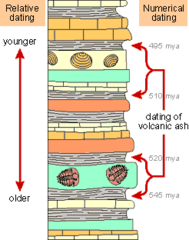
What is relative dating?
placing rocks and events in their proper sequence of formation, but can't tell us how long ago something took place.

What is a fossil?
the remains or traces of prehistoric life
Conditions favoring preservation of fossils? (2)
Rapid burial & Possession of hard parts
Types of Fossils? (3)
1) The remains of relatively recent organisms - teeth, bones, etc.
2) Entire animals, flesh included
3) Given enough time, remains may be
petrified (literally "turned into stone")
Explain how rocks of similar age that are in different places can be matched up?
Matching of rocks of similar ages in different regions is known as "correlation".
Correlation often relies upon fossils - Principle of fossil succession - fossil organisms succeed one another in a definite and determinable order, and therefore any time period can be recognized by its fossil content.
What are the 3 types of radioactive decay?
1) Alpha emission - Emission of 2 protons and 2 neutrons
(an alpha particle). Mass number is reduced by 4 and the
atomic number is lowered by 2
2) Beta emission - An electron (beta particle) is ejected from the nucleus. Mass number remains unchanged and the
atomic number increases by 1
3) Electron capture - An electron is captured by the nucleus. The electron combines with a proton to form a neutron. Mass number remains unchanged and the
atomic number decreases by 1.
Explain how radioactive isotopes are used to determine numerical dates?
the spontaneous breaking apart (decay) of certain unstable atomic nuclei. When the half-life of the isotope is known and the parent/daughter ratio can be measured the age can be calculated.
Distinguish among the 4 basic time units that make up the geologic time scale and explain why the time scale is considered to be a dynamic tool?
1) eons - the greatest expanse of time
2) eras - subdivision of an eon
3) periods
4) epochs - shortest
Dynamic tool because:
- geologic events by themselves have little meaning until they're put in a time perspective
- helps to figure out the complexities of the past
- helped geologists to realize that the Earth is much older than anyone had previously imagined and that its surface and interior have been changed over and over again by the same geological processes that operate today
Explain how reliable numerical dates are determined for layers of sedimentary rock?
not all rocks can be dated radiometrically. A sedimentary rock may contain particles of many ages that have been weathered from different rocks that formed at various times.
What are the two types of dates used to interpret Earth's history?
1) Relative age dates - placing rocks and
events in their proper sequence of
formation
2) Numerical dates - specifying the actual
number of years that have passed
since an event occurred (known as
absolute age dating)
What are the laws, principles, and techniques used to establish relative dates?
law of superposition, the principle of original horizontality, the principle of cross-cutting relationships, inclusions and unconformities.
What are fossils and how are they formed?
a fossil is the remains or traces of prehistoric life.
Rapid burial
Possession of hard parts
The remains of relatively recent
organisms - teeth, bones, etc.
• Entire animals, flesh included
• Given enough time, remains may be
petrified (literally "turned into stone")
What make a good index fossil?
Unique Shape
Widespread
Extinction
Widespread geographically
Limited to short span of geologic time
How are fossils used to correlate different rock layers?
Matching of rocks of similar ages in different regions is known as correlation.
• Correlation often relies upon fossils
- William Smith (late1700s-early 1800s) noted
that sedimentary strata in widely separated
areas could be identified and correlated by
their distinctive fossil content
Correlation often relies upon fossils:
- Principle of fossil succession - fossil organisms succeed one another in a definite and determinable order, and therefore any time period can be recognized by its fossil content.
What is radioactivity and how is it used for geologic dating?
Radioactivity is spontaneous changes (decay) in the structure of atomic nuclei.
Radiometric dating is a complex procedure that requires precise measurement. Rocks from several localities have been dated at more than 3 billion years. Confirms the idea that geologic time is immense.
What is the geologic timescale and what are the principal divisions?
a "calendar" of Earth history
• Subdivides geologic history into units
• Originally created using relative dates
Divides earth's history into units of varying magnitude and presented in chart form. Eons include the Archean, Proterozoic (together called Precambrian) and the Phanerozoic (divided into eras: Paleozoic, Mesozoic and Cenozoic).
Why is it difficult to assign reliable absolute dates to sedimentary rocks?
not all rocks can be dated radiometrically. A sedimentary rock may contain particles of many ages that have been weathered from different rocks that formed at various times.
What are the three ideas that geologists use to study Earth?
(1) The rock record provides evidence of past geological events and life forms.
(2) Processes in the present acted in the past
(3) Earth is very old and has changed over time
Uniformitarianism
concept that processes that have shaped Earth in the past are essentially the same as those operating today
unconformity
A break in the geologic record created when rock layers are eroded or when sediment is not deposited for a long period of time.
Nonconformity
A type of unconformity in which layered sedimentary rocks lie on an erosion surface cut into igneous or metamorphic rocks
angular unconformity
where horizontally parallel strata of sedimentary rock are deposited on tilted and eroded layers, producing an angular discordance with the overlying horizontal layers
Fossils form
when living things die and are THEN QUICKLY buried by sediment sediments
types of rocks are most likely to form fossils
sedimentary
Unaltered remains fossil
unaltered remains fossils e.g. insects trapped in amber or mummified remains
Altered remains fossil
chemically altered fossils e.g. petrified wood, carbonized remains in rock
cast
A type of fossil that forms when a mold becomes filled in with minerals that then harden
trace fossil
a fossil of a footprint, trail, burrow, or other trace of an animal rather than of the animal itself.
2 important factors that determine if an organism will be a fossil
rapid burial and the possession of hard parts
index fossil
index fossils are widespread geographically, are limited to a short span of geologic time, and occur in large numbers (During a specific time, specific fossils are found.)
fossil secession
That fossil organisms succeed one another in a definite and determinable order. (index fossil occurs)
What happens to the nuclei in a radioactive substance
It produces a daughter nucleus which is a different substance
half-life
The time required for one half of the atoms of a radioisotope to emit radiation an decay products to a stable isotope.