DeSaegher Energy Phase 1
 Call Kai
 Learn
 Practice Test
 Spaced Repetition
 Match
 Flashcards
 Knowt Play
1/37

Earn XP
Description and Tags
General Flow, Process Overview, and other info
38 Terms

How many digesters are in phase 1, and where does the manure for each come from?
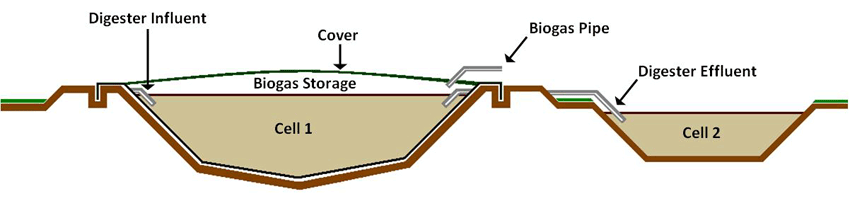
Digester 1 - Home Farm
Digester 2 - Milkstar

What is added to the manure as it enters sand separation and why?
Recycled water is added to the manure to thin it out and separate the manure from the sand (the goal is 6.5 - 8% total solids).
What are the two main goals of sand separation?
Sand separation is designed to separate the sand from the cow manure, and get said manure to a desired consistency that produces the most gas in the digester while still operating efficiently.


What liquid is added to the manure after the sand is separated and why?
Ferric Chloride (FeCl3) is methodically dosed to reduce Hydrogen Sulfide (H2S).

What are the "bugs" in the digesters referred to as?
Methanogens


What are the goals of the jet pumps in the process building?
To pull digestate out of the digesters and pump it back to keep everything mixing while also chopping up fiber (the digesters have no mixers inside the tanks).
Water is also added via the water lines by the jet pumps to help protect the pump from manure by keeping the chopping blades clean and manure out of the seal.

What is the purpose of the effluent pumps in the process building?
The effluent pumps separate some of the manure from the pipe carrying digestate to the jet pumps (while also continuing to chop up and homogenize the digestate) to be either sent to the phase 1 covered lagoon or to the sludge pumps.

What is the purpose of the sludge pumps in the process building?
The sludge pumps receive manure from the effluent pumps so it can be pumped into the heat exchangers. As the liquid is passing through the sludge pumps, it is getting even more chopped up.

How do the heat exchangers work and what is their goal?
The heat exchanger's main purpose is to heat manure up to go back into the digester and extract more biogas from it and maintain the overall digester temperature.
The heat exchangers achieve this with a small tube filled with manure (coming from the sludge pumps) surrounded by a larger tube that contains hot water which heats up the manure in the smaller, inner tube.
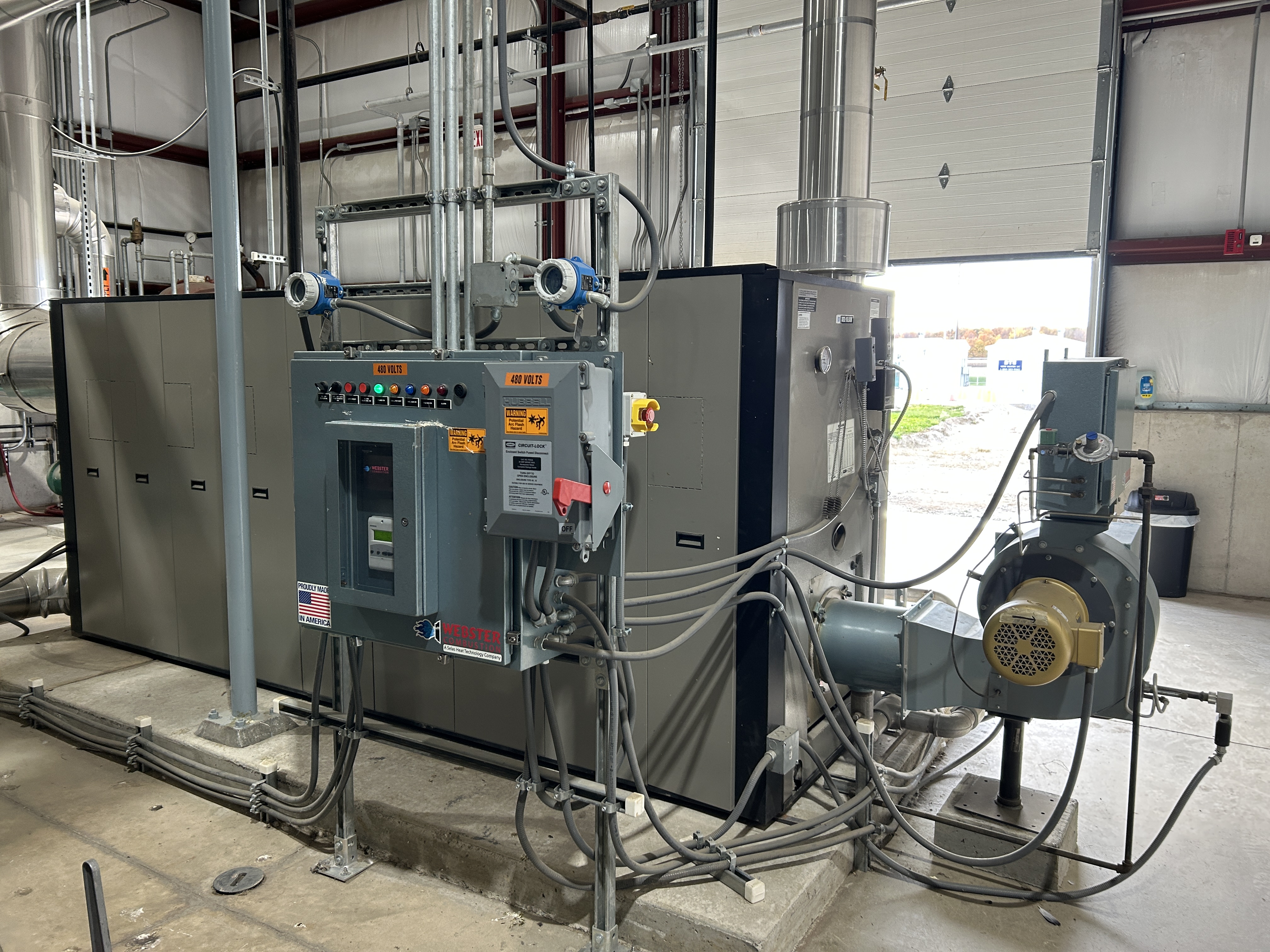
Why does process building one have boilers?
The boilers heat up water for the primary heating loop to then be used in the heat exchanger to heat digestate.

What are the tacos used for in the process building?
The tacos help move the water in the primary heating loop, some go to the boilers, others are for the heat exchangers.
What are the two purposes of the covered lagoon?
The covered lagoon serves as another place to store manure, and it is a final effort to extract more biogas after it has gone through the digesters.
What is the first step in phase one gas upgrading?
Blending skid
What are the functions of the blending skid?
The blending skid meters the biogas coming from each source (digester 1, 2, and the covered lagoon) and then comingles them together to go to the next step.
Why are there multiple steps of particulate filters in the gas upgrading process?
The particulate filters remove any fine dust particles that the gas may have picked up after traveling though media that is meant to remove other compounds (H2S, oil mist, etc.).
How many H2S removal vessels are there, and how many are in use at a time? How do they work?
There are 4 vessels total, but only 2 in use at a time (lead and lag).
The gas is pushed through these vessels, which hold carbon media, that are designed to remove H2S and it flows through.
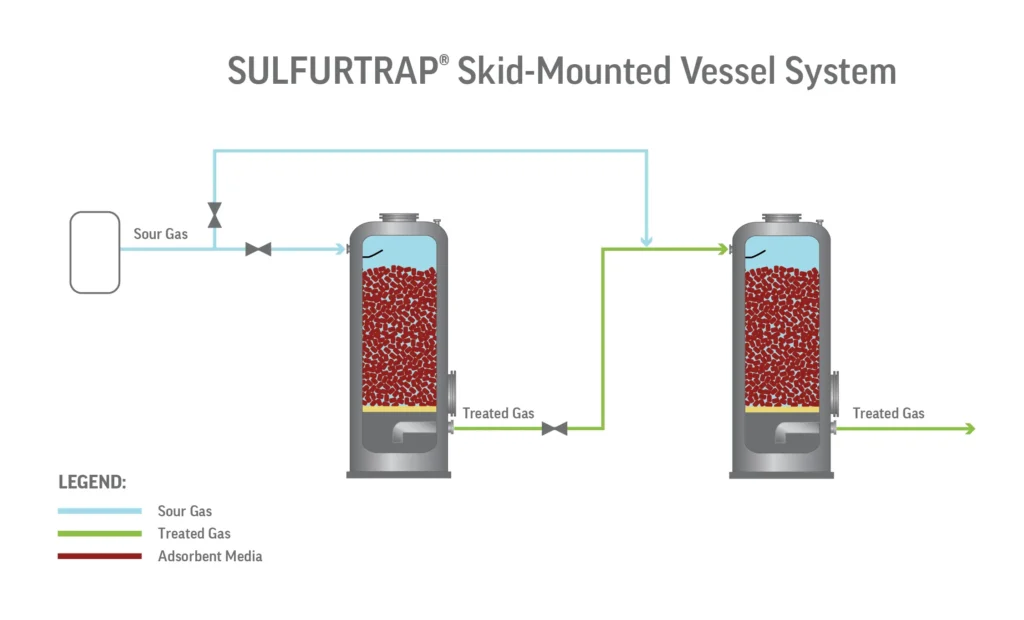
Gas from the blending skid can go two different ways, what are these?
Gas from the blending skid either goes to H2S removal or is sent to flare (off spec or tail gas).

What is off spec gas? What is tail gas?
Off spec gas is gas sent to the flare for having incorrect levels of O2, H2s, etc.
Tail gas is waste gas that has a high CO2 concentration and can be sent straight into the atmosphere without being burned.
Where does the gas travel after the particulate filter for the H2S media?
The gas is sent through a set of 4 blowers to increase the pressure. If gas is not correctly pressurized for the next step, it gets recirculated through the blowers again.
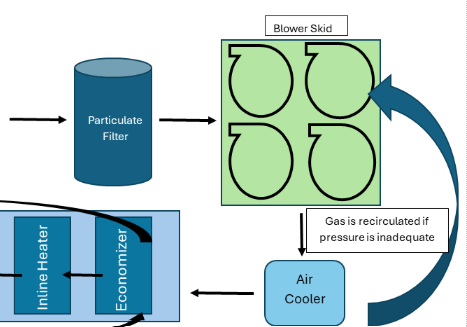
What step is after the blower skid?
After the pressure has been adequately increased, the gas goes through an air cooler where it drops down to 200 degrees.

What step is after the blower skid and air cooler? How does this step work?
O2 Removal is next. The air is first sent through an economizer to preheat the air for O2 removal by using waste heat from the Eco Vapors. Next, the gas travels through an inline heater to get even hotter, then a guard bed that removes volatile compounds and contains another 4 heaters. Next the goes through a catalyst (Eco Vapors) that turns O2 into H2O (condensate). The final step is to go back through the economizer from the first step and go to the next skid. The gas leaves O2 removal at about 480 degrees.
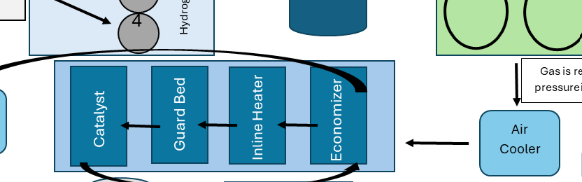
Where does the biogas travel to after the O2 removal process?
Since the gas leaves O2 removal at such a high temp, it needs to go through another air cooler so the gas can cool to 180 - 200 degrees.

After O2 removal and another air cooler, what step is next?
The gas now travels through the "DeHy" skid which contains heat exchangers and a knockout tank. In this skid, the gas is cooled even more until it reaches dew point (50 degrees). As the gas cools, more O2 is removed in the form of water.
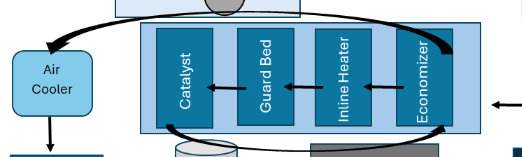
What is after the DeHy skid? What is the purpose of this step?
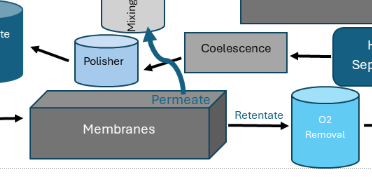
Next the gas travels into a mixing bottle to be mixed with the permeate circulating from stage 3 membranes via a permeate blower.
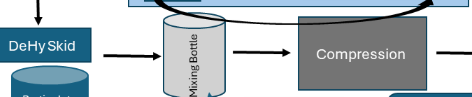
What are the two paths of compression the gas can take after leaving the mixing bottle?
Leroi or matteis

Where does the gas go after compression?
Through a high-pressure economizer that raises the temp from around 50 degrees to 82 degrees. The higher temperature helps extract more oxygen via H2O.

What happens after the gas has been through the high-pressure economizer and H2O separator?
The gas travels to the condenser to decrease its temperature again.

What does the air cooler supply to the condenser and why?
Chilled glycol at 47 degrees to help reduce the biogas's temperature after the first H2O separator.

What step is after the condenser and why?
Another H2O filter because after the gas is cooled and compressed, more oxygen can be removed via condensate.

What process is after the second water filter and why?
Coalescing filter to again collect any last O2 particles by turning them to water.

Where does the gas go after the coalescing filter?
It travels back through the economizer to the polishing tank to remove and oil mist and vapor from the previous steps.
What is the next step after the polishing tank?
The gas travels through a particulate filter to capture and remaining dust particles to protect the membranes.
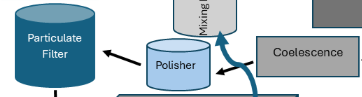
What two paths can the gas take after the particulate filter?
Either sent to flare or to stage 1 membranes (9 membranes)
What are the main goals of the membranes?
To separate carbon dioxide (CO2) from methane (CH4)

What happens after the gas passes through the first set of membranes?
The retentate (GOOD) goes to stage 2 (14 membranes) and the permeate (BAD) goes to stage 3 (8 membranes)
What happens to the gas sent to stage 2 membranes?
The retentate (GOOD) goes to the EcoVapors for final O2 removal. The permeate (BAD) goes to the flare or recirculates back to the compression system gas blowers if the gas still has potential to produce retentate (GOOD).
Where does the retentate go after the EvoVapors and why?
The retentate then travels to the sales gas compressor to increase the pressure to be sold to DTE and join the natural gas pipeline.

What happens to the permeate sent to stage 3 membranes?
The CO2 pulled out at the membrane is sent to atmosphere and the rest is sent back to the mixing bottle to go through the system again and hopefully produce retentate.