OMFPR 19 - Infectious Diseases 2: Bacterial and Fungal (Dr. Menon)
 Call Kai
 Learn
 Practice Test
 Spaced Repetition
 Match
 Flashcards
 Knowt Play
1/156

There's no tags or description
Looks like no tags are added yet.
157 Terms
- Mycobacterium tuberculosis
- Acid-fast bacteria
What type of bacteria causes Tuberculosis?
Tuberculosis
What infection has the following characteristics?
- Transmitted by airborne droplets to the lungs
- Primary variant-unexposed people involving the lungs
- Localized, calcified nodule at site of involvement
tuberculosis
____________ can be reactivated by secondary variants, associated with...
- Diabetes
- Poverty
- Old age
- Crowded conditions
- AIDS
- Miliary-spread through the vascular system
tuberculosis
What disease has extrapulmonary involvement of skin-lupus vulgaris and can also occur in in lymphatics, skin, skeletal system, CNS, kidneys, and GI tract?
tuberculosis
These are symptoms of what secondary disease?
- Hemoptysis
- Productive cough
- Night sweats
- Weight loss
- Fever
- Vascular
- Lymphatics
- Expectorated infected material
Secondary disease of tuberculosis spreads which 3 ways?
Chronic painless ulcer on tongue, palate, lip
What is the oral lesion associated with secondary tuberculosis?
scrofula
What is the nontuberculous mycobacterium found in contaminated milk?
scrofula
What is a nontuberculous mycobacterium that causes enlargement of oropharyngeal lymphoid tissues and cervical lymph nodes?
tuberculosis
Patient presents with respiratory symptoms (blood-streaked sputum), fever, fatigue, weight loss and these lesions. What is the diagnosis?

tuberculosis
Patient presents with respiratory symptoms such as hemoptysis, productive cough, night sweats, and weight loss. What is the diagnosis?

tuberculosis
What disease is associated with this type of lesion?

tuberculosis
This is the histopathology for what disease?
- Formation of granulomas (epithelioid histiocytes, lymphocytes, multinucleated giant cells) with caseous necrosis
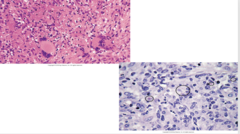
Acid fast stain
How can you identify organisms in the histopathology of tuberculosis?
true (& radiographs can diagnose)
T/F A positive PPD test with a culture of infected sputum can diagnose Tuberculosis
tuberculosis
All of the following are treatment options for what disease?
Isoniazid (INH), Rifampin, Pyrazinamide, Ethambutol for 8 weeks then INH and Rifampin for 16 weeks
Cat-scratch disease
What is the most common cause of chronic regional lymphadenopathy in children?
Bartonella henselae
Cat-scratch disease is an infection from a scratch of kitten or cat infected with what bacteria?
papule or pustule
An initial lesion of cat-scratch disease appears 3-14 days after the scratch, what is the initial lesion?
Lymphadenopathy
The most characteristic clinical feature of cat-scratch disease that occurs about three weeks or longer with fever or malaise is what?
cat-scratch disease
Patient presents with these clinical signs, once biopsied, there is granulomatous inflammation without caseous necrosis. The patient also has a cat at home. What is the diagnosis?

Treponema pallidum (spirochete)
What is Syphilis (Lues) caused by?
- Sexual contact
- Mother to fetus
What are the two modes of transmission of Syphilis?
true
T/F: There are primary, secondary, and tertiary stages of Syphilis
Site of inoculation
- Lesions found on external genitalia, anus, and/or oral cavity
- Oral lesions seen on lip, tongue, palate, gingiva, tonsils, buccal mucosa
Where does primary syphilis occur?
3 to 90 days
Chancres for Primary Syphilis are seen how many days after inoculation?
In 3 to 8 weeks w/o treatment
How long does it take for a primary syphilis lesion to heal?
painless ulcer or vascular proliferation
What type of lesion is seen with primary syphilis?
Lymphadenopathy
In primary syphilis, what clinical feature commonly accompanies the chancre?
Primary
What stage of syphilis is this lesion?
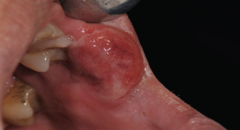
Primary
What stage of syphilis is this lesion?
4 to 10 weeks
Secondary syphilis lesions are seen how long after initial infection?
Secondary syphilis
These are clinical presentations of what stage of Syphilis?
- Painless lymphadenopathy
- Diffuse, painless maculopapular rash involving palmar/plantar areas
- Condyloma lata-papillary lesions (resemble viral papillomas)
- Oral lesions-mucous patches-whitish areas of mucosa involving lip, tongue, buccal mucosa, palate
Spontaneous resolution within 3 to 12 weeks
How long does it take for a secondary syphilis lesion to heal?
Secondary syphilis
What stage of syphilis is this lesion?
condyloma lata
These lesions are associated with secondary syphilis, what are they called?

Secondary syphilis
What stage of syphilis is this lesion?
after latency period (up to 30 years)
When does tertiary syphilis arise?
Tertiary syphilis
Which stage of syphilis has the most serious complications?
Tertiary syphilis
What disease can have these complications?
- Vascular complications (aneurysm of aorta, congestive heart failure)
- Psychosis, dementia, death
- Ocular involvement (iritis, choroidoretinitis, Argyll Robertson pupil)
Argyll Robertson pupil
What is it called when a pupil does not respond to bright light but constricts on focus?
Tertiary syphilis
What is Argyll Robertson pupil associated with?
Tertiary syphilis
Granulomatous inflammation of tissues known as gumma is the most characteristic feature of what disease?
Gumma
What is an indurated, nodular, ulcerated lesion resulting in tissue destruction called?
Gumma
What can cause the palatal surface to perforate to the nasal cavity in tertiary syphilis?
Tertiary syphilis
What stage of syphilis has these oral findings?
- Tongue will be large and irregularly shaped (interstitial glossitis)
- Luetic glossitis-loss of dorsal papillae and atrophy
- Palatal perforation
- Gumma
- Tertiary syphilis
What lesion is shown here and what is it associated with?
Syphilis
What diagnosis is determined by...
- Smear of active lesion under dark-field examination revealing corkscrew organisms (no longer used)
- Suspicious lesions require biopsy
- Immunohistochemical stain (Warthin-Starry / Steiner)
- Blood tests
- PCR testing (high sensitivity and specificity)
Penicillin
What is the treatment for syphilis?
- Hutchinson teeth (incisors, mulberry molars/moon molars/fournier)
- Ocular interstitial keratitis
- Eighth nerve deafness
Congenital syphilis is diagnosed based on the Hutchinson Triad which includes what three things?
Congenital syphilis
These are other deformities that are associated with what?
- Frontal bossing
- Saddle nose
- Rhagades (premature perioral fissuring)
- Saber shin (anterior bowing of tibia due to periostitis)
- Ocular interstitial keratitis
- Eighth nerve deafness
Patient has this clinical presentation, what other two clinical signs are required to confirm diagnosis of congenital syphilis?
Congenital syphilis
Patient has this clinical presentation. What is the diagnosis?
Congenital syphilis
Patient has this clinical presentation. What is the diagnosis?
Congenital syphilis
Patient has this clinical presentation. What is the diagnosis?
ocular interstitial keratitis, congenital syphilis
What is this clinical sign and what is it associated with?
Tonsillar concretion
What condition is the following?
- Mass of foul-smelling desquamated keratin and foreign material with bacterial colonization
Tonsillolith
What condition is the following?
- Dystrophic calcification of tonsillar concretion
Tonsillar crypts
Where is a common location of tonsillar concretions and tonsilloiths?
Abscess formation, chronic sore throat
Both tonsillar concretions and tonsilloiths are asymptomatic but can lead to what?
halitosis (due to bacteria)
Tonsillar concretions have what clinical sign?
ascending ramus
What is a radiopaque structure of tonsillar concretions/tonsilloiths superimposed on?
Tonsillar concretions/tonsilloiths
The following are treatments of what condition?
- Remove by gargling warm salt water or pulsating jets of water
- Enucleation or curettage
- Surgical removal if deep w/i crypts
- Tonsillectomy if associated with chronic tonsillitis
Tonsillar concretions/tonsilloiths
What are the radiopaque structures seen on the ascending ramus?
Bacterial (NOT FUNGAL)
Cervicofacial actinomycosis is what type of infection?
anaerobic, gram-positive branching bacteria
What type of organism causes cervicofacial actinomycosis?
Actinomyces israeli
What bacteria causes cervicofacial actinomycosis?
Cervicofacial actinomycosis
What condition has the following characteristics?
- Can be an acute, rapidly progressing infection or chronic slow spreading infection
- Results from areas of trauma
- Treatment includes high doses of antibiotics with drainage and excision of sinus tracts
Cervicofacial actinomycosis
This is the clinical presentation of what?
- Indurated (wooden) area of fibrosis
- Fistulous tract can result
- "Sulfur granules" - yellow flecks of bacterial colonies found in pus or tracts
angle of mandible
What is the common location of cervicofacial actinomycosis?
Cervicofacial actinomycosis
This is the histopathology of what disease?
- Colonies of club-shaped organisms surrounded by a rim of neutrophils
- Organisms seen by Gram stain

- High doses of antibiotics
- Drainage and excision of sinus tracts
What is the treatment of cervicofacial actinomycosis?
cervicofacial actinomycosis
What is this the clinical presentation of?
candidiasis
What is the most common oral fungal infection?
dimorphic
What type of organism is candidiasis?
- Yeast
- Hyphae
What are the two forms candidiasis exist in?
False (normal oral flora)
T/F: Candidiasis exists as a component of abnormal oral flora
Chronic debilitating disease
What is the most common predisposing factor of candidiasis?
Candidiasis
All of the following are common predisposing factor of what?
- Nutritional and endocrine disturbances
- Broad-spectrum antibiotic therapy
- Systemic corticosteroid therapy
- Partial or complete dentures
- Immune deficiency
- Pseudomembranous (thrush)
- Erythematous
- Chronic hyperplastic (Candidal Leukoplakia)
What are the three clinical forms of candidiasis?
pseudomembranous candidiasis
What type of candidiasis is thrush?
Erythematous candidiasis
The following examples are what clinical form of candidiasis?
- Central Papillary Atrophy (Median Rhomboid Glossitis)
- Denture Stomatitis (Chronic atrophic)
- Angular Cheilitis
pseudomembranous candidiasis
What is the most recognized form of candidiasis?
pseudomembranous candidiasis
What form of candidiasis?
- White plaques (cottage cheese/curdled milk)
- Easily removed with tongue blade or gauze to reveal erythematous mucosa
pseudomembranous candidiasis
What is the diagnosis?
- Symptoms including burning, salty or bitter taste
- Seen on palate, buccal mucosa, or dorsal tongue
pseudomembranous candidiasis
A patient who has asthma presents with a salty, bitter taste in their mouth and these lesions on their palate. What is the diagnosis?
erythematous candidiasis
Which form of candidiasis?
- Presents as burning sensation
- Can occur after course of broad-spectrum antibiotics
Filiform papillae is lost resulting in a red or "bald" appearance
With erythematous candidiasis, if present on tongue, what occurs?
No
Does erythematous candidiasis exhibit a white component as seen in pseudomembranous?
erythematous candidiasis
A patient presents with a burning sensation on tongue and recently got off broad-spectrum antibiotics. What is the diagnosis?
erythematous candidiasis
Median Rhomboid Glossitis (Central Papillary Atrophy) is a form of what condition?
Central Papillary Atrophy (Median Rhomboid Glossitis)
What condition?
- Asymptomatic
- Well-demarcated erythematous area involving the midline of the posterior dorsal tongue

Central Papillary Atrophy (Median Rhomboid Glossitis)
What condition?
denture stomatitis
What condition?
- Found in patients wearing removable partials or complete dentures
- Continuous wear of appliance without proper oral hygiene
- Appears erythematous with petechial hemorrhage in denture bearing areas
denture stomatitis
Chronic atrophic candidiasis is also known as what?
denture stomatitis
What condition?

angular cheilitis
What condition?
- Occurs at angles of mouth (commissures)
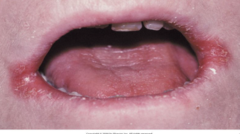
angular cheilitis
What condition?
- Found in older adults
- Can be erythematous, fissured, or scaling

staphylococcus aureus
What bacteria is angular cheilitis associated with?
loss of vertical dimension of occlusion (VDO)
What does angular cheilitis result from?