fruit crops test 2
 Call Kai
 Learn
Learn Practice Test
 Spaced Repetition
 Match
Match Flashcards
 Knowt Play
1/125

Earn XP
Description and Tags
yikes
Name | Mastery | Learn | Test | Matching | Spaced | Call with Kai | Chat |
|---|
No analytics yet
Send a link to your students to track their progress
126 Terms
multiplying, unique
plant propagation is the purposeful act of increasing or _ the number of plants of a specific species, variety, or cultivar, especially with the goal of preserving their _ qualities
propagation
_ method has a huge impact on uniformity, quality, yield, disease resistance, productivity, timing, harvest, post harvest, and more
sexual, meiosis
_ propagation is Propagation by Seed. In this system, _ is the basis for genetic diversity and variation

germ, gametes
Meiosis is a special type of cell division of _ cells (the reproductive cells that actually transmit genetic information from one generation to the next) that produces the _: the sperm or egg cells
haploid, one
Meiosis occurs in plants only during sexual reproduction in specialized cells to produce a _ egg cell. Two rounds of division result in 4 cells with _ copy of each chromosome

identical, unique
Mitosis produces two genetically _ “daughter” cells from a single “parent” cell; while Meiosis produces cells that are genetically _ from the parent and contain only half as much DNA
vegetative, sperm, egg
Most cells in the body go through mitosis: somatic or _ cells; while meiosis occurs only in the production of _ and _ cells for sexual reproduction
recombination
there are two opportunities for genetic variation in meiosis: _ or crossing over is the interchange of genetic information during the early stages of meiosis I

independant assortment
there are two opportunities for genetic variation in meiosis: __ of of the chromosomes during the later stages of meiosis I and II

cultivars, uniform
The genetic diversity that occurs from seed propagation is Great for plant breeding and developing new _! However, since many plants don’t produce true to type, you likely won’t have a stable or _ crop
line
If a plant group reproduces “true” by seeds, i.e., no characteristics are changed, cultivar is called a _. It this is self pollinated or cross pollination is prevented, seed propagation will yield progeny like the parent plant
rootstock, papaya
seed production in fruit crops is primarily only used in breeding programs, _ production, and a select few crops like _
skill, fruiting, production
Seed propagation is Inexpensive, cheap, requires the least _, Can produce large numbers of plants, and has easier rooting. However, there’s a long juvenile phase before _, high trait variability which impacts _, and many species produce few viable seeds to use
vegetative
Asexual Propagation is also known as _ or Clonal Propagation, and is used for plants that do not “breed true” from seed
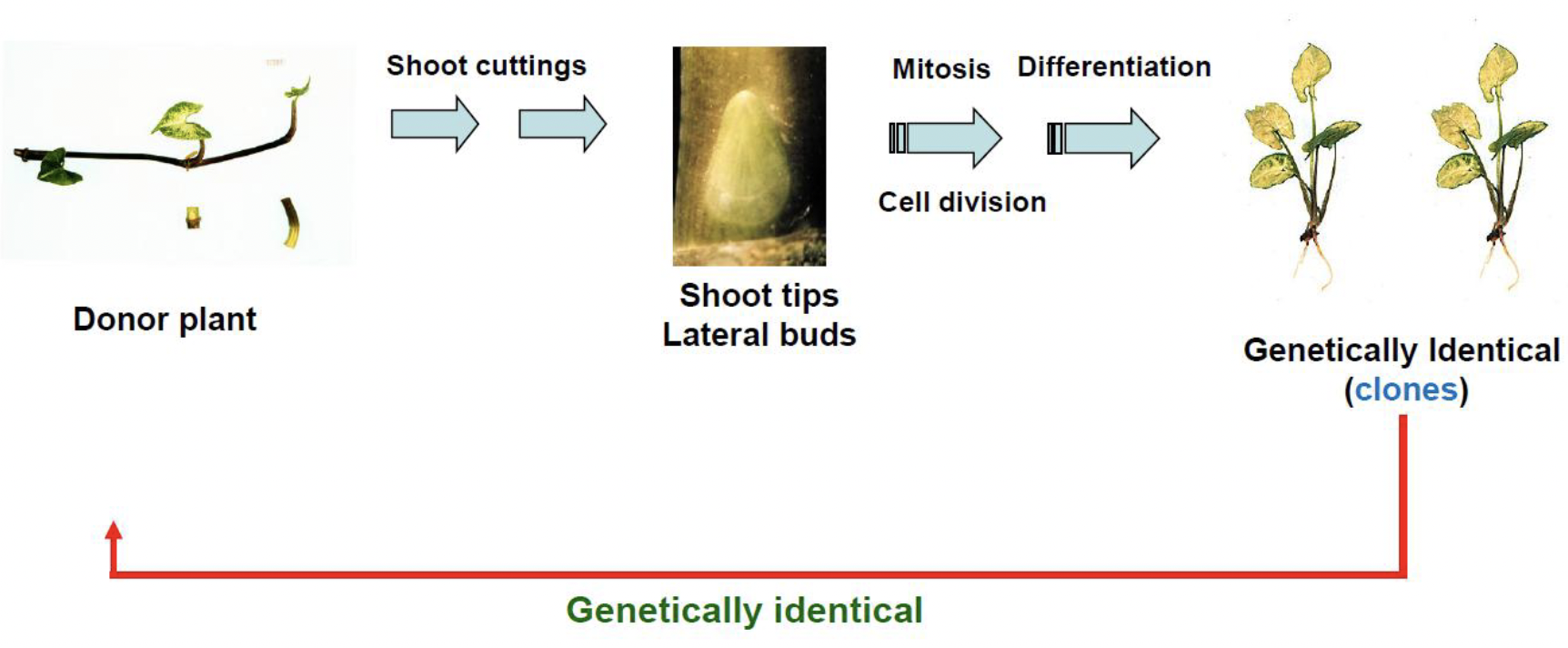
meiosis, mitosis
Asexual reproduction is the production of a new plant by any vegetative means not involving _ and the union of gametes: it is accomplished entirely through _
adventitious
Vegetative tissues (stem, root, or leaf) are used to develop new plants by inducing the formation of _ (refers to structures arising from an unnatural place) shoots, roots, or both.
roots, shoots, leaf
In asexual reproduction, a piece of veg. tissue is placed in a suitable environment. After some period of time, piece of veg. tissue will regenerate missing parts. Stem piece forms _, Root piece forms _ , and _ forms both shoots and roots
identical, genotype
in asexual reproduction, The new plant that forms is genetically _ to the plant from which the vegetative tissue was taken, due to the absence of meiosis. It possesses the same _ unless a mutation has occurred
clone
a _ is an organism that originates from a single plant or plant part by means of vegetative propagation
juvenility, stolons, propagules, labor
asexual reproduction is uniform and consistent, true to type with usually no _, and you can use inexpensive natural methods like taking _ and pups. however, there’s limited scalability, lower number of _ produced, requires controlled conditions, increase time and _ costs, and certain species can be difficult to propagate
grafting, cocktail
with _ or budding, you can incorporate desirable traits (ex. disease resistance, pest resistance, cold hardiness, heat tolerance, vigor, size control, age, fruit size, fruit quality, other traits) and combine different cultivars onto one plant (known as a _ plant)
herbaceous, softwood, semi hardwood, hardwood
stem cuttings are primarily used in fruit crop propagation. These include _(succulent, non-woody), _(soft, succulent new growth of deciduous or evergreen species), __ (aka greenwood; partially mature; green bark, with leaves), and _ dormant: brown bark, no leaves) cuttings.
roots, scalability
The majority of plant species can make adventitious _, so stem cuttings are a very successful and common method. However, Some species difficult to root, controlled conditions are required, and there is Limited _
stem
Grapes, Figs, Blueberries, Pomegranate, and Mulberry are all primarily propagated by _ cuttings
layering
_ is Inducing adventitious roots on a stem while it’s still attached to the parent plant. The rooted stem (the layer) is then detached and becomes a separate plant
mound layering
__ is a method where the shoots are cut back to the ground, then soil or rooting medium is mounded around them to stimulate roots to develop at their bases. Used to propagate rootstocks for apples, pears, quince, currants, gooseberries
air, girdled
_ layering occurs when an aerial stem is _ and enclosed with rooting media to produce rooted layers in the upper part of the plant. It’s useful for producing a few plants of relatively large size for special purposes. It’s used for lychee, longan, Persian lime, and guava

rooting hormone, plastic wrap, aluminum foil
in the steps of air layering, you first girdle the stem. Then, you apply __, then moist (not excessively wet) media to the girdled area. Then, secure the media with __ to seal moisture, and add __ to moderate temp.
air, nutrients
_ layering allows for continued supply of water, minerals, carbs, and hormones to the rooting area due to the attachment to the plant; and no _ can be leached by watering since moisture is sealed in and is therefore not required
sugar, auxin
An important factor in rooting success is the ability of the stem to accumulate _ and _ from the leaves and shoot tip. In layering, there is an accumulation of photosynthates and hormones in the rooting area, making it widely succesful
bark, carbs, water
girdling is cutting through or removing the _ completely around the stem to interrupt the downward movement in the phloem to cause accumulation of _ and other substances just above the girdle, without interfering with upward _ conductance
field, drainage
Most layering methods are _ nursery operations - may continue in beds/rows/etc. for 10 – 20+ years once established. It’s essential to select a site that has proper soil, _ and climate
insect, management
Special attention must be paid to weed, disease, and _ control of layering beds. Without good _ and hand labor, layering beds will decline over time
hard to root, propagation, expensive
air layering is Highly reliable for production of ___ clones, maintains parent traits, and results in a fairly large plant to start off with, while also needing minimum _ facilities. However, You can’t make many air layers per parent plant, since they are so large. The process is _ and labor/time intensive
stolons, pups
Some crops naturally produce vegetative propagules, including _ that are specially modified stems, produced horizontally above ground; as well as suckers or _, which are shoots that grow from roots or near the base of the plant/tree
grafting
_ is the union of a root system (rootstock, understock, or stock) with a shoot system (scion) in such a manner that they grow as one composite plant. It is one of, if not the most, important propagation techniques used for fruit crops worldwide
budding
_ is a form of grafting in which the top portion (scion) starts out as a single bud
scion, buds
the _ is the part of the graft combination that is to become the upper/top portion of the plant. It Usually starts as a piece of stem tissue several inches long with 2-4 _
graft union
the __ is the junction of scion and rootstock
rootstock
the _ is the lower part of the graft combination, the part that is to become the root system
top grafting
__ or top- working is when grafting is used to change the fruiting cultivar in a established fruit tree to a different fruiting cultivar
healthy, roostock, scion
there are 3 main grafting steps. 1st, select _ plants. then, Prepare the _ by making a clean cut according to the type of grafting. Then, prepare the _ by cutting to a shape specified by the type of grafting.
cambium, moist
When placing the scion piece into the rootstock, ensure _ layers (the green layer just under the bark) align, which is absolutely critical or the graft won’t take. secure the graft tightly with special tape or rubber bands, and keep the plant _ in a shady area, checking regularly for growth signs

vascular connection, degenerate
For a graft to be successful, a __ must be established between the scion and rootstock. Scion won’t resume growth until it can obtain water and mineral nutrients, and rootstock will _ if carbs and other metabolites can’t be sent from scion to roots
adhesion, callus, vascular differentiation
Development of a compatible graft involves three major events: _ of the rootstock and scion, Proliferation of _ cells at the graft interface or callus bridge, and __ across the graft interface
meristematic, parenchyma
Cells of the vascular cambium tissue are _ (can divide and form new cells), so a 100% “perfect match” of alignment in grafting is not strictly necessary. The cambial regions should be close enough together so the _ cells from both rootstock and scion produced in this region can interlock
necrotic, parenchyma, wound
Stage 2 of graft union formation is wound response – proliferation of callus cells at the graft interface. _/isolation layer forms from cell contents of cut scion and rootstock cells. Callus forms from uninjured _ cells adjacent to cells killed when scion and rootstock were cut. Callus tissue initially forms a _ periderm, like a scab, between the necrotic layer and uninjured tissue

undamaged, cement
stage 3 of graft union formation is callus bridge formation. Callus tissue continues to form from _ parenchyma cells. Proliferating parenchyma cells interlock, filling up space between the scion and rootstock. A “_” or binding material is released from surface of callus cells of scion and rootstock, aids the adhesion of the rootstock and scion

xylem, phloem, vascular cambium
stage 4 of graft union formation is wound-repair xylem and phloem: Differentiation of vascular cambium across the callus bridge (crossing the bridge). Wound-repair _ crosses bridge first, then WR _(both usually form directly from callus). THEN, the __ forms between the rootstock and scion

vascular cambium
stage 5 of graft union formation is production of secondary xylem and phloem from the new __ in the callus bridge

experienced
Even for _ grafters and budders, results can be inconsistent! May have a high percentage of “takes” in some operations, low in others
graft incompatibility
__ is an interruption in cambial and vascular continuity leading to a smooth break at the point of the graft union, where normal vascular tissue doesn’t develop and graft fails
physiological, phytoplasma, anatomical
Graft incompatibility occurs because of adverse _ responses between the grafting partners, Virus or _ transmission, and _ abnormalities of vascular tissue in the callus bridge. Incompatibility can occur within days, years, or decades.
pears, apricots
Some fruit crops like apples, grapes, and _ are very easy to graft, give high percentage of successful unions with variety of techniques. Others like peaches & _ more difficult, require more care & attention to detail
bench, spring
Temperature has a major effect on production of callus tissue. Temp easier to control if doing containerized or _ grafting in a controlled environment, which also creates a wider grafting window. Outdoor grafting: must occur at time of favorable temps and active vascular cambium, _
carb, field, injury
Optimum range of grafting temps is species-specific, but generally- low temps: little or no callus tissue forms. High-er temps: can speed up callus production (but high temps for too long deplete _ reserves, limits _ survival). Too high temps: callus production impeded, cell _ increases.
desiccation, die
Water is necessary for callus bridge formation. Cambium and parenchyma cells of callus tissue are thin-walled and tender, no ability to resist _ (drying out) If air is too dry, they will _. To keep graft union moist, it’s waxed or sealed with polyethylene grafting tape, parafilm, etc
uneven, desiccated, girdling
Errors in technique resulting in graft failure include insufficient or delayed waxing or wrapping of union, _ cuts, use of _ scions, and _ that occurs when wrapping tape is not removed expeditiously after graft “take” occurs
force, crippling, lopping
After graft union formation, often necessary to “_” out the scion or bud. Buds on rootstock inhibit scion growth because of apical dominance. It can be broken by _, the bending or cutting halfway through the rootstock shoot above the bud union; and by _, bending the rootstock shoot to its base and tying it in position once apical dominance broken, scion bud will start growing

identical, fruiting, incompatibility
grafting results in production of _ plants with desirable characteristics, the combined strengths of scion and rootstock, and faster _. However, it requires skilled labor, has _ risks, and involves more time and money
micropropagation, defined
_ is clonal in vitro propagation of plants from cells, tissues or organs cultured aseptically on _ media contained in culture vessels maintained under controlled conditions of light and temperature
pathogens, germplasm, vegetative
In vitro propagation eradicates plant _, can assist in the collection and storage of crops and native plants via _ storage, and introduces genetic change and facilitates transfer of genetic info between _ cells.
strawberries, citrus
micropropagation of fruit crops includes _, pineapples, and bananas, as well as _ seedlings for grafting
donor plant, photoperiod
the pre-first stage of micropropagation is __ selection and preparation: disease indexing procedures may be used initially, and the physiological state of individuals may be adjusted by application of fertilizer or changing the _ to induce certain growth, in an effort to make the in vitro transition easier
aseptic, sterilized
the first stage of micropropagation is establishment of _ culture: shoot tip, node, or non meristematic tissues from internodes, leaves, and roots are surface _
propagules
the second stage of micropropagation is multiplication of the _: that give rise to new plants. they way they grow depend on mode of regeneration
transplant, carbohydrate
the third stage of micropropagation is pre _ or rooting: small stage 2 plantlets remain in vitro while they are rooted or elongated. The goal of this stage is to produce plants that will survive ex vitro without a supplemental _ supply
natural environment, photoautotrophic
the fourth stage of micropropagation is tranfer to the __: plantlet is brought out of in vitro and into soil. Acclimatization to lower humidity and higher light levels occur. The goal is the production of a vigorous _ plant of high quality
disease free, somaclonal
the benefits of micropropagation include a large numbers of plants produced in a small space, and year-round production of __ plants. However, it is expensive and technical, requires sterile labs, aseptic technique, and specialized equipment, and risks _ variation
apomixis
_ is the production of an embryo that bypasses the usual process of meiosis and fertilization. Seeds formed without fertilization → asexual production of seeds
parthenocarpy
_ results in Fruit development without fertilization. It Can occur naturally or be induced by hormones, and results in “seedless” fruits
vegetative, stimulative
there are 2 types of parthenocarpy: _ parthenocarpy takes place in species like pear or fig, where the fruit develops even without pollination. _ parthenocarpy takes place only after pollination but does not require fertilization or seed set for continued fruit growth
inarching, bridge grafting
Repair grafts used to correct damage done to established trees include _ (left, rootstock has its own root system) and __ (right, a scion is inserted around the injured section and attached at both the upper and lowers ends of live, undamaged bark – connecting cambium layers above and below girdled area)

disease indexing
__ is Testing for viral diseases, esp. graft-transmissible pathogens. First, you graft potentially infected plant tissue onto a susceptible "indicator" plant, then closely monitor indicator plant for development of disease symptoms (may take up to 6-12 months to apprar)
cuttings
Cultivars of many fruit and nut species are not propagated commercially by _ because of poor rooting (ex. avocado)
scions
certain _ can enhance plant growth rates, fruit characteristics, yield, and ornamental characterestics like unique forms
disease, reproductive maturity
certain rootstocks can offer Greater resistance to environmental stress and _, control size of grafted plant, and hasten __
double working
__ is when you insert a third plant system (interstock) between the rootstock and scion by making two grafts or double budding. This helps avoid incompatibilities, enhance reproductive growth, and may add characteristics not on scion or rootstock
scion
the _ is the named variety/ cultivar consumers purchase in the store
rootstock
the _ increases survival and production of the fruit tree
variety, additional
Cultivar/_/rootstock selection is one of the most important management decisions a grower makes- Choosing the right combo can result in higher economic returns without any _ cost
dynamic
Variety/cultivar selection is a _ process. Some varieties are used for many years, while others are replaced by newer cultivars after a few seasons
field, performance
When you try new varieties, do so on a small-scale basis, but grow them under the same conditions likely to be encountered in the _, and keep _ records
expand, production
Variety selection can be an opportunity to _ a market or overcome certain _ obstacles. Even if outcome isn’t good, testing new varieties will often provide valuable information that can help in some other aspect of a grower’s operation
performance testing, accepted
when selecting a variety, study and use reliable results from local __, including on-farm trials, other grower's experience, vegetable and seed trade literature, and university studies. Research the market to clarify what is valued and _, and use a range of maturity groups and varieties that best match your production practices
horticultural, weather related, marketable
A good variety will provide the best blend of _ traits desired by the market, Maturity needed to match the cropping season, supply the market, and reduce the risk of __ crop failure; High _ yield potential; and dependable resistance to diseases, insects, stress, and physiological disorders
yield
one selection criteria is _: The variety being considered should have the potential to produce crops at least equivalent to those already grown
harvested yield, marketable yield
__ is the total quantity of a crop gathered/harvested from a field, regardless of quality or size, while __ is the portion of that harvest that meets specific quality standards—such as proper size, shape, color, lack of defects—and is therefore suitable for sale or processing
unmarketable
the difference between harvested yield and marketable yield is _ yield or cull yield
chilling requirement, humidity
one selection criteria is adaptation to climate- Does it have the right __ for this area? Or, Is it cold hardy enough/can it handle the heat and _ of a region?
horticultural, production
one selection criteria is _ traits- The characteristics of the plant habit must be suitable for cultural and climatic conditions in the growing area. Marketed product must be acceptable and uniform, and plant characteristics should be suitable for the intended _ system
post harvest
one selection criteria is fruit quality and marketability __- must have characteristics desired by the packer, shipper, wholesaler, retailer, and consumer, Can it survive being harvested, packed, shipped across the country, sitting on a grocery shelf, getting brought home, and still look and taste good?
branded variety
one selection criteria is fruit quality and marketability post harvest- Do the consumers want this?? Will they buy it? Do they know what it is? Is it a __? Can branding help improve its acceptance?
market window
one selection criteria is harvest timing- Is it an early, mid, or late season cultivar? Growers often plant some of each, if possible, which extends __
spray, labor
one selection criteria is disease and pest resistance- Is this cultivar/variety resistant to the pests and diseases common to this area? If susceptible, you’ll have to _/treat plants more, which increases costs (materials, _, time), and some consumers won’t accept it
insurance
Pest management traits protect yield, they do not enhance yield! They act like _
prior
Before growing the plants, carefully analyze the site! _ to site acquisition, analyze it!
area, storage facilities
one site selection consideration is having sufficient _ for initial production and future expansion, __, non growing work areas, etc. If you’re near a urban and rural interface, this could affect ability to expand.
water, vegetative, maturation
one site selection consideration is _ supply, quality, and availability: since fruit crops require adequate soil moisture thru out the growing season to maintain _ growth and produce a full crop of quality fruits. If no supplemental irrigation, Search historical rainfall data. Must also consider historical patterns of rainfall/flooding/hail- affects pollination period and fruit _, ability to harvest.
chlorides, pollutants
You must consider the quality of your irrigation- shouldn’t contain high soluble salts (calcium, sodium, _, etc), should be free of _. Correcting bad water is expensive!