Economics Terms Chapter 22-26
 Call Kai
 Learn
 Practice Test
 Spaced Repetition
 Match
 Flashcards
 Knowt Play
1/83

There's no tags or description
Looks like no tags are added yet.
84 Terms
perfect competition
a market structure in which the decisions of individual buyers and sellers have no effect on market price
many buyers and sellers, each sells a homogenous product
perfectly competitive firm
a firm that is such a small part of the total industry that it cannot affect the price of the product or service it sells
price taker
a perfectly competitive firm that must take the price of its product as given because the firm cannot influence its price
characteristics of perfect competition
there are large numbers of buyers and sellers
the product sold by the firms in the industry is homogenous (indistinguishable across firms)
both buyers and sellers have access to all relevant information
any firm can enter or leave the industry without serious impediments
the demand curve for the product of an individual firm in a perfectly competitive industry…….
is perfectly elastic at the going market price.
sell all units at market price
will sell no units at a higher price

profit-maximization model
assumes firms attempt to maximize their total profits (positive difference = total revenues - total costs)

total revenue
the price per unit times the total quantity sold & is the same as total receipts from the sale of output
profit-maximizing rate of production
the rate of production that maximizes total profits (= total revenues - total costs)
is also the rate of production where marginal revenue = marginal costs (this is when profit maximization occurs, MR = MC)
marginal revenue
the change in total revenues divided by the change in output

marginal cost
the change in total cost divided by the change in output

short-run profits
in the short run, a perfectly competitive firm can make either economic profits or economic losses.
economic profits = profit-per unit x units produced
to find profit of producers in the short run: determine excess of price above average total cost (ATC)
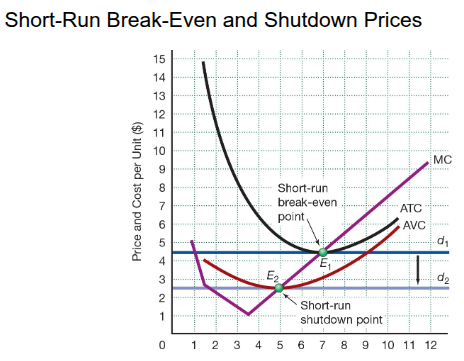
the short-run break-even price and the short-run shutdown price
if price per unit sold exceeds the average variable cost per unit produced, the profits of the firm’s owners will be higher only IF it continues in the short run rather than shut down
short-run break-even price
the price at which a firm’s total revenues = its total costs
at the first break-even price, the firm is just making a normal rate of return on its capital investment
means the firm is covering its implicit and explicit costs
short-run shutdown price
the price that just covers average variable costs
occurs just below the intersection of the marginal cost curve and the average variable cost curve
a firm goes out of business when vs a firm temporarily shuts down when
out of business → the owners sell its assets
temporarily shuts down → it stops producing but is still in business
accounting profits vs economic profits
when economic profits are zero, a firm can still have positive accounting profits
ATC curve includes the full opportunity cost of capital and all factors of production
the perfect competitors short-run supply curve
a firm’s short-run supply curve in a competitive industry is its marginal cost curve at & above the point of intersection within the average variable cost curve

industry supply curve
the set of points showing the minimum prices at which given quantities will be forthcoming
also called the market supply curve

factors that influence the industry supply curve (determinants of supply)
individual firm’s productivity
factor prices (wages, prices of raw materials
per-unit taxes and subsidies
number of sellers
how is the market price established in a competitive market
established by the interaction of all the suppliers (firms) and all the demanders (consumers)
the market-clearing price
is the exact price of a good, service, or asset at which the quantity supplied by producers equals the quantity demanded by consumers (equilibrium price)
competitive price = the intersection of the market demand curve and the short-run industry supply curve.
if firms incur losses, supply curve does what?
supply curve shifts upwards
some firms cease production (exit the industry) which causes this

if firms make economic profits, supply curve does what?
supply curve shifts outwards
new firms enter the industry which causes this

in the long run (competitive situation) firms will…
be making zero profits
exit and entry of firms, key to remember
economic profits
signals resources to enter the market
economic losses
signals resources to exit the market
in the long run, capital will…
flow into industries where profitability is highest
flow out of industries in which profitability is lowest
allocation of capital
price system allocates capital according to the relative expected rates of return on alternative investments
market signals
investors and other suppliers of resources respond to market signals about their highest-valued opportunities
signals
ways of conveying information needed to make decisions to economic decision makers
effective signal: conveys info AND provides an incentive to react appropriately
ex. economic profits and losses
tendency toward equilibrium
at break-even, resources will not enter or exit the market
competitive long-run equilibrium = firms make zero economic profits
there is a tendency toward equilibrium, but firms adjust constantly to changes in their cost curve and the market demand curve
long-run industry supply curve
A market supply curve showing the relationship between prices and quantities after firms have been allowed time to enter or exit from an industry
depends on whether there have been positive or negative economic profits
constant-cost industry
industry whose total output can be increased in the long run without an increase in prices
long run supply curve is horizontal

increasing cost industry
industry in which a long-run increase in industry output = an increase in input prices
long run supply curve slopes upward

decreasing-cost industry
industry in which an increase in output in the long run leads to a reduction in input prices
long run supply curve slopes downward

in the long run, a competitive firm….
produces where price, marginal revenue, marginal cost, and average cost (minimum, short-run, and long-run) are equal.

marginal cost pricing
system of pricing in which the price charged = the opportunity cost to society of producing one more unit of the good or service in question
opportunity cost is the marginal cost to society
economically efficient: impossible to increase the output without lowering the value of the total output produced in the economy
market failure
unrestrained market operation leads to either too few or too many resources going to a specific economic activity
short run
the time period when one input is fixed (like plant size
plant size
the size of the facilities that a firm owns/operates to produce its output
defined by square footage, maximum capacity, and other measures of the scale of productions of goods or service
long run
the time period in which all factors of production can be varied
production
the conversion of raw materials into goods
production function
the relationship between inputs and maximum output
specifies the minimum amount of inputs necessary to produce a given level of output
average product
total product
———————- = average product
variable input
marginal product
the output that is due to one more additional unit of a variable factor of production

the law of diminishing marginal product
As successive equal increases in a variable factor of production are added to fixed factors of production —> there will be a point beyond which the extra one, or marginal, product that can be provided to each additional unit of the variable factor of production will decline
diminishing marginal product example
marginal product for labor increases at the beginning, but it begins to diminish as more workers are hired (they have nothing to do/less equipment to work with = zero productivity)
point of saturation
given the amount of fixed inputs, there is no further positive use for more of the variable input
= the region of negative marginal product
total costs
the sum of total fixed costs and variable costs (TC = TFC + TVC)
fixed costs
costs that do not vary with output and are fixed for a certain period of time → ex. rent on a building
variable costs
costs that vary with the rate of production → ex. wages paid to workers/purchases of materials
average: fixed costs vs variable costs vs total costs
average fixed costs (AFC): total fixed costs / # of units produced (output - Q)
average variable costs (AVC): total variable costs / # of units produced (output - Q)
average total costs (ATC): total costs / # of units produced (output - Q)
output
the number of units produced
marginal costs
change in total costs due to a one-unit change in production rate (does not include fixed costs)
MC = change in total cost / change in output = wage / marginal product
marginal costs curve intersects average…..
average total cost curve at its minimum
average variable cost curve at its minimum
planning horizon
the long run, during which all inputs are variable
long run average cost curve
represents the minimum unit cost of producing any given rate of output, given current technology and resource prices
planning curve
the long-run average cost curve
is u-shaped because of economies of scale, constant returns to scale, and diseconomies of scale

economies of scale
decreases in the long-run average costs resulting from increases in output
reasons include: specialization (increased divisions of tasks or operations, dimensional factor (large-scale firms often require proportionately less input per unit of output, and improved productive equipment (the larger the enterprise, the more the firm can take advantage of larger-volume types of machinery
largest firm can produce at the lowest average total cost
constant returns to scale
no change in long-run average costs when output increases
diseconomies in scale
increases in long-run average costs that occur as output increases
reasons why: limits to the efficient functioning of management or as the firm begins to grow, the layers of supervision grow and the costs of information and communication grow more than proportionately
minimum efficient scale (MES)
the lowest rate of output per unit time at which long-run average costs for a particular firm are at a minimum

monopolist
the single supplier of a good or service for which there is no close substitute
constitutes the whole industry → ex. google
it’s a price-searcher
a firm that must determine the price-output combination that maximizes profit because it faces a downward-sloping demand curve
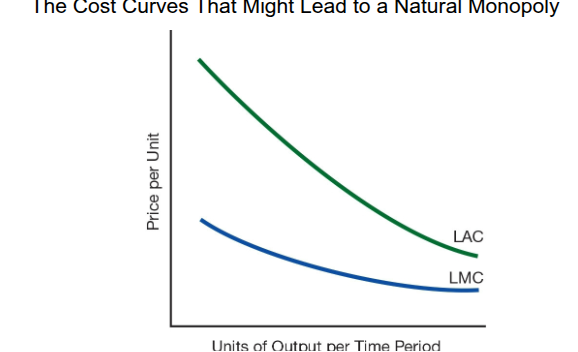
natural monopoly
a monopoly that comes from peculiar production characteristics in an industry
one firm can produce at a lower average cost than can be achieved by multiple firms
barriers to entry
restrictions on who can start, as well as stay in business
allow firms to make long-run economic profits
ex. economies of scale , legal or governmental restrictions
legal or governmental restrictions
licenses, franchises, and certificates of convenience
ex. electrical utilities, pipelines, radio and television broadcasting, transmission of natural gas
patents:
intellectual property
regulation:
government enforcement of safety and quality
tariffs:
taxes on imported goods
demand curve for monopolists
downward sloping
monopolists face the industry demand curve for the entire market because the monopolist is the entire industry
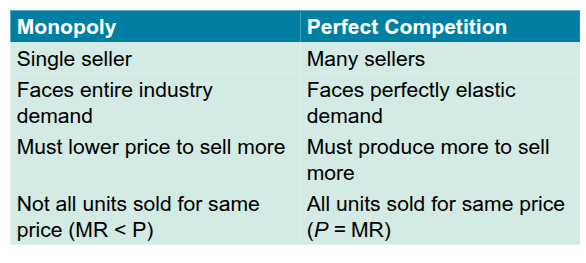
perfect competition vs monopoly
if monopolist wants to sell more, the price they charge must be lower on the last unit sold (downward sloping demand curve)
perfect competitor does not have to worry about price changes, the firm can sell all of its output at the same price

marginal revenue for perfect competition vs monopoly
if a firm faces a perfectly elastic demand curve (perfect competitor) it’s a price-taker
supply and demand in the market decide it’s price per unit → marginal revenue, average revenue, and price are all the same
to induce consumers to buy more of a particular product, the monopoly must lower the price on all units sold
marginal revenue is always less than price,
table for monopolies versus perfect competition
see image attached
the total revenues - total costs approach: price searching to maximize monopoly profits
maximize the positive difference between total revenues and total costs
the marginal revenue - marginal cost approach: price searching to maximize monopoly profits
profit maximization = when marginal revenue equals marginal cost, which is where the greatest positive difference between total revenue and total cost occurs

formula to calculate monopoly profit
total revenues (P × Q) minus total costs (ATC × Q)
if ATC is everywhere above demand, no price-output combination allows the monopolist to cover costs
price discrimination
selling a given product at more than one price, with the difference being unrelated to differences in marginal cost
price differentiation
establishing different prices for similar products to reflect differences in marginal cost in providing those commodities to different groups of buyers
necessary conditions for price discrimination
firm must face a downward-sloping demand curve
firm must be able to readily (and cheaply) identify buyers or groups of buyers with predictably different elasticities of demand
firm must be able to prevent the resale of the product or service among customers