Endocrine System
 Call Kai
 Learn
 Practice Test
 Spaced Repetition
 Match
 Flashcards
 Knowt Play
1/194

Earn XP
Description and Tags
Year 1 - Semester 2
195 Terms
How many different types of endocrine cell are found in the islets of Langerhans?
4
Which endocrine cell types are found in the islets of Langerhans?
alpha, beta, delta, F
What do alpha cells secrete?
glucagon
What do beta cells secrete?
insulin
What do delta cells secrete?
somatostatin
What do F cells secrete?
pancreatic polypeptide
basic cell signalling arc
source cell provides a signal
hormone/cell mediator is released as a signal
target cell with specific receptor receives the signal
What are the 3 main types of signalling cell?
autocrine, paracrine, endocrine
How do autocrine cells communicate?
they secrete signalling molecules which then bind to complementary receptors on their own surface membranes so they respond to their own signals
How do paracrine cells communicate?
one cell secretes a signalling molecule which binds to a complementary receptor on a nearby target cell
How do endocrine cells communicate?
one cell releases a hormone which enters the bloodstream and travels through to a complementary receptor on a target cell further away
Where are source endocrine cells typically found?
in the brain
Where is the right lobe of the pancreas found?
within the mesoduodenum
Where is the left lobe of the pancreas found?
within the deep leaf of the greater omentum
How are the exocrine cells of the pancreas found?
in acini
How are endocrine cells of the pancreas found?
in islets of Langerhans
features of active insulin
half-life of 5-8 mins, peptide hormone, water soluble
What type of receptor does insulin bind to?
tyrosine kinase-coupled membrane receptor
What different things can stimulate insulin secretion?
increased blood glucose concentration, increased amino acid concentration in blood, increased GI hormone production, increased parasympathetic stimulation of beta cells, decreased sympathetic stimulation of beta cells, local paracrine inhibition by glucagon
What is the overall effect of insulin?
increased stores of glycogen, fat and protein
functions of insulin
to increase glucose oxidation, glycogenesis, lipogenesis and protein synthesis
process of insulin release in beta cells
glucose enters the cell via GLUT2 transporter
glucose is respired to form ATP inside cell
ATP causes ATP-sensitive potassium channels to close which causes a build up of potassium ions inside the cell
the potassium ions depolarise the cell membrane
voltage-gated calcium channels open
influx of calcium ions triggers exocytosis of insulin vesicles

Which GI hormones trigger the release of insulin?
GIP and GLP-1
How does glucose move into cells in the pancreas?
via GLUT2 transporters
How does glucose move into muscle and fat cells?
via GLUT4 transporters
Which cells release GIP and GLP-1 in response to food?
intestinal epithelial cells
What is the effect of insulin binding to receptors on liver cells?
hexokinase is upregulated which converts glucose to glucose-6-phosphate, which decreases the concentration of glucose inside the cells so creates a concentration gradient
What is the effect of insulin binding to receptors on fat and muscle cells?
more GLUT4 transporters are presented on cell membranes
Which tissues do not respond to insulin?
CNS, mammary gland, GI tract, kidney tubules
How does glucose enter CNS cells?
GLUT3 transporters
How does glucose enter cells of mammary glands?
secondary active transport with sodium ions
How does glucose enter cells of the GI tract?
secondary active transport with sodium ions
How does glucose exit kidney tubules?
secondary active transport with sodium ions
How long is the half life of active glucagon?
4-6 mins
How does glucagon activate cells?
binds to a specific G protein-coupled membrane receptor which activates adenylate cyclase
What stimulates glucagon secretion?
decrease in blood glucose concentration, increased sympathetic and parasympathetic activity to alpha cells, increased amino acid blood concentration, local paracrine inhibition by insulin
functions of glucagon
stimulates glycogenolysis and gluconeogenesis, inhibits glycogenesis, stimulates hormone-sensitive lipase
diabetes mellitus
a disease in which the glucose concentration of plasma is elevated due to reduced insulin secretion or decreased sensitivity of target cells to insulin
How is the sudden absorption of glucose after a meal prevented?
insulin is released in anticipation of food
How does glucose enter/exit the liver?
via GLUT2 transporters working in both directions
Why is it important to strictly control the concentration of glucose in the CNS?
neurones rely on glucose for metabolism and excess glucose increases osmolarity of CSF which draws water out of neurones
Which type of diabetes is more common in dogs?
type 1
Which type of diabetes is more common in cats?
type 2
What are the clinical signs of diabetes?
hyperglycaemia, polydipsia, polyuria, ketoacidosis
problems caused by diabetes
production of ketones
glucose toxicity of nerves
high blood pressure
diabetic cataracts and blindness
kidney problems
connective tissue degradation
systemic inflammation
weight loss
How does hyperglycaemia cause polyuria?
the ability of the kidneys to reabsorb filtered glucose is exceeded which results in glucose in the urine which increases urine volume due to solvent drag of water
How does diabetes cause weight loss?
the lack of glucose in cells causes decreased protein synthesis and so muscles break down protein for ATP synthesis
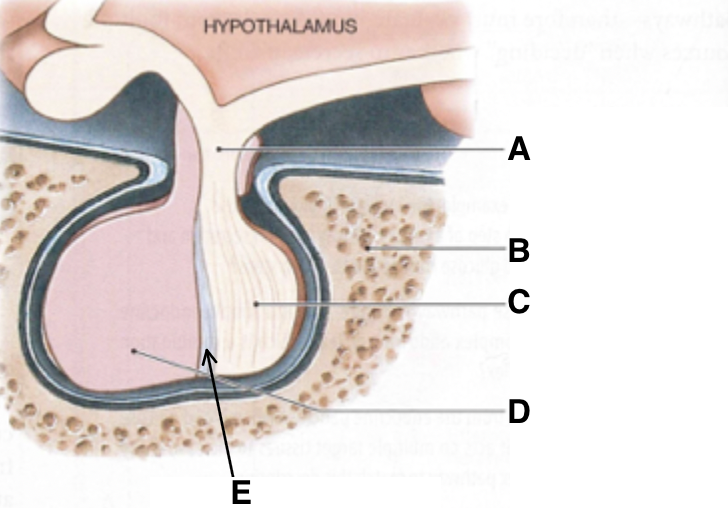
A
infundibulum

B
sphenoid bone

C
posterior pituitary gland

D
anterior pituitary gland

E
intermediate lobe of the pituitary
What is another name for the pituitary gland?
hypophysis
Where is the pituitary gland found?
in the pocket of the sphenoid bone
Where are the anterior pituitary and intermediate pituitary lobe derived from?
endoderm of the buccal cavity
Where is the posterior pituitary derived from?
neural ectoderm
Which hormones are released from the posterior pituitary gland?
oxytocin and ADH/vasopressin
Which system is the posterior pituitary gland a part of?
central nervous system
Is the posterior pituitary gland an endocrine gland?
no
Is the anterior pituitary gland an endocrine gland?
yes
Where is oxytocin and ADH produced?
hypothalamus
What connects the hypothalamus to the anterior and intermediate pituitary?
hypophyseal portal system
tropic hormone
a hormone which is used to cause another hormone to be released via a secondary messenger system
How are hormones released from the posterior pituitary gland?
the paraventricular and supraoptic nuclei in the hypothalamus produce hormones which travel to the posterior pituitary gland where they are released into the bloodstream
How are hormones released from the anterior pituitary gland?
neuroendocrine cells in the hypothalamus produce tropic hormones which travel to the anterior pituitary via a hypothalamic-pituitary portal system, at the pituitary the tropic hormones are converted to secondary hormones which are released into the bloodstream
Which hormone is released from the intermediate lobe of the pituitary gland?
melanocyte-stimulating hormone
Which hormones are released from the anterior pituitary gland?
FSH, LH, adrenocorticotropic hormone, thyrotropin, prolactin, growth hormone
Which neuro-hormones are produced by the hypothalamus?
ACTH-releasing hormone, TSH-releasing hormone, GH-releasing hormone, GHIH, gonadotropin-releasing hormone, dopamine
What is the effect of GH-inhibitory hormone on the anterior pituitary gland?
inhibits secretion of growth hormone and TSH
What is the effect of dopamine on the anterior pituitary gland?
inhibits secretion of prolactin
How is secretion of hormones from the pituitary gland regulated?
target organs are stimulated to secrete another hormone which travels to the hypothalamus through the bloodstream and inhibits it from secreting more hormones via a negative feedback loop
Where is the thyroid gland found?
in two lobes either side of the trachea just below the larynx

X
colloid

Y
C-cell

Z
follicular cell

A
parafollicular C cell

B
follicular cell

C
thyroid follicle

D
thyroglobulin (in colloid)

E
basement membrane
How is TGB-bound T3 and T4 synthesised?
iodination of tyrosine residues on thyroglobulin within the lumen of thyroid follicles after follicular cells have oxidised iodide and transported it into the colloid
What is the only known use of iodine in the body?
synthesis of thyroid hormone
Which thyroid hormone is the main product of the thyroid gland?
T4
Which thyroid hormone is more potent?
T3
Which type of cell produces thyroid hormone?
follicular cell
How are free T3 and T4 produced?
colloid droplets re-enter follicular cells where they bind to lysosomes which cleave T3 and T4 molecules from TGB
What happens to T4 within target cells?
it is de-iodinated to T3 or inactivated to rT3
How does T3 and T4 leave follicular cells?
simple diffusion across the basolateral membrane into surrounding capillaries
How are most thyroid hormones transported in the blood?
bound to thyroxine-binding globulin or albumin
How is a very small amount of thyroid hormones transported in the blood?
free in plasma
What regulates thyroid hormone synthesis and secretion?
thyrotropin-releasing hormone, thyroid-stimulating hormone, plasma iodide
What causes the secretion of thyroid hormones to increase gradually?
prolonged exposure to cold
What largely drives secretion of TRH from the hypothalamus?
central nervous system
What causes thyroid follicular cells to be inactive?
absence of TSH
What causes follicular hyperplasia?
prolonged high concentrations of TSH
What is the effect of thyroid hormone?
increases the metabolic rate in all tissues except gonads, brain and spleen
What are the 2 ways that thyroid hormone affects growth?
direct action on cells and by influencing growth hormone and potentiating its effects on target tissues
Where in the body are the adrenal glands found in the dog?
beneath the peritoneum, craniomedial to the kidneys
What are the 3 zones of the adrenal cortex?
zona reticularis, zona fasciculata, zona glomerulosa
What are the 2 main sections of the adrenal gland?
medulla and cortex