Proteins (OCR A LEVEL Biology)
 Call Kai
 Learn
 Practice Test
 Spaced Repetition
 Match
 Flashcards
 Knowt Play
1/31

There's no tags or description
Looks like no tags are added yet.
32 Terms
Covalent Bond
Strong bonds that help form new molecules, when electrons are shared between atoms to make them stable

Monomer
Single, small molecules
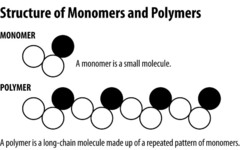
Polymer
Many monomers joined together.

Macromolecule
A very large molecule
Polypeptide
Polymer of protein molecules. Consists of many amino acid monomers covalently bonded together.

Proteins
Made up of polypeptide chains. One or more polypeptides arranged as a complex macromolecule.
Polypeptide Chains
Amino acids joined together with peptide bonds.
Amino Acids
The monomer of protein molecules. Structure contains an Amino Group, a Carboxyl Group, a Variable Group and an Alpha Carbon.

Primary Structure
The unique sequence of amino acids that makes up a protein or polypeptide chain.
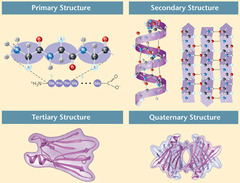
Secondary Structure
The way in which the primary structure of the polypeptide chain folds to form orderly shapes, either spirals(Alpha Helices) or pleats(Beta Pleated Sheets). Held together with many hydrogen bonds.

Tertiary Structure
The way in which the pleats or spirals fold into the final 3D structure of the protein. Hydrogen bonds, ionic bonds, disulphide bonds, hydrophobic interactions.

4 Bonds that Stabilise the Tertiary Structure
• Disulphide Bonds or Bridges
• Ionic Bonds
• Hydrogen Bonds
• Non-Polar Hydrophobic Interactions
Quarternary Structure
The structure formed when two or more polypeptide chains join together, sometimes with an inorganic component, to form a protein. Only found in proteins that contain more than one polypeptide chain.
2 Types of Proteins with a 3D Structure
Globular and Fibrous.
Denaturation
The process in which a protein loses its shape and structure through heat. Increasing the kinetic energy of a protein with a tertiary structure makes it vibrate more, and so the bonds that maintain its shape (which are mainly weak, non-covalent bonds) will be more likely to break.
Globular Proteins
Form highly folded, compact, roughly spherical structures that are water soluble. Hydrophyllic on the outside but hydrophobic on the inside. Usually have metabolic roles.
Examples of Globular Proteins
Haemoglobin, Insulin, Pepsin and Amylase.
Conjugated Globular Proteins
Globular Proteins with a prosthetic group.

Examples of Conjugated Globular Proteins
Haemoglobin and Catalase.

Fibrous Proteins
Formed from long insoluble molecules. Consist of repeated sequences of Amino Acids with hydrophobic R groups. Usually have structural roles.

amino acid structure
a carboxyl acid group, amino group, and R group
two amino acids can join via a condensation reaction to produce a...
dipeptide
Test for protein
Buriet solution
-Positive:Purple
-Negative:No change/blue
Fibrous proteins (structural proteins)
Extended and strand-like proteins. Examples: keratin, elastin, collagen, and contractile fibers
fibrous protein qualities
regular, repetitive sequences of amino acids, insoluble in water. these help them to from parallel polypeptide chains held together by cross links forming long, rope like fibres with high tensile strength.
globular protein qualities
spherical shape caused by tightly folded, polypeptide chains. hydrophobic groups on inside so soluble in water.
Collagen
-fibrous protein that provides mechanical strength whilst maintaining flexibility
-in artery walls, prevents artery walls from bursting when withstanding high blood pressure
-tendons, cartilage and connective tissue are made from collagen
-bones are also made from collagen and reinforced with calcium phosphate
Keratin
-fibrous protein that provides mechanical protection, an impermeable barrier to infection and being waterproof, prevents entry of water borne pollutants
- found in finger nails, hair, claws, hoofs, horns, scale, fur and feathers
Elastin
-fibrous protein that forms elastic tissue and gives skin its elasticity due to its cross linking and coiling properties.
-found in skin, the lungs: enabling them to inflate and deflate and the bladder: expanding to hold urine.
-like collagen, elastin helps our blood vessels to stretch and recoil as blood is pumped through them, helping maintain the pressure wave of blood as it passes through
Pepsin
-globular protein enzyme that digests protein in the stomach
-made up of 327 amino acids in a single polypeptide chain, folds into a symmetrical tertiary structure held together by hydrogen bonds and two disulfide bridges
-its hydrogen bonds, 2 disulfide links and basic R groups are what keeps it functional in the low pH of the stomach
Insulin
-A globular protein hormone synthesized in the pancreas that regulates blood sugar levels by facilitating the uptake of glucose into tissues
-binds to glycoprotein receptors on the outside of muscle and fat cells to increase their uptake and rate of consumption of glucose, from the blood
-composed of 2 polypeptide chains joined together by disulfide links
-amino acids with hydrophilic R groups are on the outside of the molecule, making it soluble in water
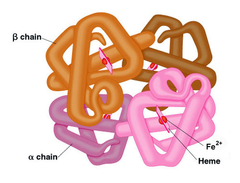
Haemoglobin
-globular protein in blood that readily combines with oxygen to transport it around the body. It comprises of four polypeptides (2xa +2xB) chains around an iron-containing haem group
-quaternary structure
-4 haem prosthetic groups containing Fe^2+
-conjugated protein
-oxygen binds with each haem in the lungs