General Chemistry Complete Set
 Call Kai
 Learn
Learn Practice Test
 Spaced Repetition
 Match
Match Flashcards
 Knowt Play
1/99

Earn XP
Description and Tags
Up to Molecular Orbitals and Bonding - p Block Diatomics... This is the complete general chemistry for year 1 chemistry flashcard set. It will be updated before and after every lecture until completion.
Name | Mastery | Learn | Test | Matching | Spaced | Call with Kai | Chat |
|---|
No analytics yet
Send a link to your students to track their progress
100 Terms
Relative atomic mass
The average relative isotopic mass of all isotopes of an element, weighted by their natural abundance.
How do you calculate the Relative atomic mass?
Multiply the Relative isotopic mass by the relative abundance.
What is the elemental identity of an atom defined by?
The atomic number (number of protons/electrons)
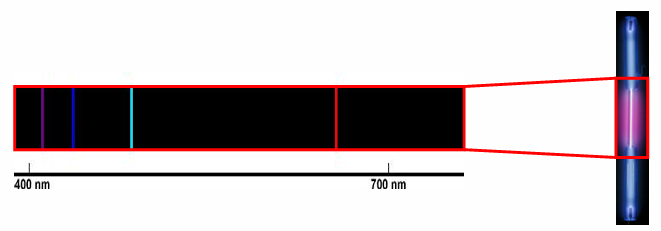
Describe Atomic Emission Spectroscopy:
Electric charge is applied to gaseous hydrogen.
Sufficient energy breaks H2 molecules into atoms.
Separated atoms give out excess energy as photons - pink/purple glow.
Diffraction grating separates constituent wavelengths of light into four colours: Balmer series.
Write out the Rydberg Equation:
Wavelengths obeyed an interesting relationship:

Use Rydberg’s Equation to show link to Einstein’s light energy equation:
So, excited atoms only lose energy in discrete jumps of energy.

Draw and describe Bohr’s model of the atom:
Electron only occupies particular orbiting distances around nucleus.
Coulombic force of attraction between nucleus and electron balanced by centrifugal force from motion of electron.
Loss or gain of energy associated with electron moving between orbits, corresponds to energy of photon emitted/absorbed.

What is de Broglie’s equation?
Suggested all particles have wave-like properties with wavelength dependent on their momentum.

What is Schrodinger’s equation?
Used to determine energy of a system and the form of the wavefunction that describes the system.

What information does the wavefunction contain, in the case of a hydrogen atom?
Energy (kinetic and potential)
Position
Momentum
What are the three quantum numbers?
n = principal quantum number (energy level/shell/distance from nucleus)
l = orbital angular momentum quantum number (shape)
ml = magnetic quantum number (orientation)
By what rules are the three quantum numbers related?
n = 1,2,3,4…
l = 0,1,2,…,(n-1)
ml = -l,-l+1,-l+2,…,l-1,l
What does the energies of the electron in hydrogen depend on?
The value of the principal quantum number. This is in agreement with the observation of the hydrogen emission lines made by Balmer:


For the case of n=3 list all of the possible allowed combinations of l and ml. There are 9 allowed combinations.

What is the Born interpretation of a wavefunction?
The square modulus of a wavefunction, evaluated at a given set of coordinates is proportional to the likelihood, P, of finding the electron at that point in space.

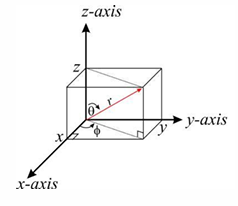
What are the wavefunction for a hydrogen atom?
Functions of all spatial coordinates, x/y/z, but can be broken into two parts:
One that depends on distance from the nucleus, r
Another (two symbols in the image showing angles) that depends on the direction taken.

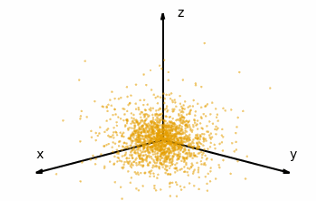
Draw a density plot for the case of n=1, l=0 and ml=0 and give reasoning as to why.
Since n=1, this is a 1s orbital. A spherically symmetric distribution will form.
Draw graph for the radial part of the wavefunction for the 1s orbital and explain it:
The wavefunction always has the same sign (always positive), the wavefunction has only one phase.

Draw both a density plot and graph of the radial part of the wavefunction for the case of n=2, l=0 and ml=0 and explain it:
Distribution is spherically symmetric, so an s orbital. The wavefunction shows two different phases separated by a radial node.

Draw both a density plot and graph of the radial part of the wavefunction for the case of n=2, l=1 and ml=0 and explain it:
Distribution shows dumbbell shape of a p orbital. The orbital shows two lobes of different phases with nodal plane in between. This is an angular node.
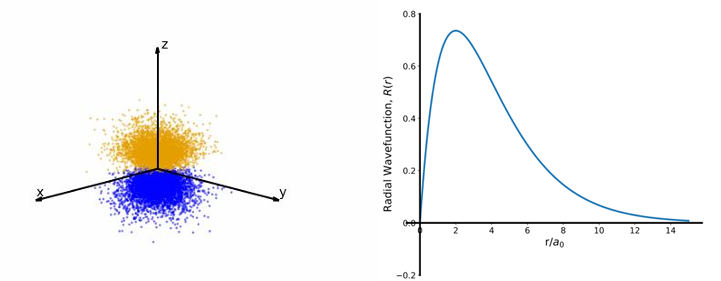
Draw both a density plot and graph of the radial part of the wavefunction for the case of n=3, l=1 and ml=0 and explain it:
Distribution shows an angular node and a radial node.

For the case n=5, l=1, ml=0, identify orbital type and predict no. angular nodes, no. radial nodes and total no. nodes:
Orbital type = p orbital
Angular nodes = 1 angular node
Radial nodes = 3 radial nodes
Total nodes = 4 nodes
How do you calculate the number of radial nodes?
n - l - 1 = number of radial nodes
How do you calculate the total number of nodes?
n - 1
How do you calculate the number of angular nodes?
Number of angular nodes = l
Draw contour plot to represent 2p atomic wavefunction:

Draw contour plot to represent 3p atomic wavefunction:

Draw an enclosure surface of atomic wavefunction for 2s:

Draw an enclosure surface of atomic wavefunction for 2p:

Draw an enclosure surface diagram for atomic wavefunctions where n=3, upto (including) 3p:

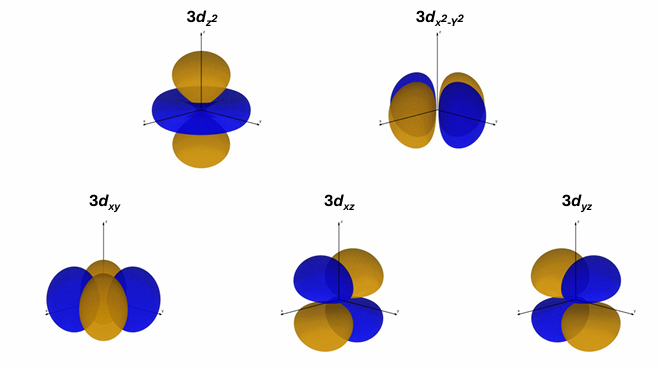
Draw an enclosure surface diagram for atomic wavefunctions where n=3, for 3d orbitals:
Define Radial Distribution Function:
The likelihood of finding an electron in a thin spherical shell of radius ‘r’ and thickness ‘dr’.
It loses information about angles (angular nodes), but shows radial nodes at values of ‘r’ where radial distribution function is 0.
Reveals the modal distance of the electron from the nucleus - maximum in RDF

Draw graph showing label of modal distance from nucleus for RDF of 2p:

What is the energy of the system of a hydrogen atom?
Kinetic energy of the electron
Potential energy of the electron-nucleus attraction
Define Central Field Approximation:
Assumption that the charge associated with all electrons other than the one of interest is spread spherically around the nucleus.
Define Effective Nuclear Charge, Zeff:
When the charge of other electrons reduces the nuclear charge felt by the electron of interest via shielding, the electron of interest experiences a reduced nuclear charge. The nuclear charge experienced by the electron of interest is called the effective nuclear charge, Zeff.
Draw RDF graph for 1s, 2s, 2p electron, and explain reasoning:
1s electron is closer to nucleus, experiences largest effective nuclear charge.
2s electron is closer to nucleus that 2p, has greater penetration through electron density, experiences larger effective nuclear charge than 2p.

Draw RDF graph for 3s, 3p, 3d electron, and explain reasoning:
3s electron is closer to nucleus, experiences largest effective nuclear charge.
3p is closer to nucleus than 3d, has greater penetration through electron density, experiences larger effective nuclear charge than 3d.

What is the trend for penetration via orbital order?
Penetration decreases further up the orbital order, for example, s orbital has greater penetration than p orbital.
What is the trend for shielding via orbital order?
Shielding increases further up the orbital order, for example, p orbital is more shielded than s orbital.
What is the trend for effective nuclear charge via orbital order?
Effective nuclear charge decreases further up the orbital order, for example, p orbital has a lower effective nuclear charge than s orbital.
What is the trend for energy via orbital order?
Energy increases further up the orbital order, for example, p orbital has a greater energy than s orbital.
Why is 3d generally before 4s in electron confirguration?
Due to shielding effects, the 3d orbital become lower energy than the 4s orbital once it starts to be filled.
What are Slater’s Rules for s or p electrons?
Electrons with the same n number, reduce Z by 0.35 (0.30 if a 1s electron)
Electrons with next lowest n number (n-1), reduce Z by 0.85
Electrons in further lowest n number (n-2) and lower, reduce Z by 1.00
What is Slater’s Rules used for?
To predict the effective nuclear energy that an electron of interest feels after accounting for any shielding from the other electrons in the atom.
What should you consider when using Slater’s Rules?
Only consider the electrons in the same or lower energy groups, for example:
[1s] [2s,2p] [3s,3p] [3d] [4s,4p] [4d] [4f] [5s,5p] [5d]
What are the Slater’s Rules for d or f electrons?
Electrons with same n and l combination, reduce Z by 0.35.
Electrons with lower n number (n-1) and lower, and/or lower values of l, reduce Z by 1.00.
Use Slater’s Rules to calculate the effective nuclear charge for carbon with configuration [1s2] [2s22p2]

Use Slater’s Rules to calculate the effective nuclear charge for silicon with configuration [1s2] [2s2 2p6] [3s2 3p6] [3d6] [4s2]

What does Valence Bond Theory predict for water molecule?
6 valence electrons on oxygen
1 valence electron on each hydrogen
So, two bonding pairs (single bonds) through sharing electrons between atoms.
Two identical lone pairs on oxygen.
Draw the formula for Molecular orbitals, Ψ, via Linear Combination of Atomic Orbitals, ϕ:

Draw the formula for Molecular orbitals, Ψ, via Linear Combination of Atomic Orbitals, ϕ, for the bonding in a H2 molecule:

Draw an in-phase combination for two 1s orbitals constructively interfering, and describe it:
Increase electron density between the two nuclei
Bonding molecular orbital, (σ)g

Draw an out-of-phase combination for two 1s orbitals destructively interfering, and describe it:
Reduced electron density (a node) between the two nuclei
Antibonding molecular orbital, (σ)u*

What does (σ) notation mean for bonding or antibonding molecular orbitals?
No change of phase is seen when rotating around the internuclear axis.

What does * notation mean for molecular orbitals?
Indicates an antibonding orbital - a node between nuclear centres.

What does g (gerade) notation indicate about molecular orbitals?
There is the same phase when travelling from one part of the molecular orbital through the centre and to the equivalent point on the opposite side.

What does u (ungerade) notation indicate about molecular orbitals?
There is a change in phase when travelling from one part of the molecular orbital through the centre and to the equivalent point on the opposite side.

Draw a Molecular Orbital Diagram for the combination of bonding and antibonding orbitals and describe the change in energy between the two bonding and antibonding orbitals:
The bonding orbital is lowered in energy by the same amount that the anti-bonding orbital is raised in energy.

*Why does the antibonding orbital raise in energy, and the bonding orbital lower in energy?
Write for formula for calculating bond order, and what does this number mean:
Bond order is the measure of the strength of the bonding in a molecule.

Calculate the bond order for Hydrogen, using the energy molecular orbital diagram:
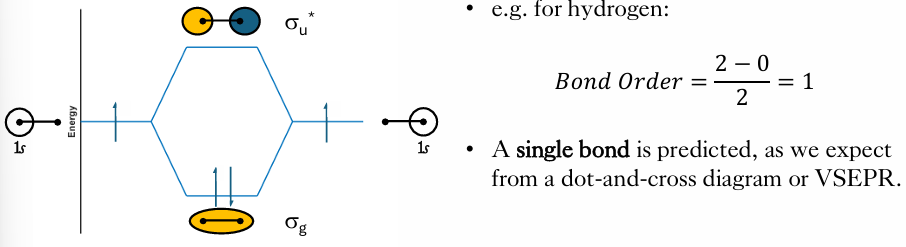

Predict the bond order for He2 molecule, using the molecular orbital energy diagram:
Bond order = 0 because helium molecule will fill orbitals in order of increasing energy and has a total of 4 electrons, two of which must go to 1σ and the other two to 1σ*, so one antibonding orbital and one bonding orbital is formed. These two molecular orbital cannot form a stable configuration
What molecular orbitals does head-on combination produce?
σg molecular orbitals and σu* molecular orbitals

What molecular orbitals does edge-on combination produce?
piu molecular orbitals and pig* molecular orbitals. Two changes of phase will be visible around the internuclear axis. Bonding and antibonding orbitals do not change as much in energy due to worse overlap.

Give one example of when some combinations of p and s orbitals have no net overlap:

Give an example of when some combinations of p and s orbitals do have net overlap:

What is the relationship between energy gaps and the impact on bonding between orbitals?
A bigger energy gap means a smaller impact on bonding.

Calculate the bond order for diatomic oxygen?
Bond order = 2
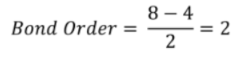
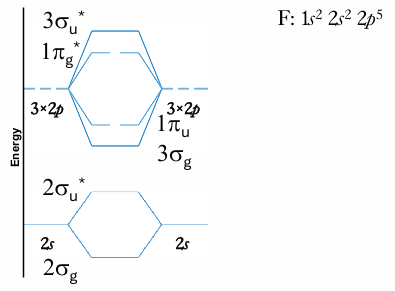
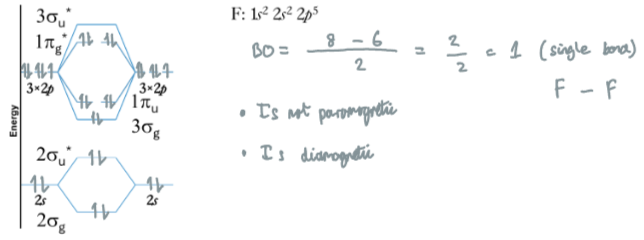
Using the molecular orbital diagram, predict the bond order of F2. State whether it is paramagnetic (unpaired electrons) or diamagnetic (all electrons paired).
Bond order = 1, is not paramagnetic, is diamagnetic.
What is the exception seen for boron to nitrogen concerning molecular bonding diagrams?
The 2σg and 3σg are close enough in energy that they can add in phase and out of phase. This raises the energy of 3σg and lowers the energy of 2σg. This changes the order of molecular orbitals, where the 1πu orbital is lower in energy than the 3σg

What is the relationship between the electronegativity of an atom in a heteronuclear diatomic molecule?
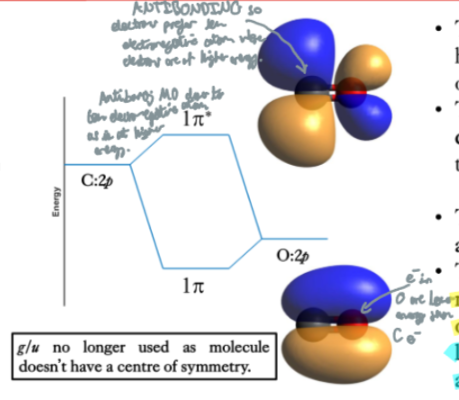
In an antibonding molecular orbital, there is a bigger contribution from the less electronegative atom, meaning electrons prefer the less electronegative atom, where electrons are at a higher energy. The antibonding molecular orbital is closer in energy to the atomic orbital on the less electronegative atom.
In a bonding molecular orbital, there is a bigger contribution from the more electronegative atom, meaning electrons prefer the more electronegative atom, where electrons are at a lower energy. The bonding molecular orbital is found to have an energy closer to the atomic orbital on the more electronegative atom.

What happens to the heteronuclear diatomic molecular orbitals when the electronegativity of one of the atoms increases?
As the electronegativity of the atom increases, the difference in electronegativity increases, causing the electrons to be pulled towards the nucleus of the more electronegative atom more strongly. The probability of finding an electron near more electronegative atom increases, so the electron density increases.

In heteronuclear diatomics, what does uneven share of electrons mean about the molecular orbital diagram?
The molecular orbital diagram is asymmetric.
Define Physical State:
The physical state of a substance is defined by particle packing and the shape and the volume it takes of the container.
What is the equation of state?
p = f(T,V,n)
p= pressure, T = temperature, V = volume, n = amount of substance
Define the state of matter gas through packing, shape and volume:
Packing: Tight
Shape: Indefinite
Volume: Indefinite

Define the state of matter liquid through packing, shape and volume:
Packing: Loose
Shape: Indefinite
Volume: Definite

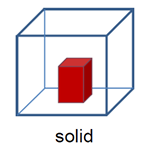
Define the state of matter solid through packing, shape and volume:
Packing: Free
Shape: Definite
Volume: Definite
What diagram represents the transitions between the states of matter, and what does the critical point mean?
A phase diagram - y axis is pressure and x axis is temperature.
The critical point marks the point, where beyond this point, the condensation of gas will never occur.

What is the full definition of Solid state?
Solids are composed of tightly packed particles that undergo little net movement and which interact with each other strongly. Solids have a defined shape and a defined volume.
What is the full definition of Liquid state?
Liquids are composed of loosely packed particles that can freely move around and which interact with each other weakly. Liquids do not have a defined shape but have a defined volume.
What is the full definition of Gas state?
Gases are composed of particles that can freely move around. The interaction between neighbouring particles is very weak. Gases do not have a defined shape and do not have a defined volume.
What is the SI unit for volume? (give the equivalent in litres)
m3 (1000 L)
What is the SI unit for temperature?
Kelvin (K)
What is the SI unit for Amount of a Substance?
Mole (mol)
What is the SI unit for Pressure?
Pascal (Pa)
Give the basic formula relating pressure to force and area:
Pressure (Pa) = Force (N) / Area (m2)
List all the Empirical Gas Laws:
Boyle’s Law
Charles’ Law
Gay-Lussac’s Law
Avogadro’s Law
What is Boyle’s Law?
Boyle’s Law is defined as when at constant temperature and amount of particles, the pressure and volume of a gas are inversely proportional.
Boyle’s Law is the pressure-volume relationship where:
pV = constant
p1V1=p2V2

What is Charles’ Law?
Charles’ Law is defined as when at constant pressure and amount of particles, the volume and temperature of a gas are directly proportional.
Charles’ Law is the volume-temperature relationship where:
V/T = constant
V1/T1 = V2/T2

What is Gay-Lussac’s Law?
Gay-Lussac’s Law is defined as when at constant volume and amount of particles, the pressure and temperature of a gas are directly proportional.
Gay-Lussac’s Law is the pressure-temperature relationship where:
p/T = constant
p1/T1 = p2/T2

What is Avogadro’s Law?
Avogadro’s Law is defined as when at constant pressure and temperature, the volume and amount of substance of a gas are directly proportional.
Avogadro’s Law is the volume-amount of substance relationship where:
V/n = constant
V1/n1 = V2/n2

Give the equations for all the empirical gas laws:

If volume increases, what happens to the temperature?
Due to Charles’ Law, the temperature increases.
If volume increases, what happens to the pressure?
Due to Boyle’s Law, the pressure decreases.
If temperature decreases, what happens to the pressure?
Due to Gay-Lussac’s Law, the pressure decreases.
If volume decreases, what happens to the number of particles?
Due to Avogadro’s Law, the number of particles decreases.
What are ideal gases, and what is the ideal gas equation?
Ideal gases are gases that follow all empirical gas laws.
The ideal gas equation is:
pV=nRT where
p = pressure
V = volume
n = moles
R = ideal gas constant (8.314 Jmol-1K-1)
T = temperature

What does the ideal gas equation approximate, and explain simple ideal gas physics:
Ideal gas approximates the state of gas. As the pressure of the gas approaches 0, the ideal gas equation result becomes increasingly more exact.
An ideal gas is composed of particles that obey Newton’s Laws of Motions. Collisions between gas phase particles are ‘elastic’ that there is no loss in kinetic energy following a collision. The gas-phase particles behave as ‘hard spheres’ so there is no potential for interaction between any two gas-phase particles.