Kines Exam 3 - Shoulder
 Call Kai
 Learn
 Practice Test
 Spaced Repetition
 Match
 Flashcards
 Knowt Play
1/51

There's no tags or description
Looks like no tags are added yet.
52 Terms
What structures originates as proximal stabilizers?
spine, ribs, cranium
What structures inserts as proximal stabilizer?
scapula and clavicle
What structures originates as distal stabilizer?
scapula and clavicle
What structures inserts as distal stabilizer?
humerus or forearm
Muscle control of scapular movement:
to maintain ______________
To maintain _____________
To maintain articular relationship of GH joint
To maintain optimal length-tension relationship of muscles at GH joint
What structures attach as Axiohumeral? What is it called?
Thorax → humerus; Power muscles of the shoulder
What muscles attach to the Axiohumeral?
pectoralis major, lats
What structures attach as Axioscapular? Where does it locate?
Thorax → scapula; position of the glenoid for the humeral head
What muscles attach to the Axioscapular?
Serratus anterior, Trap, Rhomboids, Levator Scapula, Pec minor
What structures attach as Scapulohumeral? How does it act?
Scapula → Humerus; Act on and stabilize the GH joint
What muscles attach to the Scapulohumeral?
Deltoid, Supraspinatus, Infraspinatus, Subscapularis, Teres Major, Teres minor
What muscles act as the force couple of the shoulder?
Serratus Anterior - throughout
Upper trapezius - initiation and continues
Lower trapezius - late phase
Which muscle does have greatest mechanical advantage for upward rotation?
serratus anterior
In the force couple, middle trapezius acts as what?
adduction (retraction) to balance abduction (protraction) action of serratus anterior
Muscles of acting scapular downward rotation
rhomboid, levator scapula, pectoralis minor
Muscles of acting scapular posterior tilt
serratus anterior, lower trap, latissimus dorsi
When scapular posterior tilting, what does it occur at?
occurs at end-range arm elevation
maintain “open” subacromial space which prevents impingement
Muscles of acting scapular elevation
upper trap (+upward rotation), levator scapulae (+downward rotation), rhomboids (+downward rotation)
What are the functional tasks of scapular elevation?
support the posture, lifting, shrug
Muscles of acting scapular depression
lower trap, latissimus dorsi, pectoralis minor, subclavius
What are the functional tasks of scapular depression?
walking with crutches or cane
Muscles of acting scapular abduction (clavicular protraction)
serratus anterior
What are the functional tasks of scapula abduction?
punching, forward pushing, reaching forward, push-up
Muscles of acting scapular adduction (retraction on clavicle)
middle trapezius, rhomboids (+elevation), lower trap (+depression)
What are the functional tasks of scapular adduction?
maintain posture, pulling activities like climbing
Scapular Downward rotation- causes by a long thoracic nerve injury:
When the person lifts your arm (flex arm), where does the person’s inferior angle go?
inferior angle does not reach mid-axillary line during flexion and ABD
What motion causes to deficit when the person limits scapular downward rotation?
What muscles would be weak or long?
deficits upward rotators
serratus anterior, trapezius
What muscles would be excessive or short when the person limits scapular downward rotation?
rhomboid, levator scapulae
What motion would limit for the person who has limitation of scapular downward rotation?
short abductors and potential for impingement
What nerve causes to limit the scapular downward rotation?
long thoracic nerve
Alignment of scapular anterior tilt
inferior angle of scapula protrudes from thorax
For scapular anterior tilting, posterior tilt insufficient with arm elevation. What structures are “short” vs. “long/weak”?
short → pec minor
long/weak → serratus anterior, subscapularis
Inappropriate scapular movement can cause impingement of structures at ____ joint
glenohumeral joint
People with chronic impingement syndrome compared to healthy controls:
less ____________ early in the range of shoulder elevation
Progressive _________ vs. normal posterior tilting at end-range of shoulder elevation
Decreased activity of (muscle) & increased (muscle) activity in people with shoulder impingement
1 scapular upward rotation
2 anterior tilting
serratus anterior; upper trap
Muscles of scapulohumeral joint
deltioid, supraspinatus, infraspinatus & teres minor, subscapularis, teres major
What is the action of middle deltoid?
abduction
Functions of deltoid
multipennate structure compensates for SMALL moment arm
maintenance of optimal length-tension relationship is dependent on scapular position
4 rotator cuff muscles
supraspinatus, teres minor, infraspinatus, subscapularis
Arthrokinematics of supraspinatus
drives the superior roll of the humeral head
Important function of supraspinatus
Compress _______ against _____?
creates a semi-rigid spacer above ____, restricting excessive _____ translation
compress humeral head against the glenoid fossa
above humeral head, superior translation

Arthrokinematics of infraspinatus, teres minor, subscapularis
superior roll and inferior glide
Functions of infraspinatus, teres minor, subscapularis
for infraspinatus, teres minor, subscapularis
for infraspinatus, teres minor
For infraspinatus, teres minor, subscapularis, exert a downward translational force on humeral head
for infraspinatus, teres minor, externally rotates the humerus

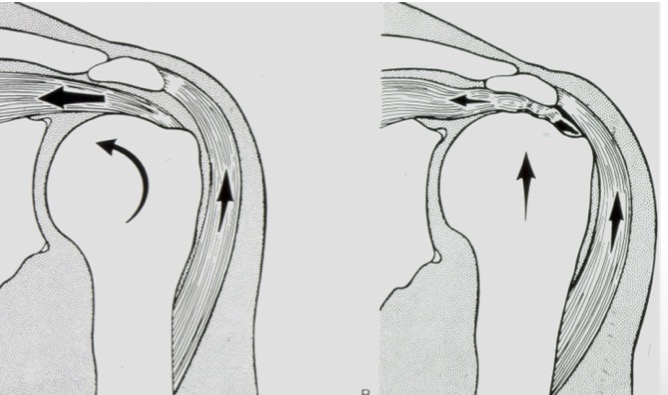
Test question: As the force couple between rotator cuff and deltoid, which direction of the force of rotator cuff and deltoid go to?
Downward force of rotator cuff & superior force of the deltoid
strong force couple between deltoid and rotator cuff muscles

Functions of rotator cuff insufficiency
can result in superior movement of humeral head because of dominant deltoid
± insufficient humeral lateral rotation
maybe a mechanism for undersurface/ articular surface tearing of the rotator cuff
Rotator cuff degeneration
High incidence of ____ and ____
tendonitis; rotator cuff muscles
Rotator cuff degeneration: Test question
Common site of _______ at which tendons?
hypovascularity (low blood supply); supraspinatus and infraspinatus tendons
Rotator cuff degeneration
Tears noted on where?
articular (humeral) side of avascular zone
Rotator cuff degeneration
Incidence of ________ tear increases with advancing ___
rotator cuff; age
Humerus-scapula arthroskinematics
superior roll and inferior glide
What is the insufficient of humeral superior glide?
insufficient inferior glide during flexion and ABD
For humeral superior glide, deficit humeral head depressors which muscles?
subscapularis, teres minor, infraspinatus
For humeral superior glide, what muscles would be dominant humeral head elevators?
deltoid and supraspinatus