PSYC 1200 Ch.5: Sensation and Perception
 Call Kai
 Learn
 Practice Test
 Spaced Repetition
 Match
 Flashcards
 Knowt Play
1/95

There's no tags or description
Looks like no tags are added yet.
96 Terms
Sensation
The detection, by sensory organs, of physical energy emitted or reflected by physical objects (physical stimuli)
Where does sensation begin at?
Sense receptors
Sense receptors
Specialized cells needed to sense different stimuli and sends messages to sensory neurons
Perception
The process by which the brain organizes and interprets sensory information
Anatomical code
The principle that different sensory modalities exist because signals received by the sense organs stimulate different nerve pathways leading to different areas of the brain
What do we use to see and hear? (trick question)
Brain, not our eyes and ears
Synesthesia
A condition in which a sensation in one modality consistently evokes a sensation in another
What condition is smelling colours an example of?
Synesthesia
Possible cause of synesthesia
Increased neural connections or a lack of inhibition between sensory areas in the brain
What does anatomical encoding not explain?
Why our sense are separate or the variations of experience within a particular sense
Functional code includes what information? (4)
Which cells are firing
How many cells are firing
Rate at which cells are firing
Patter of each cell’s firing
Stimulus thresholds (2)
Absolute threshold
Difference threshold
Absolute threshold
The minimum amount of energy or quantity of a stimulus required for it to be reliable detected at least 50% of the time it is presented
Difference threshold
Smallest difference between two stimuli that a subject can detect
“just noticeable difference” fraction name
Weber fraction
Does the Weber’s fraction stay consistent or change?
Stay consistent
What does the Weber’s fraction tell us as the physical stimuli gets stronger?
As the magnitude of the stimuli increases the larger the difference has to be to be able to detect it
Signal detection theory
A psychophysical theory that divides the detection of a sensory signal into a sensory process and a decision process
Signal detections (4)
Hit: Stimuli is present; stimuli perceived
Miss: Stimuli is present; stimuli not perceived
False Alarm: Stimuli is not present; perceive as if stimuli was present
Correct rejection: Stimuli is not present; perceive as stimuli not present
Sensory adaptation
Decline in sensory responsiveness when a stimulus is unchanging or repetitious
Is sensory adaption beneficial? If not, give an example why.
Usually beneficial
At times not - e.g. smell of smoke in the house
Do we adapt to all stimulus?
No, we never completely adapt to very intense stimuli
Is too little sensory stimulation bad?
Depends on personal factors and how people perceive it as their own
Selective attention
Process of focusing on selected aspects of the environment while blocking out others
Inattentional blindness
Failure to consciously perceive something you are looking at because you are not attending to it
What is the stimulus for vision and what is its form?
light - form of electromagnetic radiation
3 dimensions of visual experience
Hue
Saturation
Brightness
Hue
The dimension of visual experience specified by color names, is related to the wavelength of light
Short and long wavelength hue (colour)
Short - blue/violet
Long - red/orange
Saturation (colourfulness)
The dimension of visual experience related to the complexity of light - how wide or narrow the range of wavelength is
Colours in white
All colours
Saturation of black
No saturation at all - void
Brightness
The amount, or intensity, of the light an object emits or reflects and corresponds to the amplitude (maximum height) of the light wave
Parts of the eye (6)
Sclera
Cornea
Pupil
Iris
Lens
Retina (cones and rods)
Sclera
White outer layer of eye
Cornea (3)
Clear layer that covers the front of the eye; protects the high and bends light
Pupil
Regulates amount of light let into the eye
Iris
Round muscle that adjusts the size of the pupil
Lens (2)
Clear structure that focuses light onto the back of the eye; changes shape of light
Retina
Neural tissue lining the back of the eyeballs interior that contain the receptors for vision (cones and rods)
Cones
Produce high-detail, colour vision at our point of visual focus; concentrated on fovea (small pit in the center of retina)
Rods
Provide peripheral vision and are specialized for low light conditions; located on outer regions of the retina
Phototransduction
The process by which rods and cones gain sensitivity to low light levels
How are visuals perceived in the eye and brain?
Eye sees visuals upside down but the brain flips it back right side up
Cells involved in light to nerve
Bipolar neurons
Ganglion cells
Optic discs
Optic nerves
Bipolar neurons
Synapse onto photoreceptors and carry message to ganglion cells
Ganglion cells
Transmits signals from bipolar neurons to the brain
Optic disc (how blind spots are created)
Area on retina lacking rods and cones due to the optic nerve in the way - creating a blind spot
Optic nerve
Axon tracts from ganglion cells leading to the brain
Feature-detector cells in the visual areas of the brain detect what?
Specific aspects of the visual world, such as lines at various orientations
What parts of the brain have feature-detection cells and what do they perceive? (3)
Above the cerebellum - faces
Hippocampus - environment
Occipital cortex - body parts
Trichromatic Theory (Young-Helmholtz Theory)
Colour vision is determined by three different cone types that are sensitive to short, medium, and long wavelength light (blue, green, red)

Combined activity of all three cone types generate what in the Trichromatic Theory?
A unique signature associated with each perceived colour, even colours without a corresponding wavelength


What cone distribution is depicted by these pictures?
Left - trichromat cone distribution (normal)
Right - dichromat cone distribution
What type of trait is dichromatic (lack red cones)?
Recessive x-linked trait
Opponent-process theory (and colours)
Perceive colour in terms of opposite ends of the spectrum (red to green, yellow to blue, white to black)
Oppose-process cells
In the retina and thalamus; respond in opposite fashion to short and long wavelengths of light
How do opponent-process theory work?
Opponent-process cells that are inhibited (red cells) by a particular colour (green cells) produce a burst of firing when the color is removed (red cells on white screen)
Opponent-process theory explains why we are susceptible to what?
Negative afterimages - seeing red after staring at green
Gestalt psychologists
First to study how people organize the world visually into:
meaningful units
patterns
Gestalt principles
Describe strategies used by the visual system to group sensory building blocks into perceptual units
Types of Gestalt principles (4)
Figure and Ground
Proximity and Similarity
Continuity
Closure
Figure and Ground idea
Objects or “figures” in our environment tend to stand out against a background

Proximity and Similarity
Ways we group things together
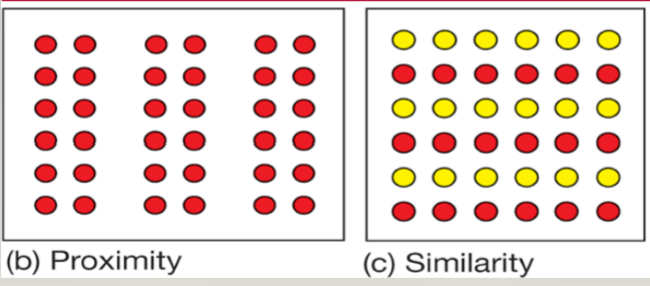
Continuity
Perceptual rule that lines and other objects tend to be continuous, rather than abruptly changing direction

Closure
People tend to fill in blanks to perceive a complete object whenever an external stimuli partially matches the object
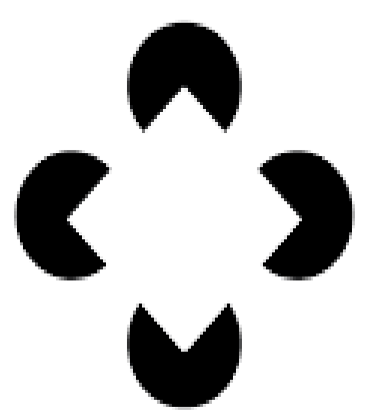
Visual pathways (2)
Dorsal stream
Ventral stream
Dorsal stream
Where/how
Guides interaction with objects
Responsible for depth and motion perception
Where is the dorsal stream located
Extends from visual cortex to the parietal lobe
Binocular depth cues
Distance cues that are based on the differing perspective of both eyes
Types of binocular depth cues (2)
Convergence
Retinal disparity
Convergence
Depth cue; when the eye muscles contract so that both eyes focus on a single object

Retinal disparity
Depth cue; the difference in perspective provided by each eye
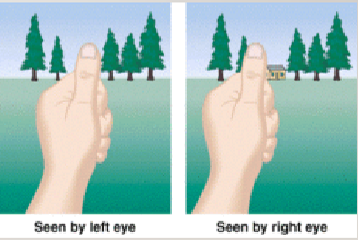
Stereopsis
Sense of depth
When do we use binocular and monocular cues in terms of distance?
Binocular - 50 feet or less
Monocular - anthing farther
Monocular depth cues
Depth cues that depend on only one eye
Types of monocular depth cues (7)
Interposition
Linear perspective
Motion parallax
Relative size
Relative clarity
Texture gradients
Light and shadow
Interposition
When an object is interposed between the viewer and a second object, partly blocking the view of the second object, the first object is perceived as being closer

Linear perspective
When two lines known to be parallel appear to be coming together or converging, they imply the existence of depth

Motion Parallax
When an observer is moving, objects appear to move at different speeds and in different directions.
Closer an object - faster it seems to move and seem to move backward
Farther an object - slower it seems to move and seem to move forward
Relative size
Perceive the same object but a smaller size as being farther
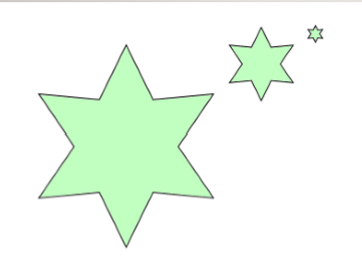
Relative clarity
Closer objects seem to have more detail as farther objects seem more blurry and gradient

Texture gradients
Able to see green, larger, details in closer objects, but only see a field of yellow when looking farther

Light and shadow
Allow us to understand 3D objects and its relative distance

Ventral stream (6)
‘What’
Responsible for object and face recognition
Fusiform face area
Pareidolia
Prosopagnosia
Perception Constancies
Where is the ventral stream located
Extends from the visual cortex to the temporal lobe
Pareidolia
Seeing faces in non-face objects

Prosopagnosia
No ability to recognize faces
Fusiform face area is responsible for what and not specific to what?
Visual expertise, not specific to faces
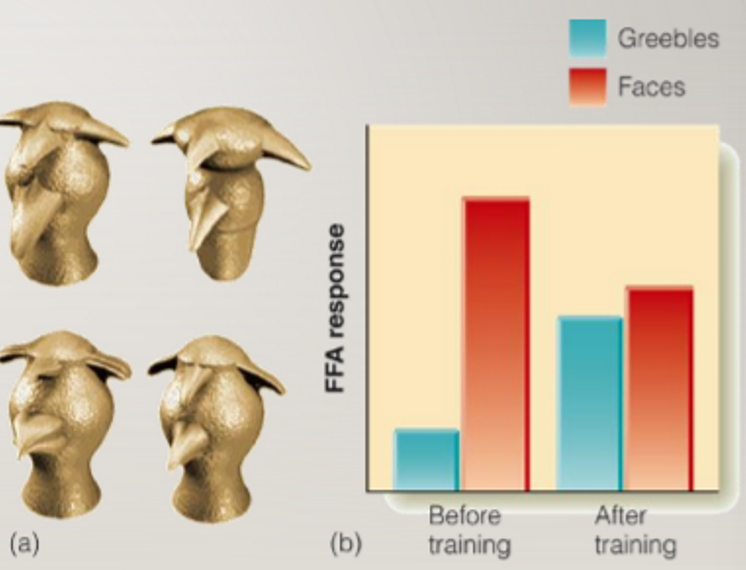
Perceptual constancies
The accurate perception of objects as stable or unchanged despite changes in sensory patterns they might produce
Best-studied visual perceptual constancies (5)
Size
Shape
Location
Brightness
Color
Size constancy example

Shape constancy example
Heavily context dependent - need to understand how the object works first

Location constancy example
Tendency for objects to appear stable in their positions even when the observer moves (car door)

Brightness constancy example

Perceptual illusions
When sensory cues are misleading or when we misinterpret cues
