Aerobic & Anaerobic Energy Systems in Muscles
 Call Kai
 Learn
 Practice Test
 Spaced Repetition
 Match
 Flashcards
 Knowt Play
1/23

There's no tags or description
Looks like no tags are added yet.
24 Terms
ATP
Adenosine Triphosphate
the universal "energy currency" of cells and the direct chemical fuel required for muscle contraction and relaxation
ADP-P
Adenosine Diphosphate + Inorganic Phosphate
Represents the direct products formed when ATP (Adenosine Triphosphate) is broken down by the enzyme ATPase during the Muscle Contraction and Locomotion cycle
ATP-PC (Anaerobic Alactic)
This is the simplest of the two anaerobic energy pathways.
It allow for quick, intense muscle contraction - typically enough ATP for about 10-15 seconds of strenuous effort
Relies on the breakdown of phosphocreatine, a compound normally stored in muscle and readily accessible
ADP → ATP = creates energy
Replenishment of phosphocreatine requires ATP
This system is referred to as anaerobic alactic because the ATP-PC system does not yield lactic acid as a byproduct.
Recovery about 2-5 minutes
Phosphocreatine in ATP-PC
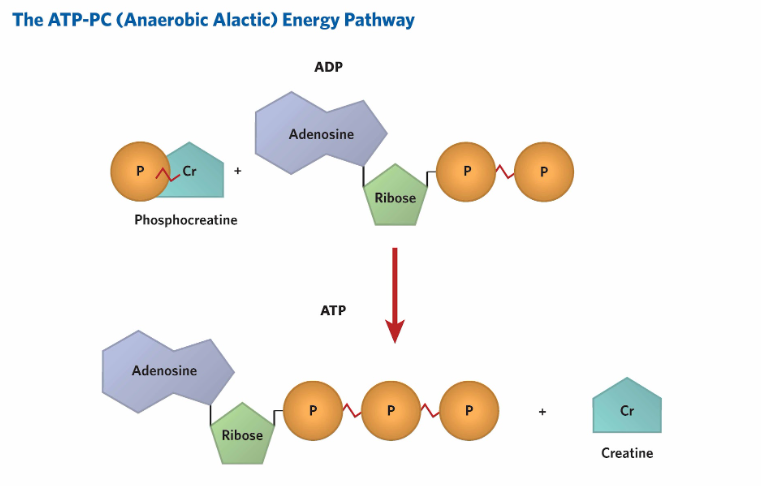
Phosphocreatine (PC) is a high-energy molecule in which the phosphate can be broken off easily and which can be used to convert ADP (adenosine diphosphate) back to ATP.
The chemical equation representing this process is:
PC + ADP → ATP + creatine
ATP-PC Pathway Diagram
Glycolysis (Anaerobic Lactic)
This pathway involves the partial breakdown of glucose, with lactic acid as a byproduct
It does not involve oxygen and is therefore “anaerobic”
Pyruvate acid → used in aerobic system if oxygen is available
If oxygen is not readily available, pyruvate acid converted into lactic acid
Glycolysis Chemical Pathway
The first sequence of reactions in the full metabolism of glucose.
During glycolysis, glucose is partially broken down to provide usable energy in the form of ATP.
Glycolysis involves eleven separate biochemical reactions and yields twice as much ATP compared to the ATP-PC system.

Glycolysis Pathway

Pyruvate
Main product of glycolysis is pyruvate (pyruvic acid).
Under aerobic conditions, pyruvate is the beginning of cellular respiration, which produces ATP.
In the absence of sufficient oxygen (intense training, or high altitudes), pyruvic acid is converted to lactic acid → “anaerobic lactic system”
Allows a person to engage in a high level of performance for about an additional 90 seconds (in comparison to ATP-PC)
The “Oxygen Factor”
The lesson mentions pyruvate is the "beginning of cellular respiration" when oxygen is available - visualize pyruvate as a traveler at a fork in the road.
Path A (Oxygen): Leads to the Krebs Cycle and 32 ATP.
Path B (No Oxygen): Leads to Lactate and only 2 ATP.
Lactic Acid
The buildup of lactic acid eventually hinders the breakdown of glucose and decreases the ability of the muscle fibres to contract.
The buildup of lactic acid is associated with the intense burning sensation felt in muscles.
Lactic acid removal requires 30-60 minutes of exercise recovery or 1-2 hrs of rest recovery. This can be achieved by light aerobic activity combined with rest intervals.
Cellular Respiration
the process in which the body’s cells use oxygen to generate energy through the various metabolic pathways found in the mitochondria of cells. (Aerobic Glycolysis, Krebs Cycle, ETC)
In the presence of oxygen, cellular respiration can, in theory, sustain activity for a very long time, or until other physiological limits are reached. This is the pathway that underlies endurance-type events
C6H12O6 + 6O2 → 6CO2 + 6H2O + energy
(glucose) (ATP)
3 Sub Pathways of Cellular Respiration
Glycolysis
Krebs Cycle
Electron Transport Chains
Glycolysis
Same as in the anaerobic lactic system, except that, in the presence of oxygen, pyruvic acid is converted to acetyl CoA (rather than lactic acid).
Acetyl CoA enters into the Krebs cycle or citric acid cycle
Krebs cycle is a central pathway for the metabolism of fats and proteins as well
Krebbs Cycle
Involves a series of 8 chemical reactions
2 ATP molecules are produced at the end of the process, along with new compounds that are capable of storing “high energy” electrons
These high energy electrons are then sent to a process within the mitochondria of cells, known as the electron transport chain
Electron Transport Chain
By the end, large amounts of ATP are produced, along with carbon dioxide and water
The “chain” is a series of electron carriers and protein complexes that accept and donate electrons in a sequential series.
The final electron acceptor is oxygen
Cellular Respiration (Aerobic) Pathway Diagram

Creatine Kinase
The enzyme involved in the ATP-PCr energy pathway that splits PCr into individual phosphorous and creatine ions.
Anaerobic Threshold (AT)
The point at which the lactate is accumulating in the bloodstream.
Lactate Threshold 1 (LT1): The First Rise
Definition: This is the first intensity level at which blood lactate levels begin to rise above resting levels.
Physiological Context: At this stage, the Aerobic System is still the primary energy provider. However, the Anaerobic Lactic system is starting to contribute more significantly to the energy mix.
Athlete Sensation: The athlete can usually maintain this pace for a long duration (e.g., a marathon pace). They can still talk in full sentences, but their breathing becomes slightly deeper.
Training Application: Training at or just below LT1 improves aerobic efficiency and the body’s ability to use fats as a primary fuel source.
Lactate Threshold 2 (LT2) / OBLA
Definition: This is the point where lactate production significantly exceeds the body's ability to clear it. It is often referred to as OBLA (Onset of Blood Lactate Accumulation) and typically occurs when blood lactate concentration reaches 4 mmol/L.
Physiological Context: The body is transitioning from a "steady state" to an unsustainable state. The Anaerobic Lactic system is working at a high rate, and hydrogen ions (H+) are beginning to accumulate, causing the pH in the muscles to drop (acidosis).
Athlete Sensation: This is often described as "the wall" or the maximum intensity an athlete can maintain for about 30–60 minutes (e.g., a 10k race pace). The "burning" sensation in the muscles begins shortly after passing this point.
Training Application: Training at LT2 increases the "ceiling," allowing athletes to perform at higher intensities for longer before fatigue sets in.
Energy System Continuum,
At Rest/Low Intensity
Your aerobic system is so efficient that it "clears" (recycles) any lactate as fast as it is produced. Your blood lactate levels stay flat.
Energy System Continuum,
At LT1
You have reached an intensity where the aerobic system can no longer keep up with the demand on its own. To help out, the Anaerobic Lactic system starts "turning up the volume."
Angiogenesis
The Increase in vascularization (# of blood vessels) within muscles.