H Chemistry Unit 3 Habibi
 Call Kai
 Learn
 Practice Test
 Spaced Repetition
 Match
 Flashcards
 Knowt Play
1/22

There's no tags or description
Looks like no tags are added yet.
23 Terms
atom
the smallest particle of an element that retains the properties of that element
why is an atom neutral?
The number of protons (+) and electrons (-) are equal in a neutral atom.
electron cloud
the area outside of the nucleus containing electrons.
electrons
negatively charged subatomic particles found outside of the nucleus
What determines which element an atom is?
the number of protons determines the element
neutrons
subatomic particle found in the nucleus that carries no charge
atomic number
equal to the number of protons of an element, (and the number of electrons in a neutral atom)
mass number
the number of protons plus neutrons is the mass number of an isotope
hyphen notation
the element name or symbol is followed by a hyphen and the mass number of the isotope
How are cations formed?
electrons are lost giving the ion more positive charges than negative, and an overall positive charge. (cats are positive)
How are anions formed?
electrons are gained giving the ion more negative charges than positive, and an overall negative charge.
What type of element generally forms cations?
Metals generally form cations by losing electrons.
How are isotopes of the same element alike, and how are they different?
Isotopes of the same element have the same number of protons, but they have different numbers of neutrons giving them different masses.
How did Rutherford's model improve on Thomson's model?
Rutherford's model determined that most of the atom
is empty space. He also determined that the positive nucleus is very dense, small, and only takes up a very small amount of the volume of the atom. He described the electrons as circling around the nucleus.
According to the current Quantum Model of the atom, describe the movement and location of the electron.
In the current Quantum Mechanics Model, the electrons are located in an electron cloud. Within that cloud electrons have a dual-wave particle nature and exist in orbitals, 3-d regions around the nucleus that indicate the probable location of electrons.

Billiard Ball Model (John Dalton)

Quantum Mechanical Model

Bohr Model

Plum Pudding Model
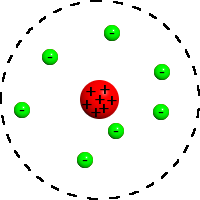
Rutherford Model
# of protons (p+) is equal to...
atomic number (bottom number)
# of neutrons (n0) is equal to...
mass number - atomic number (top-bottom)
# of electrons (e-) is equal to...
atomic number (ONLY IN NEUTRAL ATOMS)