Drug Excretion
 Call Kai
 Learn
Learn Practice Test
 Spaced Repetition
 Match
Match Flashcards
 Knowt Play
1/43

There's no tags or description
Looks like no tags are added yet.
Name | Mastery | Learn | Test | Matching | Spaced | Call with Kai | Chat |
|---|
No analytics yet
Send a link to your students to track their progress
44 Terms
Excretion
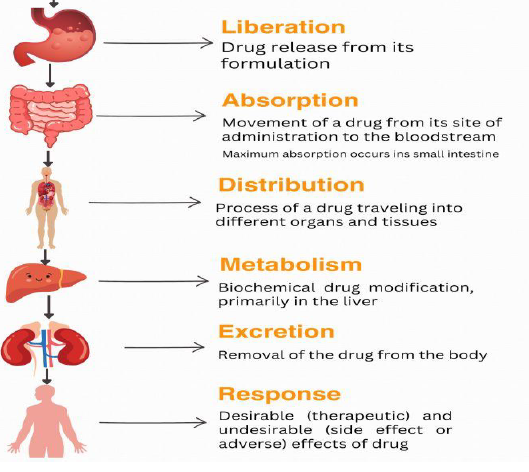
the final LOSS of the drug substance or its metabolites from the body such as through the kidney (urine), intestines (feces), skin (sweat), saliva, and/or milk.
route of drug excretion

drug elimination
Irreversible removal of drug from the body by all routes of elimination.
Collective term for metabolism and excretion
nonvolatile drugs
are excreted mainly by renal excretion, into the urine
volatile drugs
gaseous anesthetics, or drugs with high volatility, are excreted via the lungs into expired air.
clearance
the process of drug elimination from the body or from a single organ without identifying the individual processes involved.
the volume of fluid cleared of drug from the body per unit of time
mL/min or L/hr.
kidney
Located in the peritoneal cavity
most important organ for excretion
maintain normal fluid volume
maintain salt and water balance
with 2 endocrine fxn
secretion of renin(regulates BP)
secretion of erythropoetin(RBC production)
regulation of renal blood flow
Blood flow to an organ is directly proportional to the arteriovenous pressure difference (perfusion pressure) across the vascular bed and indirectly proportional to the vascular resistance.
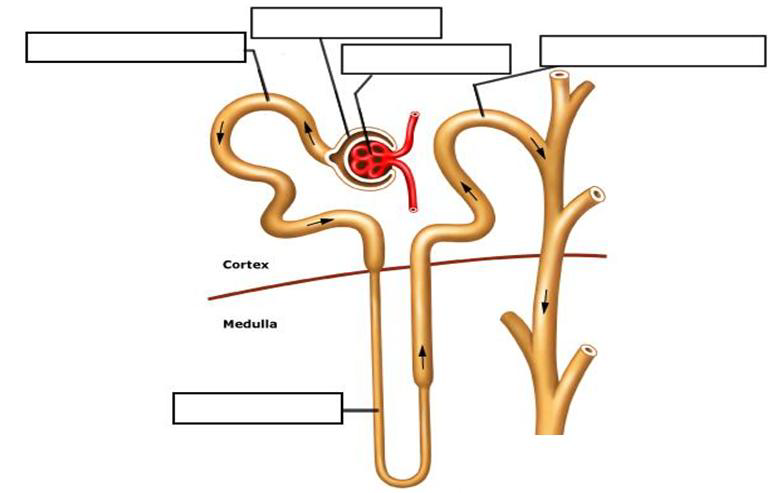
nephrons/malphigian bodies
responsible for the removal of metabolic waste and the maintenance of water and electrolyte balance.
parts of capillary part
of nephron
glomerulus and bowman’s capsule
parts of tubular part
of nephron
PCT
LOH
DCT
CG
Ureter
parts of nephron
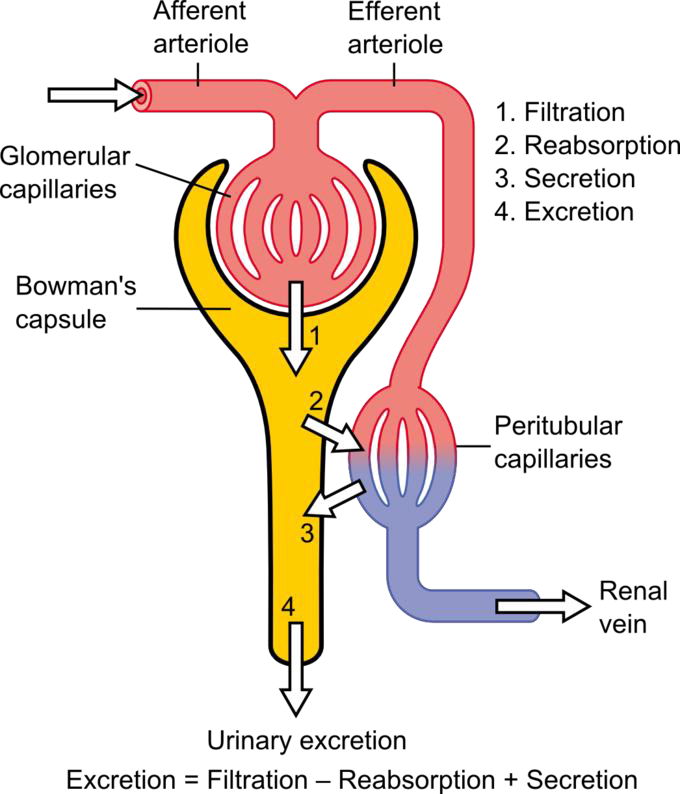
3 kidney processes
GF ATS TR
Glomerular filtration
Active tubular secretion
Tubular reabsorption
glomerular filtration
passive process by which small molecules & drugs are filtered through glomerulus
filtration of LMW molecules (MW<500)
normal GFR: 125mL/min (180 L/day)
GFR - tells how healthy the kidney is
ave urine: 1-1.5 L (99% are reabsorbed)
depends on pressure
100 mmHg - pressure of artery
45-65 mmHg - pressure on glomerulus
active renal secretion
Occurs in proximal convuluted tubule
Reabsorption of water and active secretion of some weak electrolyte (weak acids)
Requires carrier and energy ( against conc gradient)
reflects the effective renal plasma flow (ERPF) - 425 to 650 mL/min
excretion
filtration - reabsorption + secretion = ?
P-amino hippuric acid (PAH) and Iodopyracet (Diodrast)
drugs used to measure active tubular secretion
These substances are both filtered by the glomeruli and secreted by the tubular cells
tubular reabsorption
occurs in distal convoluted tubule
If a drug completely reabsorbed (eg. Glucose), then the values for the clearance of the drug is approximately ZERO.
For drugs that are partially reabsorbed, clearance values will be less than the GFR of 125 to 130 mL/min
tubular reabsorption
Reabsorption of water and passive excretion of lipid soluble drugs
Depends on urine pH
Based of Henderson-Hasselbalch equation
reabsorb
acidic urine + acidic drug = ?
excreted
acidic urine + basic drug = ?
excreted
basic urine + acidic drug = ?
reabsorb
basic urine + basic drug = ?
factors affecting excretion
Diet rich in:
Carbohydrate > higher urinary pH
Protein > lower urinary pH
Drugs (ascorbic acid and antacids)
alter urinary pH when administered in large quantity
Intravenous fluids (solutions of bicarbonate or ammonium chloride)
change urinary pH and alter drug reabsorption
factors affecting excretion
molecular size
lipid solubility
plasma protein binding
urine pH
renal blood flow
disease states
drug interactions
molecular size
smaller molecules are filtered more easily through the glomerulus
lipid solubility
lipophilic drugs are reabsorbed more, reducing excretion
plasma protein binding
bound drugs are not filtered; only free drug is excreted
urine pH
affects ionization and reabsorption of weak acids/bases
real blood flow
igher flow increases filtration and clearance
disease states
renal impairment reduses excretion; liver disease affects metaboloism and biliary excretion
drug interactions
competing drugs may inhibit or enhance excretion pathways
tubular reabsorption
valproic acid + protein-rich diet → ?
tubular reabsorption
losartan K + vitamin C → ?
tubular excretion
aspirin + NaHCO3 → ?
tubular excretion
dipenhydramine HCl + Vitamin C
tubular excretion
methamphetamine + ammonium chloride → ?
drug clearance
pharmacokinetic term for describing drug elimination from the body without identifying the mechanism of the process
described in terms of volume of fluid clear of drug per time unit
fixed volume of fluid (containing the drug) cleared of drug per unit of time
units : volume/time (eg, mL/min, L/hr)
organ clearance
renal clearance
hepatic clearance
creatinine clearance
renal clearance
Vol. of plasma that is cleared of drug per unit time through the KIDNEY
hepatic clearance
Vol. of plasma that is cleared of drug per unit time through the LIVER
creatinine clearance
ratio of creatinine the urine and creatinine in the plasma
Response
refers to the therapeutic effect, sub-therapeutic effect, side effect and toxic effect
LADMER