HAA exam 2
 Call Kai
 Learn
 Practice Test
 Spaced Repetition
 Match
 Flashcards
 Knowt Play
1/30

There's no tags or description
Looks like no tags are added yet.
31 Terms

Title: The town of Secoton
Author:Theodore de Bry
Date:1950
why: for volume 1 of Collected travels in the east Indies and west Indies which reprinted Thomas Hariot, A briefe and true report of the new found land of Virginia, of the commodities and of the nature and manners of the naturall inhabitants

Title:Spanish Fury at Antwerp
Author:unkown
Date:Belgium/Flanders 1576.
why:These images show Spanish atrocities committed against the residents of the Netherlands. At the same time that Spain was building a global empire, it was also looking to hold onto territorial possession in Northern Europe. This was complicated by a religious divide between Catholics and Protestants. Images like this helped contribute to the formulation of what has been called the Black Legend.

Title: The Massacre of Vessy
Author:Anonymous
Date:1562
why:Catholic violence against Protestants

Title: The burning of the Indians.
Author: Theodore de Bry
Date:V.4, plate 18
why:Catholic violence against indigenous.

Title: Hanging, Burning and Clubbing of Indians
Author:Theodore de Bry
Date:1598
why:It visually represents atrocities described in Las Casas’s accounts. It shows how printed images could communicate accusations of colonial cruelty to European audiences and shape criticism of Spanish imperialism.

Title:Burning at the stake with a catholic Priest
Author:Theodore de Bry
Date:1598
why:The image raises questions about the contradiction between Christianity’s message of salvation and the violence committed during colonization. It also shows how images could criticize the Church’s or religious authorities’ involvement in colonial oppression.

Title: The mass of St. Gregory
Author:
Date: 1539
why:made for Diego Huanutzin (ruler of Tenochtitlan, i.e. Mexico City) as a gift from Pope Paul III.
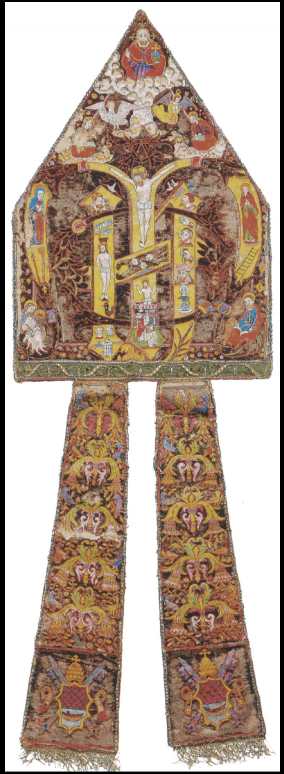
Title:Bishop’s Miter with Scenes of Christ’s Passion Amanteca (Feather painting/ mosaic.
Author:
Date:16th century
why:the comparison illustrates how Christian imagery was adapted across cultures and media. Indigenous featherwork and European engraving communicated shared Catholic themes through very different artistic techniques.

Title:Engraving Showing the Crucifixion and Scenes of the Passion contained in the monograms of Jesus and Mary.
Author:
Date:. Italian, ca. 1500
why:the comparison illustrates how Christian imagery was adapted across cultures and media. Indigenous featherwork and European engraving communicated shared Catholic themes through very different artistic techniques.

Title:Festival in Plaza Mayor
Author:Juan de la Corte
Date:1623
why:The painting represents public festivals and civic life in a major urban square. It helps illustrate how public ceremonies and spectacles expressed royal power, social hierarchy, and the importance of shared public spaces in the Spanish world.
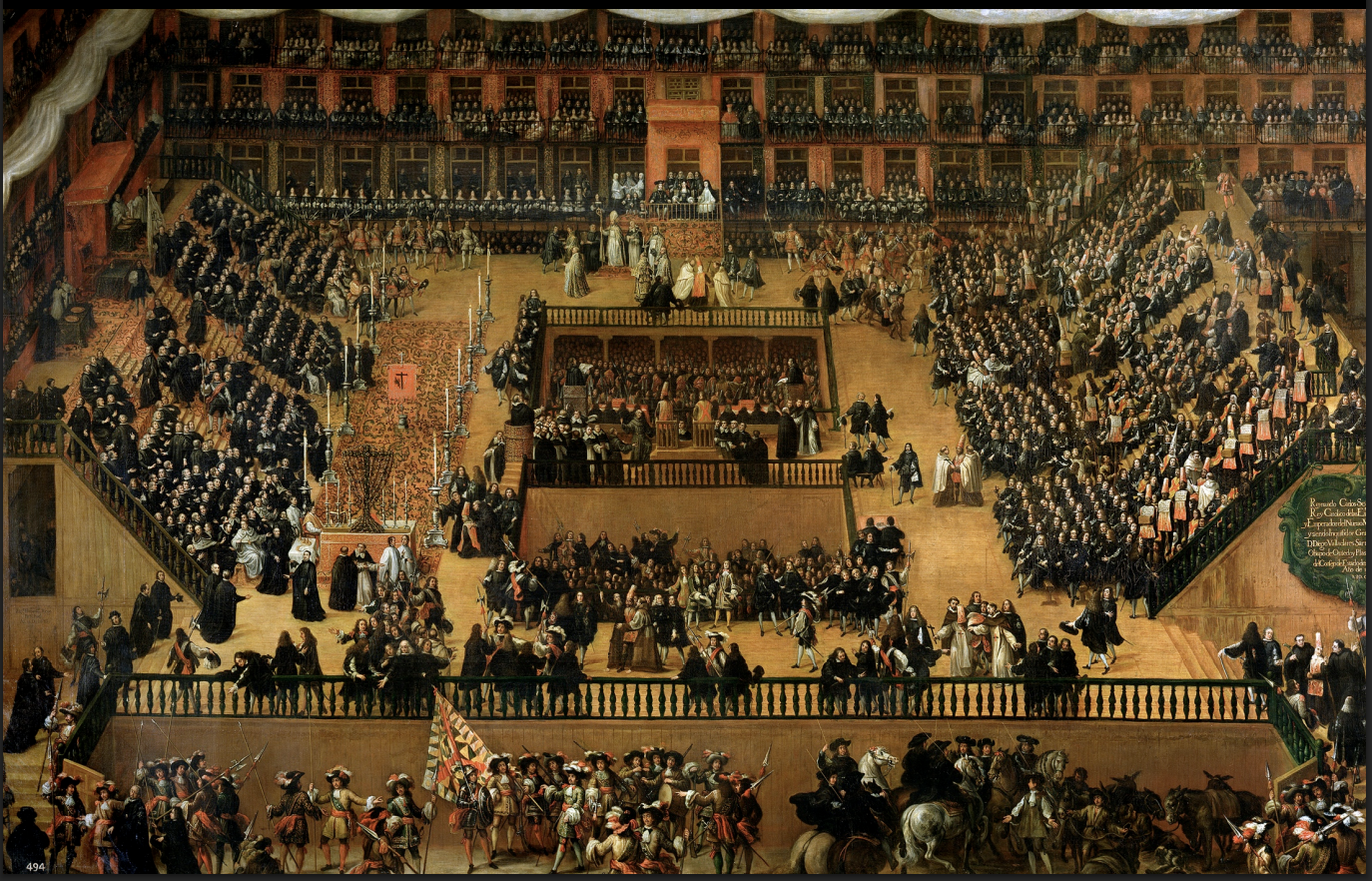
Title:Auto de Fe en Plaza Mayor, Madrid
Author:Francisco Rizi.
Date:1683
why:An auto-da-fé was a public ceremony associated with the Spanish Inquisition. The painting demonstrates the public relationship between Catholic religious authority, political power, ritual, and the punishment of religious dissent.

Title:View of the Plaza Mayor (Zócalo) of Mexico City
Author:Cristóbal de Villalpando
Date:1695
why:The painting shows the colonial capital as a center of political, religious, and commercial life. It illustrates how Spanish urban planning and public spaces helped establish colonial authority while also becoming places where colonial society interacted.

Title:Mexico City side, Biombo with the Conquest of Mexico and View of Mexico City
Author:
Date:late 17th century
why:A biombo is a folding screen. This side emphasizes the colonial city, showing how urban life and the memory of conquest were represented together in elite decorative art.

Title:Conquest of Tenochtitlan, Biombo showing the Conquest of Mexico and View of Mexico City,
Author:
Date:late 17th century
why:It represents the Spanish conquest of the Aztec capital from a later colonial perspective. It helps explain how colonial society remembered, interpreted, and visually presented the conquest long after the event itself.

Title:Battle scene (detail), Biombo with the Conquest of Mexico and View of Mexico City,
Author:
Date:late 17th century
why:This detail emphasizes the military conflict involved in the conquest of Mexico. It helps explain how colonial images portrayed the violence of conquest and shaped later understandings of Spanish and Indigenous relations.

Title:Assassination of Moctezuma II (detail), Biombo with the Conquest of Mexico and View of Mexico City,
Author:
Date:late 17th century
why:The image concerns the death of Moctezuma II during the conquest era. It raises questions about how colonial artists represented Indigenous rulers, political violence, and the history of Spanish conquest. The exact circumstances of Moctezuma’s death remain historically contested.

Title:“Miracle of a Black Leg.”
Author:Matteo di Pacino
Date:1370-75
why:This medieval miracle image provides an earlier European context for the religious representation of Black people. It helps establish a historical background for understanding the later veneration of Black saints and the relationship between race, healing, and Christian devotion.

Title:Saint Benedict of Palermo,
Author:José Montes de Oca
Date:1734
why:Saint Benedict of Palermo, also called Benedict the Moor, was a Black Catholic saint. This sculpture demonstrates the importance of Black sanctity in Catholic devotional art and invites discussion of race, religious identity, and the place of Black figures in the Catholic world.
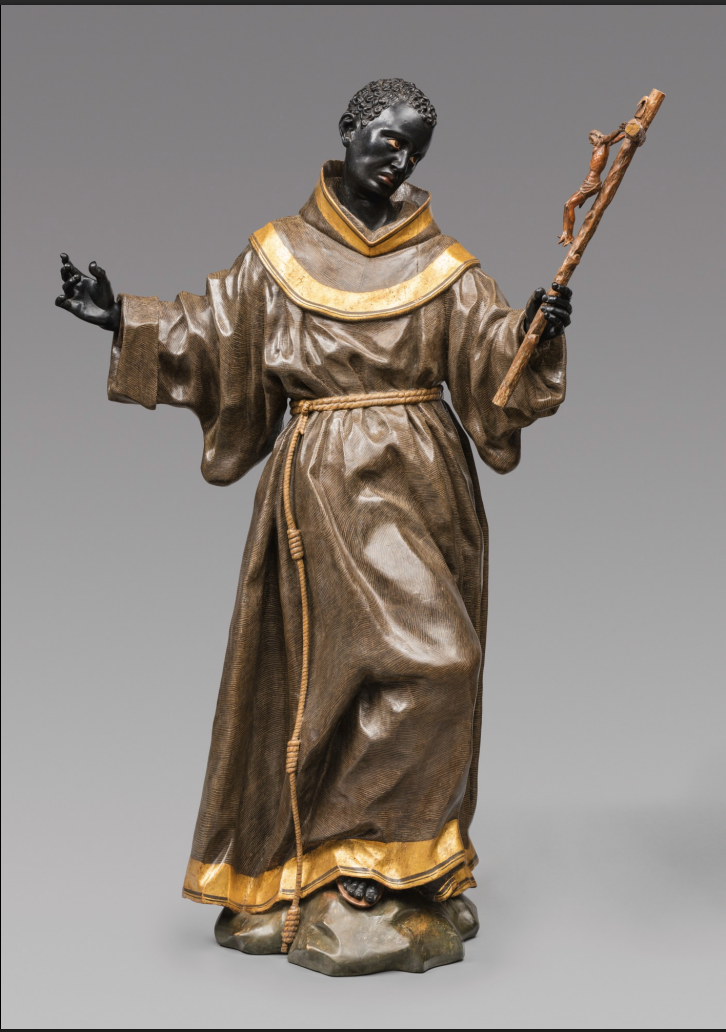
Title:Saint Benedict of Palermo,
Author:Juan Pascual de Mena.
Date:1770-1780
why:This second representation of Saint Benedict shows the continued popularity of Black saints in Catholic art. Comparing it with the sculpture on page 24 helps demonstrate how devotional imagery could reinforce religious reverence while representing racial identity.

Title:Portrait of St. Benedict the Moor called by all “the Black Saint”
Author:anon
Date:1700
why:The portrait explicitly identifies Benedict through his Blackness and sainthood. It is relevant to discussions about how Black identity was represented in religious imagery and how the veneration of Black saints functioned within colonial-era Catholic societies.

Title:The Virgin of Potosí
Author:Anon. Cusco artist.
Date:1700
why:The image connects Marian devotion with the Andean colonial world. Potosí was a major silver-mining center, so the work can help explore the intersection of Catholic imagery, Indigenous and Andean traditions, colonial wealth, and the social consequences of mining.

Title:Christ Child of Huanca
Author:
Date:1600
why:The image represents devotion to Christ in the colonial Andean world. It illustrates how Catholic religious figures were incorporated into local devotional practices and how Christianity developed within culturally diverse Indigenous communities.

Title:Virgin of Guadalupe
Author:Marcos Cipac de Aquino
Date:1556
why:This work is associated with the development of the Virgin of Guadalupe’s imagery in colonial Mexico. It is important for understanding the interaction of Indigenous artistic traditions and Catholic devotion, as well as the development of a distinctly Mexican religious identity.

Title:Legend of the Virgin of Guadalupe appearing to Juan Diego.
Author:Jose Juarez.
Date:1665
why:The painting represents the tradition of the Virgin Mary appearing to Juan Diego. It helps explain how Marian devotion became significant in New Spain and how religious images supported the formation of a local Catholic identity through the merging of European Christianity and Indigenous culture.

Title:Lettera dell’isole che ha trovato nuevamente il Re di Spagna.
Author:Giuliano Dati
Date:Florence, 1493.
why:It shows how news of Columbus’s voyages circulated in Europe. Printed accounts helped shape European perceptions of the Americas and encouraged further exploration and conquest.

Title:De insulis inventis
Author:Christopher Columbus
Date:florence, 1495
why:It represents the publication and circulation of accounts of Columbus’s discoveries. These accounts helped promote European expansion and framed Indigenous lands through a European perspective.

Title:Natural History of the West Indies. Hammock.
Author:Fernández de Oviedo
Date:1535
why:The hammock demonstrates Indigenous knowledge and technology encountered by Europeans. It illustrates how European writers documented, described, and sometimes appropriated knowledge from the Americas.

Title:Natural History of the West Indies. Pineapple
Author:Fernández de Oviedo
Date:1535
why:The pineapple represents the exchange of plants, foods, and knowledge between the Americas and Europe. It also shows how European natural histories documented the unfamiliar environments of colonized territories.

Title:Pearl ship pin
Author:
Date:16th century
why:It connects maritime imagery and precious materials to overseas trade, exploration, and wealth. It can also prompt discussion of the relationship between European luxury goods and colonial extraction.

Title:Brevissima relacion
Author:Title page of Bartolomé de las Casas,
Date:Seville, 1552
why:Las Casas criticized Spanish colonial brutality and the treatment of Indigenous peoples. His account is important for understanding debates over conquest, forced labor, Christian morality, and the justification of Spanish imperial rule.
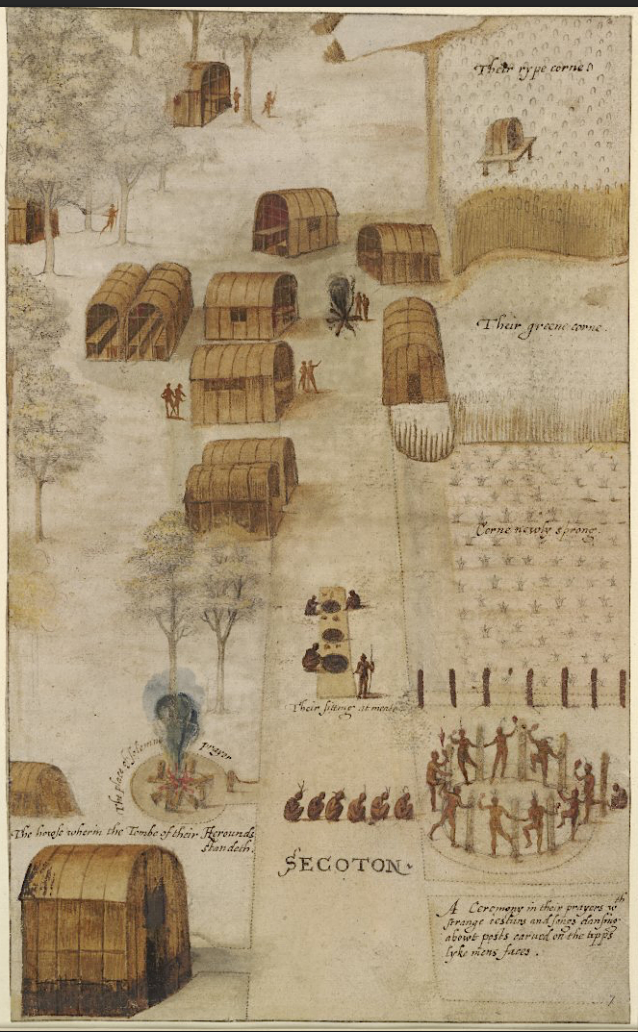
Title:The town of Secoton
Author:John White
Date:1585-1593
why:White documented an Indigenous community in the region of present-day North Carolina. The image gives insight into Indigenous settlement, agriculture, and social organization before English colonization transformed the region.