05Needs analysis and physiological assessment of athletes - WICHTIG (glaube für Portfolio)
 Call Kai
 Learn
 Practice Test
 Spaced Repetition
 Match
 Flashcards
 Knowt Play
1/18

There's no tags or description
Looks like no tags are added yet.
19 Terms
[A] What are the three primary purposes of physiological assessment in sports science according to Godfrey & Whyte (2006)? (Linked to Learning Objektive 1)
Identify the parameters underpinning performance in a specific sport.
Profile athletes (evaluate individual strengths and weaknesses).
Assess training adaptation and programme efficacy (determine objectively if the intervention worked).

[A] What are the two distinct stages of a Needs Analysis and what elements does each stage analyze?
Stage 1 · Analyse the SPORT: Movement analysis (movement patterns, muscles involved, GPS/video time-motion data), Physiological analysis (energy systems, strength, speed, endurance priorities), and Injury analysis (common injury sites and causes).
Stage 2 · Assess the ATHLETE: Training status & history (training age, current phase, previous injuries), Physical testing (lab and field tests of identified determinants), and Primary goal (which quality must improve, by how much, by when).
[A]What are the sequential steps in the complete assessment cycle from initial testing to programme modification?
Needs analysis → Initial assessment → Aim & standardisation → Plan the programme → Implement & monitor → Re-test → Evaluate → Modify(adjust the aim or programme if targets are not met)
[A] How do Closed-skill events differ from Open-skill events regarding physiological determinants and performance predictability?
Closed-skill events (e.g., rowing, running, cycling, swimming): Demands are stable and repeatable; performance can be predicted from a few key laboratory variables.
Open-skill events (e.g., football, basketball, tennis): Demands change dynamically with tactics, opponents, and positions; time-motion analysis (GPS, video) comes first; physiology is necessary, but not sufficient
[A] What is the Endurance Equation (Joyner & Coyle, 2008) and how do its three components interact to dictate race speed?
Equation: VO2max * Fractional Utilisation = Performance VO2; then Performance VO2 / Economy = Race Speed.
Definitions:
VO2max: The physiological ceiling (maximal oxygen uptake).
Fractional Utilisation: The percentage of VO2max sustained over distance (approximated by Lactate Threshold).
Economy: The oxygen cost per kilometer
[A] What are the main differences between Laboratory and Field-based testing regarding standardisation, reliability, validity, and practicality? (Linked to learning Objektive 3)
Laboratory: Environment strictly controlled; High test-retest reliability; Construct validity with objective physiological measures (VO2, lactate, ECG, force); Costly and tests one athlete at a time.
Field: Weather/terrain vary; Lower reliability; Ecological validity (sport-specific performance context); Cheap, enables whole squad testing, and frequent.
Best Practice: Occasional laboratory testing + more frequent field testing using sport-specific ergometers.
[A] How are Validity, Reliability, and Sensitivity defined in athletic assessment? (Linked to Objektive 3)
Validity: Does the test measure what it claims to? (Criterion validity compares with a gold standard; Ecological validity checks if it mirrors the sport).
Reliability: Do you get the same result twice? (Measured via Typical Error [TE] and Intraclass Correlation Coefficient [ICC]).
Sensitivity: Can it detect the Smallest Worthwhile Change (SWC)? A change is real only when SWC > TE
[A] How are VO2max/VO2peak and Fractional Utilisation derived from an incremental laboratory treadmill test?
Protocol (Godfrey & Whyte, 2006): 10-minute warm-up, 5 x 4-minute submaximal stages (+0.6 km/h per stage, 1% gradient) with 30-second rest breaks for earlobe blood lactate sampling, followed by constant speed with +1% gradient increase per minute until exhaustion (lasting 9–16 minutes for true VO2max, or about 25 minutes total test time called VO2peak).
Fractional Utilisation: Calculated as (VO2 at Lactate Threshold devided VO2max) * 100
[A] How is Oxygen Economy derived and what did Paula Radcliffe's longitudinal data prove?
Oxygen Economy: Derived as the VO2 cost at a fixed submaximal speed (e.g., 16 km/h; expressed in ml per kg per km). Lower VO2 at the same speed indicates superior economy.
Radcliffe Finding (Jones, 2006): Her VO2max stayed stable at approximately 70 ml per kg per min from 1992 to 2003, but a ~15% improvement in running economy (205 down to 175 ml per kg per km) drove her world-record progression.
[A] What is the fundamental difference between Lactate Threshold 1 (LT1) and Lactate Threshold 2 (LT2)?
LT1 (Aerobic Threshold): The first non-linear rise in blood lactate above baseline (greater than or equal to 1 mmol per L increase; workload right before the rise).
LT2 (Anaerobic / Accumulation Threshold): The onset of rapid blood lactate accumulation (OBLA at 4 mmol per L, Maximal Lactate Steady State / MLSS, critical speed).
[A]How are heart rate training zones derived from a lactate test, and how is an effective re-test interpreted?
Training Zones: Prescribed as HR ranges around key break-points: LSD (below LT break-point), LT Zone (at LT break-point), and High-Intensity (greater than 90% HRmax). Always prescribe a range, not a single number!
Re-Test Interpretation: Effective training shifts the lactate curve to the right (same lactate at a faster speed) and the HR curve down (same speed at a lower HR).
[A]What are the five core Take-Home Messages?
A needs analysis has two stages: analyse the sport, then assess the athlete.
Determinants are event-specific (easy to model in closed-skill, harder in open-skill).
Lab tests give control and reliability; field tests give specificity. Use both.
One incremental test yields VO2peak, fractional utilisation, economy, and the lactate threshold.
Thresholds depend on definition: name your method, give zones as ranges, and re-test identically
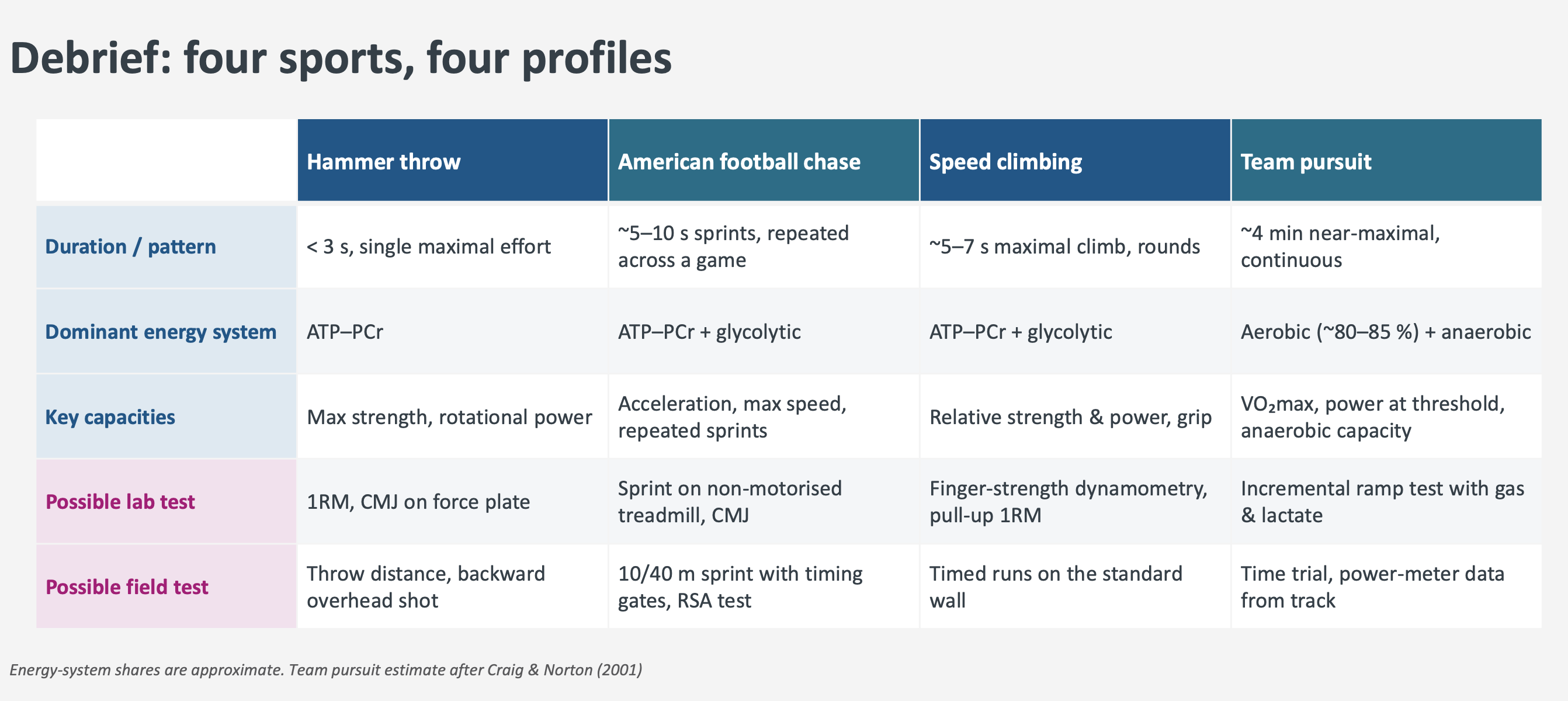
[B] How do the physiological demands and key capacities differ across Hammer Throw, American Football Chase, Speed Climbing, and Team Pursuit?
Hammer throw (under 3s): ATP-PCr dominant; Max strength and rotational power; Lab: 1RM / CMJ.
American football chase (5-10s): ATP-PCr + glycolytic; Acceleration, max speed, repeated sprints; Field: 10/40m sprint timing gates.
Speed climbing (5-7s): ATP-PCr + glycolytic; Relative strength/power and grip; Lab: Finger dynamometry.
Team pursuit (approx. 4 min): Aerobic (approx. 80-85%) + anaerobic; VO2max, threshold power; Lab: Ramp test with spiro-ergometry
[B] What did Slattery et al. (2006) discover regarding the strongest predictors of 3 km running performance in triathletes?
Strongest Predictors: Peak running speed (Vmax, r = 0.91) and Speed at Lactate Threshold (r = 0.90), followed by VO2max (r = 0.80).
Key Insight: Speed-based metrics (Vmax, LT speed) outperform single physiological variables because they combine VO2max and economy into one performance output. Jump power (r = 0.07) had no predictive value.
[B] What physical match performance metrics separate top-tier Bundesliga football teams according to Chmura et al. (2022)?
Key Differentiator: Total running distance WITH ball possession and Sprint distance WITH ball possession significantly separated top 6 teams from lower-ranked teams (p < 0.05).
Testing Implication: Total distance without possession does not separate team success. Testing must focus on repeated high-intensity ability, acceleration, and maximal speed under tactical context.
[B] What are the four major field tests presented and their primary estimation formulas or uses?
Cooper 12-min run: Distance (d in meters) estimates VO2max = (d - 504.9) / 44.73.
Yo-Yo IR1: Intermittent recovery distance (d in meters) estimates VO2max = d * 0.0084 + 36.4.
30-15 IFT: Gives final velocity (V_IFT) to prescribe interval training runs as %V_IFT.
Time Trial / Critical Speed: Direct performance measurement; Critical Speed marks the boundary between heavy and severe intensity domains.
[B]What are the six required sections of the oral case study presentation and how does this presentation feed into it?
6 Sections: (1) Background, (2) Rationale, (3) Method of assessment, (4) Training plan, (5) Applicability, (6) Scientific literature.
Week 05 Feed: Provides the core framework for Section 1 (Needs analysis: sport demands) and Section 3(Method of assessment: lab and field tests, validity/reliability)
[C]How many different lactate threshold concepts were identified in scientific literature by Faude et al. (2009)?
Faude et al. (2009) identified 25 different lactate threshold concepts, highlighting the absolute necessity for sports scientists to state their exact definition and measurement method when presenting data.
[C] What percentage of VO2peak was required for elite male marathoners in the Breaking2 project to sustain 21.1 km/h race pace?
Elite runners required 94% of VO2peak (or 67 ml per kg per min) at an oxygen cost of 191 ml per kg per km (Jones et al., 2021).