radiation
 Call Kai
 Learn
 Practice Test
 Spaced Repetition
 Match
 Flashcards
 Knowt Play
1/33

There's no tags or description
Looks like no tags are added yet.
34 Terms
radiation
the transmission of energy as electromagnetic waves or as moving subatomic particles
radiation is broadly divided into two types
ionising and non-ionising
non-ionising radiation
Long wavelength radiation (low frequency)
May have enough energy to excite molecules
But does not have enough energy to break chemical bonds
e.g. radio waves, microwaves, infrared radiation, visible light and some UV
ionising radiation
Short wavelength radiation (high frequency)
Sufficient energy to break chemical bonds
e.g. X-rays, gamma rays, some UV
radiowaves
Longest wavelengths and lowest frequency
Most commonly artificially generated by a transmitter
Used for communication over long distances
Exposure is not harmful
effects of radiowaves
Can cause the oscillation of polar molecules
Can generate heat
Can be used for muscle relaxation as radio waves can penetrate tissue
Can kill cancer cells
microwaves
Shorter wavelengths and higher frequency compared with radio waves
Most commonly artificially generated by a transmitter
Used for communication
Used for cooking food as waves are absorbed by water
Can generate heat in tissues
effects of microwaves
Microwaves can denature proteins and amino acids
Denaturing is the process by which proteins lose their normal folded structure via an external stress
infrared radiation
Generated by anything that produces heat
Main source of electromagnetic radiation from the sun
Widely produced and used by humans
effects of infrared radiation
Causes heating which can cause burns
Can also denature proteins
visible light
Light humans can see between 400-790 THz
Can damage the eye if bright and prolonged enough
Damage can be due to heating
photochemical toxicity
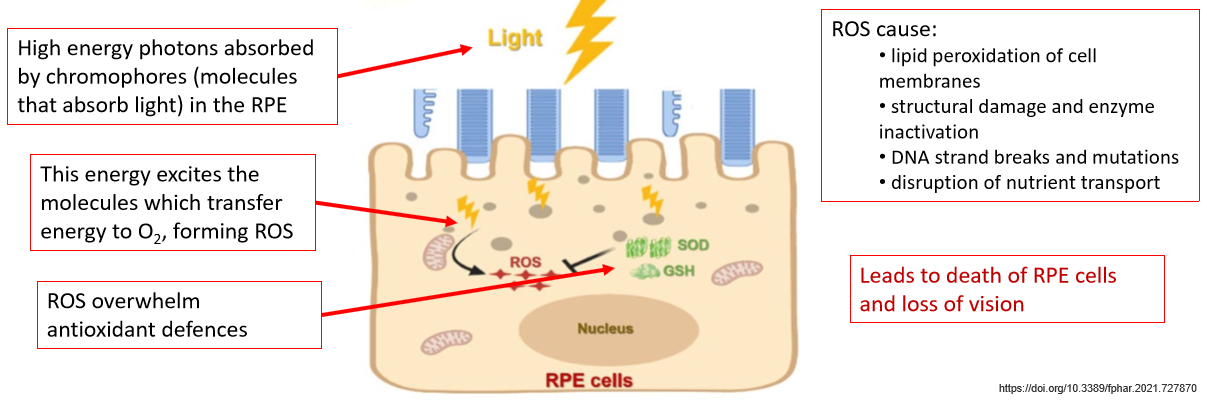
Bright light in the blue (and ultraviolet) spectrum can damage the retinal pigment epithelium and photoreceptor cells
Through a photochemical cascade involving oxidative stress and free radical generation
High energy photons absorbed by chromophores (molecules that absorb light) in the retinal pigment epithelium
This energy excites the molecules which transfer energy to O2, forming reactive oxygen species
Reactive oxygen species overwhelm antioxidant defenses
Leads to death of retinal pigment epithelial cells and loss of vision
ultraviolet radiation
Invisible radiation produced naturally by the sun
Can be produced artificially
Contains both non-ionising and ionising wavelengths
Non ionising → UVA and UVB → longer wavelengths
Ionising → UVC → shorter wavelengths
Physiological effects can be beneficial of harmful
beneficial effects of UV radiation
UVB is required for humans to make vitamin D
Usually just a few minutes of exposure is sufficient
vitamin D formation
7-dehydrocholesterol in the skin absorbs UVB from sunlight
this energy cleaves the steroid structure (7-dehydrocholesterol) creating previtamin D → unstable and undergoes non-enzymatic thermal isomerisation in vitamin D3
vitamin D3 diffuses into the blood, binds to vitamin D-binding protein for transport to the liver for further activation

harmful effects of UV radiation (UVA)
All forms of UV can be harmful
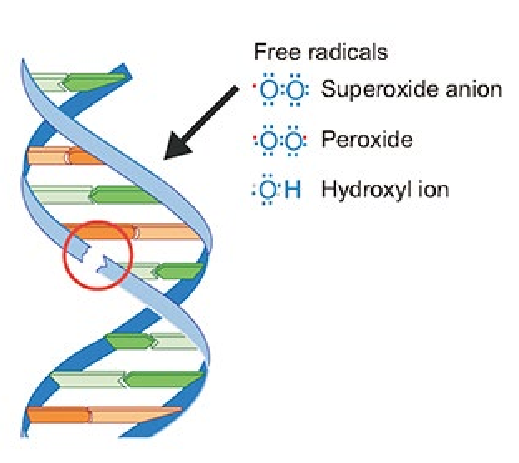
UVA exposure generates reactive oxygen species (ROS)
ROS can cause DNA single strand breakage → reaction with the deoxyribose sugar in the DNA structure
harmful effects of UV radiation (UVB and UVC)
UVB and UVC exposure can result in double strand DNA breakages
Formation of dimers -> covalent bonds that form between adjacent pairs
Most are promptly fixed by DNA repair mechanisms
However an overwhelming number can lead to mutations and cancer
UVB and UVC can directly damage mRNA
Triggering an immune and inflammatory response

what is photokeratitis and what type of UV is it caused by?
sunburn of the eye → caused by UVC
ionising radiation
Has sufficient energy to ionise a molecule (break chemical bonds)
Ions created are generally unstable
Ions want to become stable via radioactive decay → shedding of particles and energy
ionising radiation can have different types of (a) and varying degrees of (b)
(a) charge
(b) penetrance
alpha radiation
Lowest end of ionising spectrum
A particle consisting of two protons and two neutrons
For example radium 226 (solid) becomes radon 222 (gas) → alpha radiation emitted from radium to form radon
Rapidly lose energy in matter and can be stopped by a sheet of thick paper or human skin
If inhaled or ingested can cause severe tissue damage and cancer

beta radiation
Electrons shed from a radioactive particle
Beta particles can travel through metres of air and through millimetres of skin or tissue
Can be stopped by 1-3mm aluminium
Sufficient intensity of beta-radiation can cause burns
If inhaled or ingested can cause severe tissue damage (acute radiation syndrome) and cancer

gamma rays and x rays
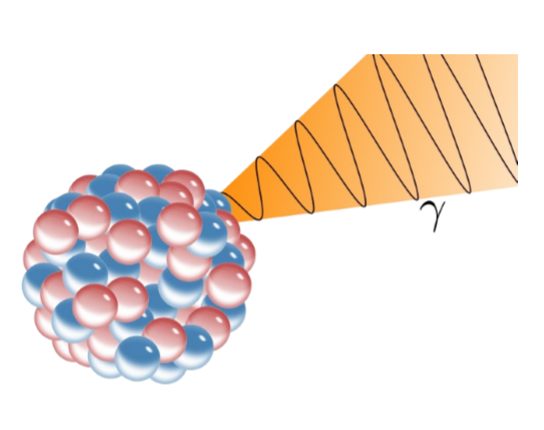
Photons emitted by the nucleus of some radionucleotides
Often the 'daughter product' of alpha and beta decay
Can easily pass into the human body and can damage bone marrow and internal organs
Can be stopped by thick lead or concrete
x-rays
High energy photons produced when electrons strike a target or when electron are rearranged within an atom
Largely indistinguishable from gamma rays
Called 'X-rays' when used for medical purposes
Called 'gamma-rays' otherwise
Able to penetrate many substances including biological tissue
neutron radiation
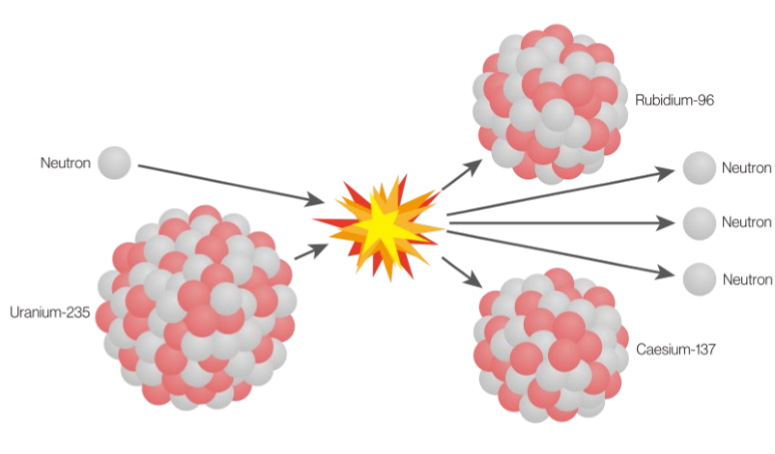
Emission of neutrons
Typically during nuclear fusion and nuclear fission
Most dangerous and severe type of radiation
High kinetic energy
Readily passes through most substances
Free neutrons are very unstable and decay into a proton + electron
Can create radioactivity in bodily tissues by transforming nuclei to radionuclides
effects of ionising radiation can be divided into two types:
deterministic effects
stochastic effects
deterministic effects
Reliably occur above a threshold dose
Severity increases with increasing dose
High doses of radiation delivered in a short period of time (e.g. atomic bombings, radiation therapy for cancer treatment)
Effects are most pronounced on cells that rapidly divide
e.g. skin, bone marrow, cancer cells
deterministic effects mechanisms (list 3)
Causes direct and indirect cellular damage
Radiation causes DNA strand breaks, cross-linking, dimers → direct
Radiation ionises water in tissues producing ROS which amplify damage → indirect
Cell death
Apoptosis triggered in response to direct DNA damage
Damaged cells try to replicate leading to cell death
Radiation directly damages cell membranes causing lysis
Immune response
Radiation triggers an inflammatory response
Causes fever, tissue damage, etc
Bone marrow fails to produce new lymphocytes in response to radiation
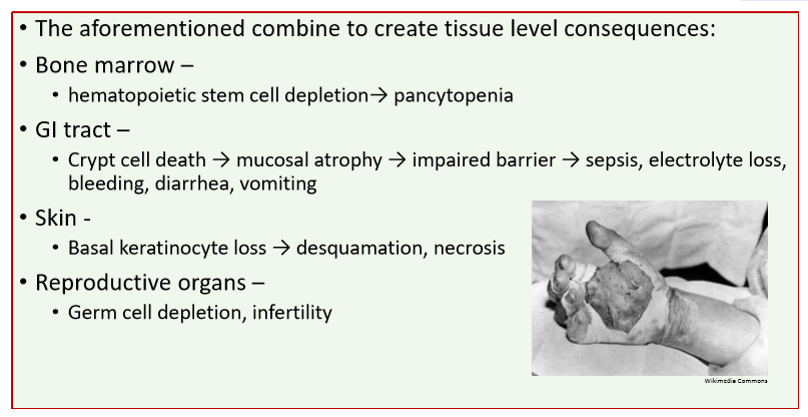
ionising radiation effects on bone marrow, GI tract, skin, and reproductive organs
stochastic effects
occur with increasing probability as dose increases
severity is independent of dose
includes cancers
the most common mechanism is via the production of double-strand breaks in DNA → most difficult to repair
biological repair of DNA due to ionising radiation (single stranded breaks)
DNA polymerase uses complimentary strand to copy repair portion
DNA ligase joins backbones
name the two genes that inhibit progression of the cell cycle when damaged DNA is detected
cells can also detect DNA damage
Rad9 gene detects DNA damage and stops cells from entering the M-phase (mitotic phase → DNA divided between daughter cells)
p53 detects damaged DNA and stops cells from entering the S-phase
cancer risks of ionising radiation

summary
radiation → the emission of energy in the form of electromagnetic waves
non- ionising radiation → low wavelength and frequency
can cause excitation of ions
cannot break chemical bonds
radiowaves, microwaves, infrared radiation, visible light, some UV
ionising radiation → high wavelength and frequency
can break chemical bonds
some UV, a-radiation, b-radiation, X-rays, gamma rays, neutron radiation
radiowaves
artificially generating for communication
generally does not cause harm
microwaves
artificially generated for communication
used for heating
generally does not cause harm
infrared
produced naturally by biological organisms
generates heat
can be artificially generated
denatures proteins
