Carbonyl compounds
 Call Kai
 Learn
 Practice Test
 Spaced Repetition
 Match
 Flashcards
 Knowt Play
1/29

There's no tags or description
Looks like no tags are added yet.
30 Terms
What is aldehydes oxidised to and with what
carboxylic acid , with acidified K₂Cr₂O₇/H⁺.
What colour change occurs with acidified dichromate?
Orange → green
Do ketones react with acidified dichromate?
No.
What are primary and secondary alcohols oxidised into?
Primary alcohols: Aldehydes, then carboxylic acids (further oxidation).
Secondary alcohols: Ketones.
What reagent reduces aldehydes and ketones?
NaBH₄
What does an aldehyde form with NaBH₄?
A primary alcohol
What does a ketone form with NaBH₄?
A secondary alcohol.
Can NaBH₄ reduce carboxylic acids to alcohols?
No. NaBH₄ reduces aldehydes and ketones only.
(Carboxylic acids require LiAlH₄)
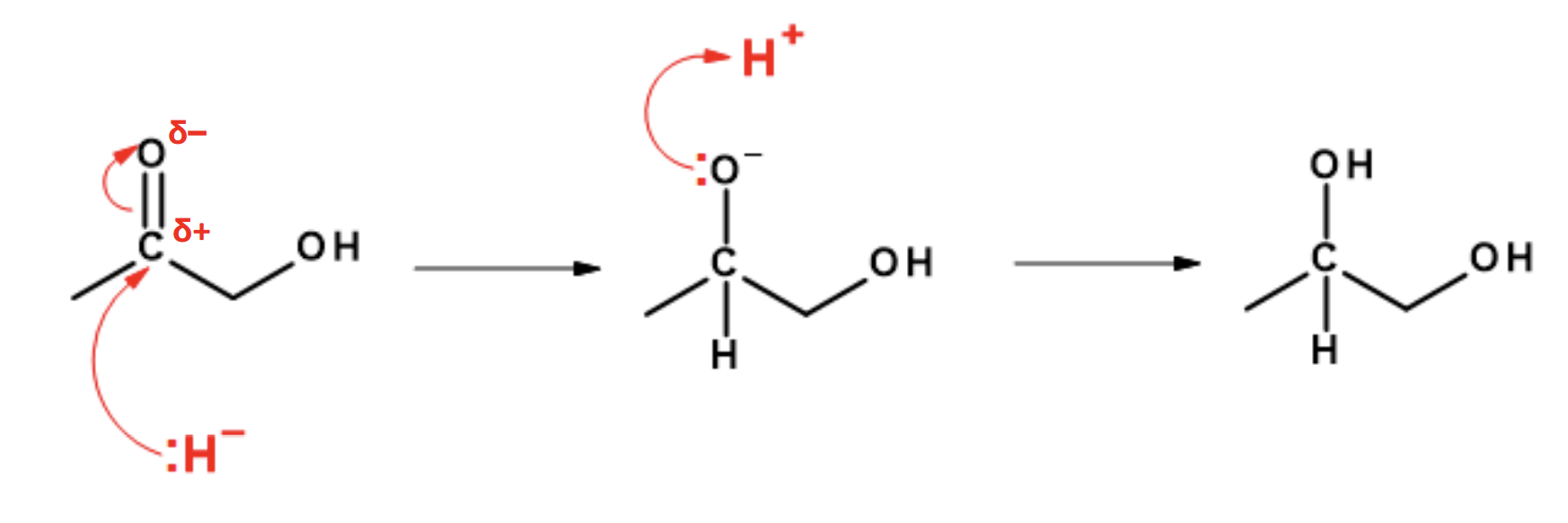
What is the nucleophile in NaBH₄ reduction?
H⁻ (hydride ion).
What type of mechanism does NaBH₄ undergo with carbonyls?
Nucleophilic addition


How many hydrogen atoms are needed to reduce an aldehyde, and what is formed?
2[H] → Primary alcohol.
How many hydrogen atoms are needed to reduce a ketone, and what is formed?
2[H] → Secondary alcohol.

Draw the mechanism for nucleophilic addition of hydride / reduction of aldehyde

Where does the H+ come from in the reduction of carbonyls
Water provides H⁺.
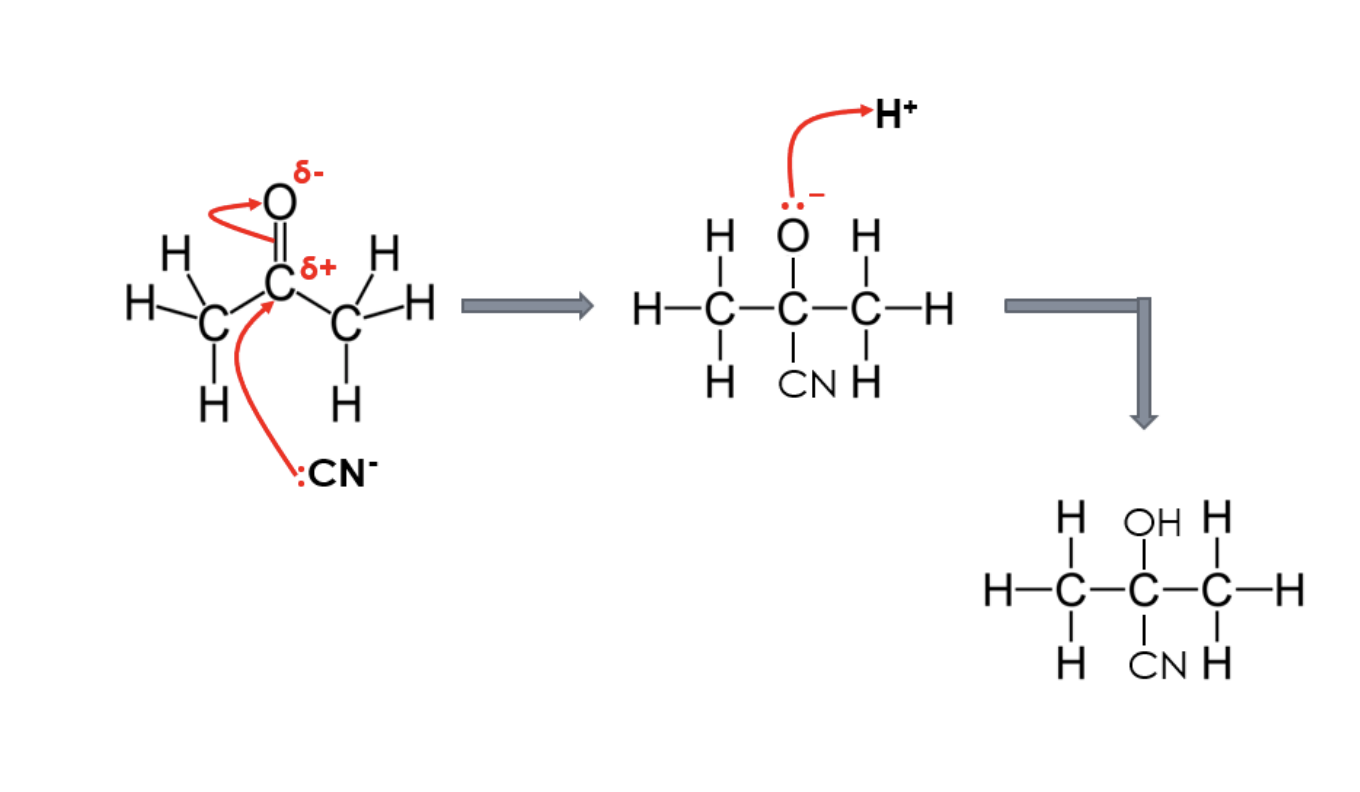
What is the role of CN⁻ in reactions with aldehydes and ketones?
CN⁻ is a nucleophile that attacks the δ⁺ carbonyl carbon.
What is formed when HCN (CN- + H+) reacts with a carbonyl compound?
A hydroxynitrile


Finish the equation
Nucleophilic addition to carbonyls using hydrogen cyanide


Complete the mechanism
How would you prove the presence of the phenol group in the molecule using simple test tube tests.
Universal indicator turns red / orange (as acidic) AND does not fizz on addition of Na₂CO₃


What is the positive result of adding Brady’s reagent to an aldehyde or ketone?
An orange precipitate forms.
How can you distinguish between different carbonyl compounds using Brady’s reagent?
Add Brady’s reagent to form an orange precipitate.
Purify the solid by recrystallisation.
Measure its melting point and compare with database values.
Tollens reagent formula
[Ag(NH₃)₂]⁺
What is Tollens’ reagent used for?
To distinguish between aldehydes and ketones.
What type of oxidising agent is Tollens’ reagent?
A weak oxidising agent.
What is the oxidising species in Tollens’ reagent?
Aqueous silver(I) ions, Ag⁺(aq).
(Ag⁺ ions are reduced to silver metal when Tollens’ reagent reacts with an aldehyde)
What happens when Tollens’ reagent reacts with an aldehyde?
Aldehyde is oxidised to a carboxylic acid; Ag⁺ ions are reduced to silver metal.
A silver mirror forms
