Targeted Therapy 1
 Call Kai
 Learn
 Practice Test
 Spaced Repetition
 Match
 Flashcards
 Knowt Play
1/31

There's no tags or description
Looks like no tags are added yet.
32 Terms
Cytotoxic treatment kills cancer cells.
Cytostatic treatment inhibits cancer-cell growth or proliferation without necessarily killing every cell.
unique to cancer cells
overexpressed in cancer
mutated into an abnormal active form
or particularly important for cancer-cell survival
Using molecular information about a patient and their tumour, including biomarkers, to select treatment more likely to be effective and appropriate for that individual.
Better selection of effective treatment, avoidance of some unnecessary toxicity, potential improvements in outcomes, more efficient trials, earlier molecular detection and avoidance of spending on treatments unlikely to benefit a patient.
Biomarker testing can be expensive and time-consuming, may require invasive or difficult-to-obtain tissue samples, needs specialist resources, creates unequal access and can leave very small patient populations for individual drugs.
Obtain tumour tissue or another appropriate sample, analyse relevant genes or proteins, identify actionable biomarkers, select a matching treatment and monitor response or resistance.
Biomarker type | Question it answers | Example |
Predisposition | Is this person at higher risk of cancer? | BRCA1/2; Lynch syndrome genes |
Screening | Is cancer present? | Mammography, cervical (HPV) screening; PSA (limited) |
Diagnostic | What type of cancer is it? | Philadelphia chromosome (BCR::ABL1) in CML |
Prognostic | How likely is it to come back? | 21-gene Recurrence Score (Oncotype DX) |
Predictive | Will this drug work? | HER2, EGFR, KRAS, BRAF |
Monitoring | Is the treatment working? | BCR::ABL1 level (CML); PSA |
Pharmacogenomic | Can the patient handle this dose? | DPYD (5-FU, capecitabine); TPMT/NUDT15; UGT1A1 |
A prognostic biomarker provides information about likely disease outcome.
A predictive biomarker indicates whether a particular treatment is likely to work.
BRCA1/2 can indicate hereditary predisposition
PSA is used in prostate assessment
BCR::ABL1 helps diagnose and monitor CML
HER2 predicts benefit from HER2-targeted therapy
EGFR mutations
Inherited genetic variants that help predict medicine response or toxicity.
DPYD variants are relevant to fluoropyrimidine toxicity risk, and UGT1A1 variants are relevant to irinotecan toxicity risk.
HER2 is a cell-surface growth-signalling receptor encoded by ERBB2.
Amplification or overexpression can increase proliferation and survival signalling in some breast cancers, making HER2 a treatment target.

Trastuzumab is a humanised monoclonal antibody that binds the extracellular region of HER2, interferes with HER2-associated growth signalling and can recruit immune cells to kill antibody-coated cancer cells through ADCC.
Antibody-Dependent Cellular Cytotoxicity occurs when immune effector cells, especially NK cells, recognise the Fc region of an antibody bound to a tumour cell and release cytotoxic molecules that kill the cell.

Immunohistochemistry (IHC) assesses HER2 protein expression,
Fluorescent situ hybridisation (FISH) assesses HER2 gene amplification. Treatment selection depends on the relevant HER2 testing criteria.
The Philadelphia chromosome results from reciprocal translocation t(9;22), joining ABL1 from chromosome 9 to BCR on chromosome 22 and creating the BCR::ABL1 fusion gene.
BCR::ABL1 encodes a constitutively active tyrosine kinase that continuously phosphorylates signalling proteins, promoting abnormal proliferation and survival of myeloid cells.
Imatinib is a tyrosine kinase inhibitor that binds the ATP-binding region of BCR::ABL1 in a suitable inactive conformation.
It prevents ATP-dependent phosphorylation of downstream proteins and suppresses abnormal growth signalling.
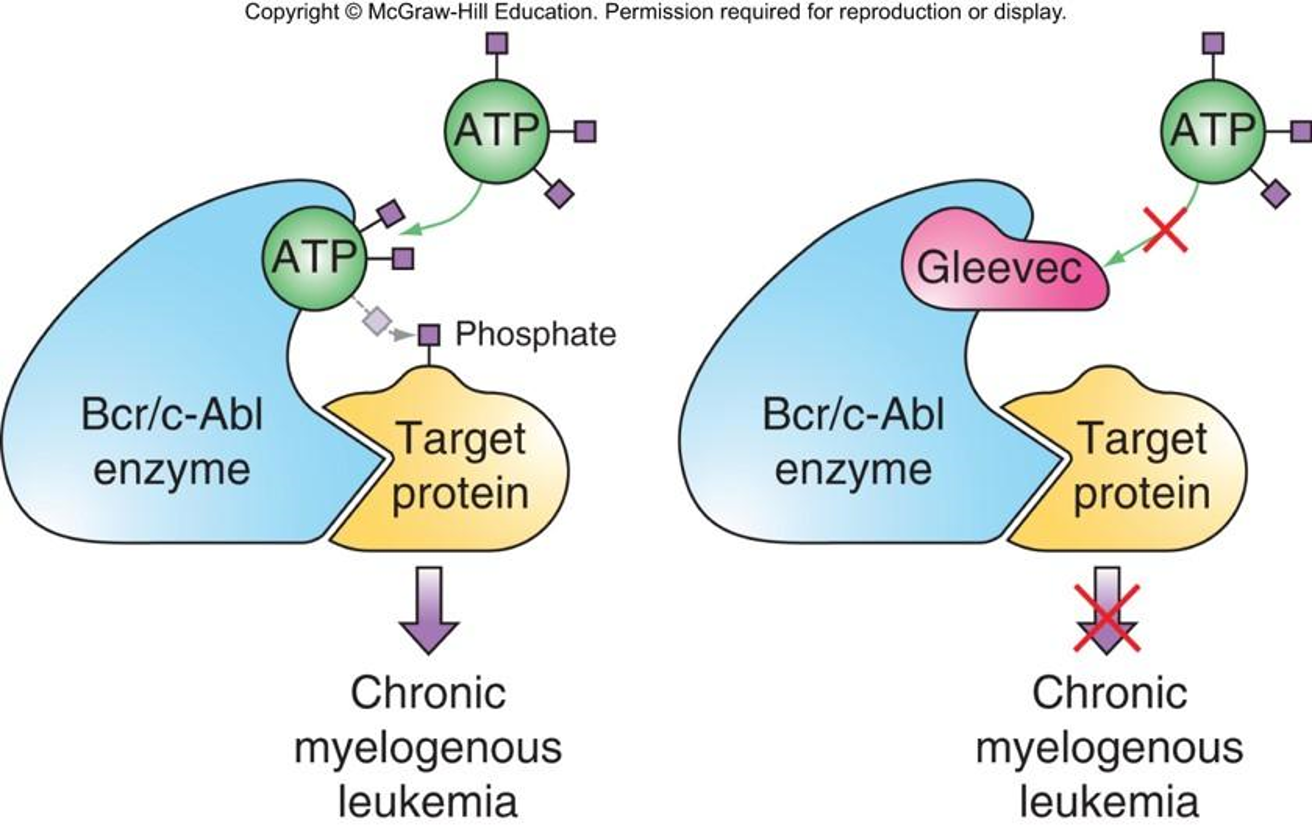
Imatinib inhibits the activity of the abnormal kinase rather than removing the underlying BCR::ABL1 genetic alteration.
Residual leukaemic cells may persist, so continued treatment and molecular monitoring are often needed.
Karyotyping can identify the Philadelphia chromosome
FISH uses fluorescent DNA probes to detect the BCR::ABL1 fusion
quantitative RT-PCR measures BCR::ABL1 transcripts to monitor molecular response.
Primary resistance means an adequate initial treatment response is not achieved.
Secondary resistance means an initial response is achieved but subsequently lost.
Check adherence, administration and drug interactions before assuming biological resistance.
Mutations can change the drug-binding region or kinase conformation, reducing imatinib binding while allowing kinase activity to continue.
T315I is a particularly important resistant mutation.
Imatinib is first generation.
Dasatinib, nilotinib and bosutinib are second generation.
dasatinib is effective after mutations occur as can conform to active site (unlike imatinib)
Ponatinib is a third-generation inhibitor with activity against T315I.
Asciminib is an allosteric inhibitor targeting the ABL myristoyl pocket.
Adherence, correct administration with or without food (imatinib with food), (nilotinib empty stomach)
CYP3A4 interactions,
acid-suppressing medicines
cardiovascular and QT-related risks
relevant electrolytes
pregnancy risk and contraception (teratogenic)
Absorption requirements differ between TKIs.
Imatinib is generally taken with food and large glass of water
nilotinib has fasting requirements (no food 2hrs before and 1hr after)
and gastric acid suppression can reduce absorption of dasatinib.
Angiogenesis is formation of new blood vessels from existing vessels.
Growing tumours can become hypoxic and release factors such as VEGF to stimulate new vessels that provide oxygen and nutrients.
Tumour hypoxia promotes VEGF release
VEGF binds VEGF receptors on endothelial cells
receptor signalling stimulates endothelial-cell proliferation and migration
new blood vessels form and support tumour growth.
Bevacizumab is an antibody that binds VEGF-A ligand
ramucirumab is an antibody that binds VEGFR2
aflibercept is a soluble decoy receptor that traps VEGF ligands
Bevacizumab is a humanised monoclonal antibody that binds VEGF-A, preventing it from activating VEGF receptors on endothelial cells and thereby reducing tumour angiogenesis.
Hypertension requires blood-pressure monitoring
proteinuria requires urine monitoring
impaired wound healing requires surgical planning
gastrointestinal perforation requires urgent recognition
bleeding, thrombosis risk
reproductive risks require assessment and counselling.
Wound healing requires VEGF-mediated new blood-vessel formation, so blocking VEGF can delay repair.
VEGF also contributes to normal vascular function, so its inhibition can increase vascular resistance and blood pressure.
CML is strongly driven by BCR::ABL1, giving imatinib a highly specific molecular driver to inhibit.
Tumour angiogenesis is more complex and can use alternative pathways, so VEGF inhibition alone may have limited effects and is often combined with other treatments.