AH3 Exam 1: Dysrhythmias

0.0(0)
Studied by 26 people
call kaiCall Kai
learnLearn
examPractice Test
spaced repetitionSpaced Repetition
heart puzzleMatch
flashcardsFlashcards
GameKnowt Play
Card Sorting

1/23

encourage image

There's no tags or description

Looks like no tags are added yet.

Last updated 6:56 PM on 9/26/26
Name
Mastery
Learn
Test
Matching
Spaced
Call with Kai
Chat

No analytics yet

Send a link to your students to track their progress

24 Terms

1
New cards

What to look for when interpreting ECG

  1. is it regular?

  2. whats the rate?

  3. is there a P wave for every QRS?

  4. is there a QRS for every P wave?


2
New cards

Electrical conduction of the heart pathway:

  1. Atrial Depolarization at P wave (contracts)

  2. Ventricular Depolarization @ QRS

  3. Ventricular Repolarization @ T wave


<ol><li><p><span style="color: rgb(208, 99, 99);"><strong>Atrial </strong>Depolarization</span> at P wave (contracts)</p></li><li><p><span style="color: rgb(85, 81, 211);"><strong>Ventricular </strong></span>Depolarization @ QRS</p></li><li><p><span style="color: rgb(92, 73, 223);"><strong>Ventricular </strong></span>Repolarization @ T wave</p></li></ol><p></p>
3
New cards

treatment for Sinus Bradycardia:

  • what med is given?

    • if it doesnt work?


Atropine IV!!

  1. 1st dose: 1mg bolus

  2. repeat q3-5 mins

  3. max dose: 3mg


→ Move onto Transcutaneous Pacing

<p><span style="color: rgb(71, 75, 202);"><strong>Atropine </strong></span>IV!!</p><ol><li><p><span style="color: rgb(38, 129, 145);"><strong>1st dose</strong>: <strong>1mg bolus</strong></span></p></li><li><p><span style="color: rgb(183, 151, 36);">repeat<strong> q3-5 mins</strong></span></p></li><li><p><span style="color: rgb(38, 129, 145);"><strong>max dose</strong>: <strong>3mg</strong></span></p></li></ol><p></p><p>→ Move onto <span style="color: rgb(192, 29, 29);"><strong>Transcutaneous </strong></span>Pacing</p>
4
New cards

What are PACs?


Premature Atrial Contractions

  • atrial contracts early in a sinus rhythm…not worrisome

    • caffeine


<p><span style="color: rgb(65, 102, 239);"><strong>Premature </strong></span>Atrial Contractions</p><ul><li><p>atrial contracts early in a sinus rhythm…not worrisome</p><ul><li><p>caffeine </p></li></ul></li></ul><p></p>
5
New cards

Whats Atrial Fibrillation and Atrial Flutter?

  • tx?


Multiple impulses in atria with NO P wave and narrowed QRS

  • can turn into LETHAL rhythm!!

→ Cardioversion

<p><span style="color: rgb(70, 64, 196);"><strong>Multiple </strong></span>impulses in atria with <span style="color: rgb(230, 34, 34);"><strong>NO P wave</strong> and <strong>narrowed QRS</strong></span></p><ul><li><p>can turn into LETHAL rhythm!!</p></li></ul><p>→ Cardioversion</p>
6
New cards
  • Major complications of A. Fib/ Flutter (2)


complications

  1. loss of Cardiac output (blood just sits in atria, not moving)

  2. stationary blood in atria → clots → stroke

  • put on blood thinners


<p>complications</p><ol><li><p>loss of <span style="color: rgb(35, 158, 134);"><strong>Cardiac output</strong></span> (blood just sits in atria, not moving)</p></li><li><p>stationary blood in atria → <span style="color: rgb(149, 109, 38);"><strong>clots → stroke</strong></span></p></li></ol><ul><li><p>put on blood thinners</p></li></ul><p></p><p></p><p></p>
7
New cards

Whats the difference b/w A.Fib rhythm and A.Flutter rhythm?

A. Fib (quiver)

  • irregular (chaotic)

    • Random electrical activity

A. Flutter (sawtooth waves)

  • more regular/patterned

    • Organized rapid electrical activity


<p><span style="color: rgb(215, 57, 57);">A. <strong>Fib</strong> (quiver)</span></p><ul><li><p><span style="color: rgb(215, 57, 57);"><strong>irregular</strong></span><strong> </strong>(chaotic)</p><ul><li><p>Random electrical activity</p></li></ul></li></ul><p>A. <span style="color: rgb(30, 145, 87);"><strong>Flutter</strong> (sawtooth </span><span style="color: rgb(23, 38, 31);">waves)</span></p><ul><li><p><span style="color: rgb(30, 145, 87);">more <strong>regular/patterned</strong></span></p><ul><li><p>Organized rapid electrical activity</p></li></ul></li></ul><p></p>
8
New cards

Whats SVT? (3)

Supra Ventricular Tachycardia (happens in the atria = NO P wave)


  1. > 150-250 BPM

  2. regular rhythm w/ narrowed QRS

  3. NO P wave


<p>Supra Ventricular Tachycardia (happens in the atria = <span style="color: rgb(199, 38, 38);"><strong>NO P wave</strong></span>)</p><p></p><ol><li><p><span style="color: rgb(66, 132, 194);"><strong>&gt; 150-250</strong></span> BPM</p></li><li><p><span style="color: rgb(202, 33, 153);"><strong>regular rhythm w/ narrowed QRS</strong></span></p></li><li><p><span style="color: rgb(199, 38, 38);"><strong>NO P wave</strong></span></p></li></ol><p></p>
9
New cards

tx for SVT: (2)

1) adenosine!!

  1. 1st dose: 6mg via RAPID IVP

  2. 2nd dose: 12 mg rapid IVP if needed

  3. Follow each dose w/ RAPID 10-20 mL NS flush!!

*has extremely short ½ life and needs to reach heart quick!!—IV site closest to heart


2) Vagal Maneuvers

  • bearing down

  • blow into syringe

  • put face in ice water


<p><strong><mark data-color="#effce1" style="background-color: rgb(239, 252, 225); color: inherit;">1) adenosine!!</mark></strong></p><ol><li><p><span style="color: rgb(217, 132, 45);"><strong>1st dose: 6mg</strong></span> via RAPID IVP</p></li><li><p><span style="color: rgb(103, 166, 34);"><strong>2nd dose: 12 mg</strong></span> rapid IVP if needed</p></li><li><p>Follow each dose w/ RAPID <span style="color: rgb(69, 161, 212);"><strong>10-20 mL NS flush!</strong></span>!</p></li></ol><p>*has extremely <strong>short ½ life</strong> and needs to reach heart quick!!—IV site closest to heart</p><p></p><p><strong><mark data-color="#e1f9dc" style="background-color: rgb(225, 249, 220); color: inherit;">2) Vagal Maneuvers</mark></strong></p><ul><li><p>bearing down</p></li><li><p>blow into syringe</p></li><li><p>put face in ice water</p></li></ul><p></p><p></p>
10
New cards

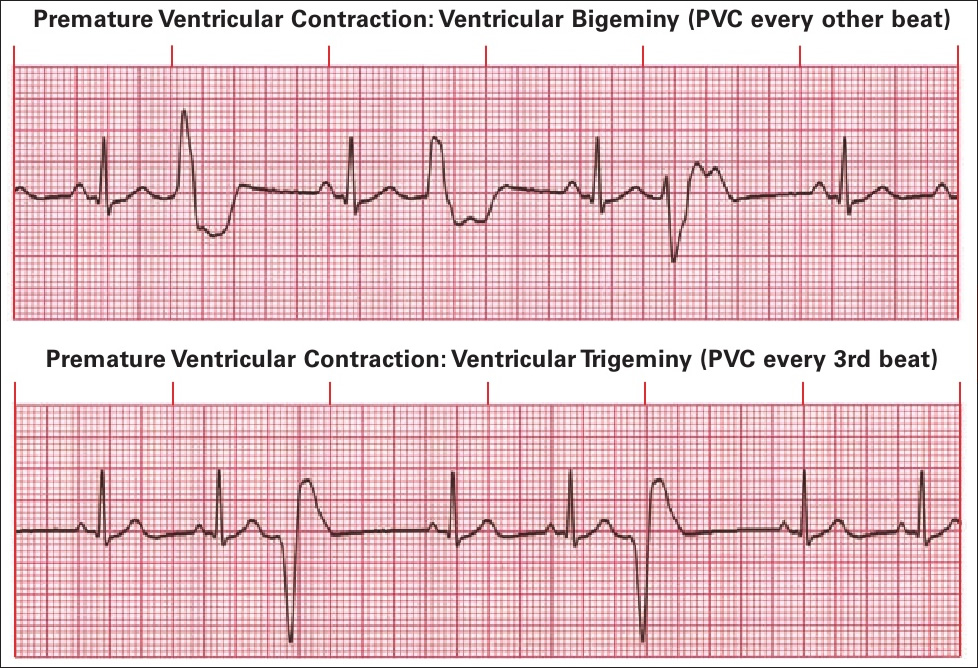
What are PVCs: (2)

Premature Ventricular Contractions

  1. has a wide, abnormal QRS complex

  2. person may feel skipped beat


<p><strong>Premature </strong>Ventricular Contractions</p><ol><li><p>has a <strong>wide, </strong><span style="color: rgb(189, 23, 209);"><strong>abnormal QRS </strong></span><strong>complex</strong></p></li><li><p>person may feel <strong>skipped </strong>beat</p></li></ol><p></p>
11
New cards

What is V-Tach? (3)

  1. ventricles beat rapidly (3+ PVCs in a row)

  2. organized QRS

  3. Pulse OR no pulse


<ol><li><p><span style="color: rgb(215, 62, 62);">ventricles beat <strong>rapidly</strong></span><strong> </strong>(3+ PVCs in a row)</p></li><li><p><span style="color: rgb(39, 134, 80);"><strong>organized QRS</strong></span></p></li><li><p><span style="color: rgb(27, 148, 177);">Pulse <strong>OR </strong>no pulse</span></p></li></ol><p></p>
12
New cards

monomorphic v-tach vs polymorphic v-tach:

*important note

mono: QRS have similar appearances

poly (aka Torsades de Pointes): QRS vary in appearance

**give Magnesium!!!* for Torsades


<p><span style="color: rgb(110, 65, 196);"><strong>mono</strong>: QRS have <strong>similar </strong>appearances</span></p><p><span style="color: rgb(173, 114, 42);"><strong>poly</strong> (aka <em>Torsades de Pointes)</em>: </span><span style="color: rgb(178, 116, 41);">QRS <strong>vary </strong>in appearance</span></p><p><span style="color: rgb(178, 116, 41);"><mark data-color="#ece7d0" style="background-color: rgb(236, 231, 208); color: inherit;">**give </mark><strong><mark data-color="#ece7d0" style="background-color: rgb(236, 231, 208); color: inherit;">Magnesium</mark></strong><mark data-color="#ece7d0" style="background-color: rgb(236, 231, 208); color: inherit;">!!!* for Torsades </mark></span></p><p></p>
13
New cards

V-tach treatment

  • with pulse (3)

  • NO pulse: (2)


  • with pulse

  1. antiarrhythmic med (Procainamide, Amiodarone, Sotalol)

  2. electrolyte replacement (K+)

  3. cardioversion (shocks)

  • NO pulse:

  1. CPR

  2. defibrillate


14
New cards

What is V.Fib? (3)

  1. Ventricles quiver chaotically

  2. Chaotic, no organized QRS

  3. NO PULSE!!

worst one**


<ol><li><p>Ventricles <span style="color: rgb(207, 79, 79);"><strong>quiver chaotically</strong></span></p></li><li><p><span style="color: rgb(59, 134, 162);"><strong>Chaotic</strong></span>, no organized <strong>QRS</strong></p></li><li><p><span style="color: rgb(160, 29, 29);"><strong>NO PULSE!! </strong></span></p></li></ol><p>worst one**</p><p></p>
15
New cards

Tx V. Fib: (5)

  1. CPR

  2. Defibrillate

  3. EPI

  4. Amiodarone

  5. Lidocaine


<ol><li><p><span style="color: rgb(16, 197, 33);"><strong>CPR</strong></span></p></li><li><p><span style="color: rgb(16, 197, 33);"><strong>Defibrillate</strong></span></p></li><li><p><span style="color: rgb(84, 84, 251);"><strong>EPI</strong></span></p></li><li><p><span style="color: rgb(84, 84, 251);"><strong>Amiodarone</strong></span></p></li><li><p><span style="color: rgb(84, 84, 251);"><strong>Lidocaine</strong></span></p></li></ol><p></p>
16
New cards

Asystole protocol: (3)

No electrical activity!!

  1. Call Code!!

  2. Start CPR!

  3. Give Epi

  • 1mg IV bolus q 3-5 mins!


<p>No electrical activity!!</p><ol><li><p>Call <span style="color: rgb(250, 120, 120);"><strong>Code</strong></span>!!</p></li><li><p>Start <span style="color: rgb(57, 101, 189);"><strong>CPR</strong></span>!</p></li><li><p><span style="color: rgb(45, 173, 110);"><strong>Give Epi</strong></span></p></li></ol><ul><li><p><span style="color: rgb(45, 173, 110);"><strong>1mg IV bolus q 3-5 mins!</strong></span></p></li></ul><p></p><p></p>
17
New cards

What is PEA? (3)

  • treat?


Pulselessness Electrical Activity

  1. electrical activity present but NO pulse

  2. NOT shockable rhythm!! (pt dead x_x)

  3. can give 1mg IV bolus Epi q3-5 mins and CPR


<p><strong>Pulselessness </strong>Electrical Activity</p><ol><li><p>electrical activity present but <span style="color: rgb(229, 37, 37);"><strong>NO pulse</strong></span></p></li><li><p><span style="color: rgb(42, 152, 117);"><strong>NOT shockable</strong></span> rhythm!! (pt dead x_x)</p></li><li><p>can give 1mg IV bolus <span style="color: rgb(175, 93, 239);"><strong>Epi q3-5 mins and CPR</strong></span></p></li></ol><p></p><p></p>
18
New cards

What are NON-shockable rhythms??

Asystole!!

PEA!! (pulseless electrical activity)

  • continue CPR


19
New cards
  1. Which rhythm has NO P waves and is irregularly irregular?

  2. Which rhythm is associated with sawtooth waves?


  1. atrial fibrillation (quivering)

  2. a.flutter


<ol><li><p><span style="color: rgb(68, 107, 199);"><strong>atrial fibrillation</strong></span> (quivering)</p></li><li><p><span style="color: rgb(37, 151, 43);"><strong>a.flutter</strong></span></p></li></ol><p></p>
20
New cards
  1. Which rhythm is usually 150–250 bpm with a narrow, regular QRS?

  2. which rhythm has premature wide beats originating in the ventricles?

  1. V-tach + NO pulse =?

  2. Which rhythm is especially associated with magnesium?


  1. SVT

  2. PVC

  3. CPR and Defibrillator

  4. Torsades de Pointes


21
New cards
  1. What is the difference between PEA and asystole?

  2. What is the biggest complication of A-fib?


  1. PEA has activity but no pulse; asystole has no activity and no pulse

  2. ⬇CO & blood clots


22
New cards

Whats adenosine used for?

SVT

  1. 1st dose: 6mg rapid IVP

  2. 2nd dose: 12 mg rapid IVP

  3. flush 10-20 mL NS after each dose


23
New cards

What is the epinephrine dose for asystole and PEA?

1mg IV bolus q3-5 mins

  • no limit to this


24
New cards

What cardiac rhythm do u give atropine for? (3)

Sinus Brady

  1. 1st IV dose: 1mg bolus

  2. repeat q3-5 mins

  3. max 3 mg