Chapter 3
 Call Kai
 Learn
 Practice Test
 Spaced Repetition
 Match
 Flashcards
 Knowt Play
1/164

There's no tags or description
Looks like no tags are added yet.
165 Terms
Reflexes
unlearned responses triggered by specific stimulation
Importance of testing newoborns for reflexes
Infants who have problems with the nervous system often lack certain reflexes
Babinski Reflex
A baby’s toes fan out when sole of foot is stroked from heel to toe
disappears at age 8-12 months
significance: remnant of evolution
Blink Reflex
baby’s eyes close in responsse to bright light or loud noise
permanent reflex
significance: protect eyes
Moro Reflex
Baby throws its arms out and then inward(as if embracing) in response to loud noise or when its head falls
disappears at 6 months
significance: may help baby cling to mom
Palmar reflex
baby grasps an object placed in palm of its hand
disappears at 3-4 months
significance: precursor to voluntary walking
Rooting Reflex
When baby’s cheek is stroked, it turns its head toward the stroking and opens its mouth
disappears at 3-4 wks(replaced by voluntary head turning)
significance: helps baby find the nipple
Stepping Reflex
Baby who is held upright by an adult and is then moved forward begins to step rhythmically
disappears at 2-3 months
precursor to voluntary walking
Sucking reflex
baby sucks when an object is placed in its mouth
disappears at 4 moths(replaced by voluntary sucking)
significance: permits feeding
APGAR test
quick assessment of the baby’s physical condition
Appearance: color of skin
Pulse: heart rate
Grimace: reflex irritability
Activity: muscle tone
Respiration
≥ 7 indicates the baby is in good physical condition
4–6 means the newborn needs special attention or care
≤ 3 signals the need for emergency medical care

4 states that infants alternate among through the day
alert inactivity
waking activity
crying
sleeping
Alert inactivity state
he baby is calm with eyes open and attentive; the baby seems to be deliberately inspecting the environment
Waking activity state
the baby’s eyes are open but they seem unfocused; the arms or legs move in bursts of uncoordinated motion
Crying state
the baby cries vigorously, usually accompanied by agitated but uncoordinated motion
Sleeping state
the baby alternates from being still and breathing regularly (Quiet sleep) to moving gently and breathing irregularly (active sleep); eyes are closed throughout 7
3 types of Crying
Basic cry: starts softly and gradually becomes more intense; often heard when babies are hungry or tired
Mad cry: more intense version of a basic cry –
Pain cry: begins with a sudden long burst, followed by a long pause and gasping
crying occupies 3 hrs of newborn’s day
REM sleep
sleep in which a person’s eyes dart rapidly beneath the eyelids. Cortex is very active, sleeper wakes easily, often from a dream
REM accounts for 50% of a baby’s sleep; 40% by 4 months; and 25% by 1 ye
Non-REM sleep
sleep in which heart rate, breathing, and brain activity are steady. NonREM sleep can be very ‘deep’ with the person waking slowly and being groggy
Why do newborns need more REM
M because they have so little waking time, and that REM provides brain stimulation needed to foster growth in the nervous system.
Altricial species vs precocial specie
3 types of sleep for newborns
Quiet sleep (QS, like Non-REM sleep in adults)
Active sleep (AS, like REM sleep)
Intermediate sleep (IS – no real equivalent)
QS & AS alternate in a 50 to 60 min cycle
Sleep makes up 16-18 hours of 24 da
2 types of wake for newborns
Quiet wake (alert inactivity)
Active wake (waking activity
The sleep-wake cycle is about 3-4 hours (not ~24 hrs) – Coincides with normal feeding times
After how many weeks does active sleep become REMS
12 weeks
By how much does total sleep time drop as newborn ages to toddler 4
Total sleep time drops to 14-15 hours by 16 weeks and 10-12 hours between ages 3-5 year
when do naps disappear
around 2-4 years old
by what age does sleep become similar to adult sleep
by age 10
becomes ~10hrs
Sudden Infant Death Syndrome
ituation in which a healthy baby dies suddenly, for no apparent reason
5% of infant deaths in Canada
17.5% of deaths between 28 days and 1 year of age
Higher incidence among economically disadvantaged and Aboriginal population
Risk factors that contributes to SIDS
Exposure to cigarette smoke prenatally or during infancy
Sleeping on stomach (hence ‘back to sleep’ campaign of 1994)
Co-sleeping mostly a risk when parents smoke/drink
Co-sleeping less likely to be a risk in cultures where beds are more firm, like large mats on the ground, instead of soft mattresses with many blankets
What does ‘average’ growth of body mean
considered the 50th percentile
meaning that the child is longer or heavier than 50% of agemates
What does ‘normal’ growth of body mean
considered anything above the 10th percentile and below the 90th percentile
Correlation between child and both parents height
The correlation between the average of the two parents’ heights and that of their child at age 2 is about 0.7
Final adult height is a combination of genetics and the environment (primarily diet and health
Breast milk
Breast milk is considered ideal for the first 6 months
Balanced vitamins
Protection against illness
Formula
provides similar nutrients, but does not protect against illness
Benefit is that other people can help feed the baby and bond with them as well
Much more expensive
Is dangerous in developing nations
In developing nations, formula is often made with contaminated water, causing chronic diarrhea.
Also, parents often dilute formula to make it last, leading to malnutrition.
Solid food
Solid foods are added to milk at about 6 months, when the child is ready
Offer only one new food at a time to check for allergies or other reactions
To lower the risk of allergies, introduce foods early
Babies often prefer foods that their mother ate while pregnant
Avoid giving the baby honey until 2 years old in case of food poisoning (rare but still a risk)
Expect some decrease in appetite when growth slows in toddlerhood
Malnutrition
being small for one’s age because of inadequate nutrition
Affects growth and development greatly in infancy, including brain development
By school-age, causes difficulty maintaining attention in school
Children are often listless, inactive, apathetic
Unresponsiveness to parents often influences parental behaviou
Weight of brain
25% of its adult weight at birth
80% of its adult weight at 3 year
The brain weighs about 3 pounds
Myelin
Fatty sheath that wraps around neurons to permit them to transmit information more rapidly (up to 100x faster)
Begins developing on some axons in the 4th prenatal month, but myelination isn’t complete until adulthood. The process then switches to myelin maintenance.
Starts from the back of the brain (brainstem, cerebellum) towards the front (ending with social skills and good judgement in adulthood)
Requires fats, vitamins (like B12), iron, good sleep, low stress
“Childhood ADHD” likely linked to delays in myelination of frontal lobes that control executive function
Synaptic Pruning
gradual reduction in the number of synapses, beginning in infancy and continuing until early adolescence
We begin with overproduction of dendrites and synapses, and then gradually weed out the ones that are not in use
By late childhood we have trimmed 50% of our synapses.
Recent research points to autism being linked to a lack of synaptic pruning (16% decrease in synapse density vs 50% in one study) 25
Neuroplasticity
extent to which brain organization is flexible
Plasticity is greater in infancy, and thus infants recover functions more easily than do older children or adults after many forms of brain damage
Our brains remain plastic throughout our lifespans, and learning remains beneficia
Motor skills
coordinated movements of the muscles and limbs
Locomote: to move around in the world –
Fine motor skills: motor skills associated with grasping, holding, and manipulating objec
Locomotion
Some typical milestones (considerable variability is expected and normal).
5 months: roll from back to front; sit upright with support
7 months: sit alone
10 months: creep
14 months: stand alone briefly; walk with assistance
Toddling: early, unsteady form of walking done by infants
Toddler: a young child who has learned to wal
Dynamic systems theory
views motor development as involving many distinct skills organized and reorganized over time to meet specific needs
Motivation is important
Children combine the skills they have already mastered to form new skills
When do infants spontaneously step
Most infants don’t spontaneously step until about 10 months
Before this, they can’t hold themselves upright
What did Thelen and Ulrich discover in terms of stepping
Thelen and Ulrich found that 6- and 7-month-olds will often step if held upright
Differentiation
distinguishing and mastering individual motions
Integration
combining intricate motions in proper sequence into a coherent, working whole
Ulnar grasp
an almost clawlike grasp that permits very little manipulation
4-month-olds grasp by folding fingers toward palm
They don’t start using their thumbs to help grasp until about 7 or 8 months

When are infants able to coordinate 2 hands for different actions
At about 5 or 6 months, infants can coordinate two hands for different actions
Hold a toy in one hand and pet it with the other
Pincer grasp
occurs when the thumb is used in opposition to the fingers
Achieved by the end of the first year
Greatly improves manipulative skill
Perception
processes by which the brain receives, selects, modifies, and organizes incoming nerve impulses that are the result of physical stimulatio
Habituation procedures
measuring decreased responsiveness to a stimulus after repeated presentation
How did Phelps describe habituation procedure via measuring rate of sucking reflex
Researchers first measure the initial baseline rate of sucking to a pacifier equipped with transducers that measure muscle contractions.
Next, an auditory stimulus is presented, such as a human voice uttering a speech sound such as “da.” The rate of sucking will typically increase with the new sound, but then decrease to baseline levels as “da” is repeatedly presented, showing habituation.
If the sound “ma” was then presented, the rate of sucking would again increase, demonstrating that the infant can discriminate between these two stimuli
What smells do newborns show a preference for
Have a keen sense of smell
Show a preference for
Pleasant smells such as honey or chocolate
Familiar smells such as their own amniotic fluid, Mom’s breast, or Mom’s perfume
What smells do newborns react negatively to
React negatively to unpleasant smells such as rotten eggs or ammonia
Can newborns distinguish different tastes
Can distinguish salty, sour, bitter, and sweet
Most show a preference for sweet
React to changes in breast milk based on Mom’s diet
Will nurse more if Mom has consumed something sweet
How do newborns react to touch
Newborns exhibit reflexive reactions to touch of cheek, mouth, hand, or foot
Skin-to-skin contact positively influences growth in preterm infants
Newborns react intensely and negatively to painful stimuli such as inoculations
When do newborns exhibit their best hearinng
Can hear, but acuity is not as great as in adults
Best hearing is for pitches in the range of human speech.
By 6 months they prefer their language
What types of noise can newborns distinguish from
Can distinguish musical notes, distinguish pleasant (consonant) from unpleasant (dissonant) melodies
Can discriminate different rhythmic structure
What voices do newborns prefer to hear
Will prefer voices and even specific stories that they heard while in utero
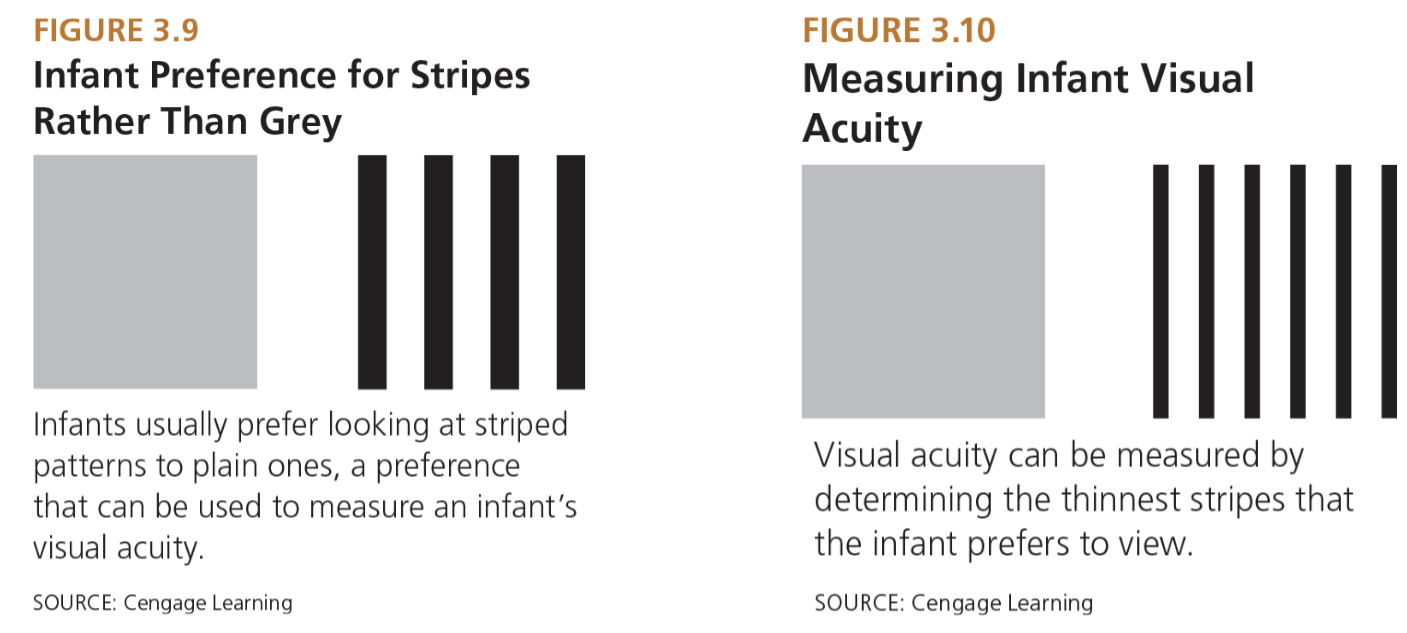
Visual Acuity
smallest pattern that one can distinguish reliably
About how many inches from their face can newborns see
Newborns can only see about 10 inches from
their face
Why does the world still appear blurry for infants
because the fovea (center of the retina, where we see details) is still developing at birth, until about 15 months
Cones
specialized neurons in the back of the eye that sense colour
Some are most sensitive to blues and violets; some to greens and yellows; some to reds and oranges
Ironically they can’t easily see ‘baby’ colours in pastel shades, beige
Newborns don’t distinguish many colours, but colour vision is adultlike by 4 or 5 months
Visual Cliff experiment
glass-covered platform that appears to have a “shallow” side and a “deep” side; used to study infants’ depth perception
Non-crawlers show decreased heart rate on the deep side, indicating increased attention.
Once they have some experience crawling, they show increased heart rate if you place them on the deep side, indicating distress. They typically refuse to cross the deep side themselves
How do infants determine what is part of the same object and what is not
common motion
color
texture
aligned edges
how do newborns track faces
Newborns track faces and facelike stimuli more than other stimuli
By 4 weeks, they track all moving objects equally It has been suggested that face tracking is
reflexive, and falls away as the brain’s cortex starts controlling lookin
at how many months do infants perceive human and nonhuman faces in same way
6 months
at how many months do infants become better at distinguishing among different human faces than nonhuman faces
AFTER 6 months
at how many months do infants become better at distinguishing faces of their own race than of other races, according to Kelly et al.
9 months
Intersensory Redundancy
infants’ sensory systems are attuned to information presented simultaneously to different sensory modes
For instance, watching Mom clap her hands while hearing the clapping sound
Infants prefer stimuli in which the different modes “match”
What did Jean Piaget suggest about children in terms of cognitive development
suggested that children are actively trying to understand their world
They form theories about how the world works, then conduct experiments on their environments to test and revise these theorie
Schemes
according to Piaget, mental structures that organize information and regulate behaviour
Early schemes are typically based on actions, such as a “Sucking” scheme. After infancy, we see more conceptual schemes, such as “Pets” or “Things I Use to Eat.”
Assimilation
according to Piaget, taking in information that is compatible with what one already knows
Birds fly. That thing flies so it’s a bird
Accommodation
according to Piaget, changing existing knowledge based on new knowledge
Birds fly but that flying thing is not a bird. So ‘things that fly’ must have more than just birds in i
Equilibration
according to Piaget, a process by which children reorganize their schemes to return to a state of equilibrium when disequilibrium occurs
Disequilibrium occurs when too many of our schemes are inadequate for understanding the world
How does equilibration change our thinking
Equilibration qualitatively changes our thinking, moving us to a new period of cognitive development

Object Permanence
that objects still exist independently even when we cannot see them
A 4-month-old will act as if an object has ceased to exist if you cover or hide it
A-not-B error
An 8-month-old will search for a hidden object
However, after finding it in the same hiding place several times, this child will keep looking in that hiding place even after watching you move it somewhere else (A-not-B error
A 12-month-old will not make this error, but doesn’t show complete object permanenc
When does complete object permanence occur
18 months
Criticisms of Piaget’s theory on cognitive development
Underestimates competence in infants and young children
Overestimates competence in adolescents
Describes too vaguely how change occurs
Defines assimilation and accommodation too vaguely to test scientifically
Core Knowledge hypothesis
infants are born with rudimentary knowledge of the world, which is elaborated based on experiences
Children test and modify their theories, much like real scientists
What did Renee Baillargeon describe in terms of Naive Physics
shown that infants have some understanding of physical properties, such as object permanence, earlier than Piaget suggested
4 ½ - month-olds frequently pass the rotating screen test (next slide)
This is our interpretation of their reactions, so not a certainty
Naive physics

Violation-of-expectation
Other violation-of-expectation studies have indicated that 6-month-olds are surprised when an object
Released in midair does not fall
Remains stationary after being hit
Passes through another solid object
Appears to be completely hidden by another, shorter object
Naive Biology
Infants and toddlers use motion to distinguish animate from inanimate objects
By about 12–15 months, they know that animate objects
Are self-propelled
Can move in irregular paths
Act to achieve goal
Attention
processes that determine which information will be processed further by an individual
Orienting Response
individual fixes eyes on a strong or unfamiliar stimulus and changes in heart rate and brainwave activity occu
Habituation
: becoming unresponsive to a stimulus that is presented repeatedly
This is adaptive, because then you don’t waste energy and attention on a non-threatening part of your environment
3 major types of learning in infants and toddlers
Classical conditioning
Operant conditioning
Imitation
Classical Conditioning
a form of learning that involves pairing a neutral stimulus and a response originally produced by another
A neutral stimulus is paired repeatedly with a stimulus that naturally elicits a response
Over time, the neutral stimulus comes to elicit the same response
For example, if, every time Mom puts your coat on, you go outside and have fun, your coat is an indicator that fun is coming, and should elicit happiness and/or excitement.
Operant Conditioning
occurs when a child learns to expect certain consequences for certain actions
If smiling is typically rewarded with a hug, smiling will likely increase
If grabbing a family heirloom is punished with anger from a parent, it is less likely to be repeat
Imitation
ewborns imitate facial expressions
There is no indication that they can imitate behaviours not already in their repertoire
Later in infancy, they may imitate actions that they have not already engaged in themselve
What did Rovee-Collier learn about 2 and 3 yrs olds in terms of memory
learned that 2- and 3-month-olds can remember, for at least several days and often longer, that kicking their legs will move a mobile
After a few weeks, they often could not remember, unless she moved the mobile herself first So even small babies can learn, forget, and be reminded
5 month olds can…
Distinguish sets of 2 objects from sets of 3 objects
Perform very simple addition and subtraction
Wynn study
suggests simple addition, but we can never be sure in infant research

At what age do most children say their 1st word
Most children say their first word at about 1 year. They have been
Communicating in other ways for some time
Baby sign language can be used as early as six months
Understanding at least some of their parents’ speech for month
Children’s first form of communication
is crying
Parents typically respond readily, trying to figure out exactly what their infant is trying to tell them
Parental responses are often a mix of verbal (e.g., “It’s okay”) and non-verbal (e.g., rocking) behaviour
Phonemes
unique speech sounds that can be used to create words
Habituation studies indicate that infants can distinguish among different phonemes, even those from other languages
The ability to distinguish phonemes that come from unfamiliar languages declines by about 1 yea
How do infants percieve speech
Syllables that occur together often are likely a single word
A stressed syllable is likely either a word or the start of a multi-syllable word (in English)
Certain sounds rarely go together in a single word (e.g., sd in English), and thus likely represent the end of one word and the start of anothe
Infant -directed speech
way of speaking in which adults speak slowly and with exaggerated changes in pitch and loudness
Seems to attract infants’ attention more than adult-directed speech
Seems to help infants to segment word