Populations Exam 2
 Call Kai
 Learn
Learn Practice Test
 Spaced Repetition
 Match
Match Flashcards
 Knowt Play
1/99

There's no tags or description
Looks like no tags are added yet.
Name | Mastery | Learn | Test | Matching | Spaced | Call with Kai | Chat |
|---|
No analytics yet
Send a link to your students to track their progress
100 Terms
epidemic
the simultaneous occurrence of a great many cases of a specific disease in a human community, unexpected
pandemic
an epidemic occurring worldwide or over a very wide area, usually crossing international borders
direct contact transmission
involves body-to-body surface contact
-ex) STD, ebola
indirect contact transmission
occurs via contact with contaminated intermediate objects, such as contaminated hands, or inanimate objects(fomites)
-includes vector transmission
airborne transmission
occurs when viruses travel on dust particles or on small respiratory droplets that may become aerosolized when people sneeze, cough, laugh, or exhale
-ex) TB, COVID, Influenza
seasonal influenza
-mild/moderate illness, highly contagious
-incubation 2 days, contagious for 1 to four days before SxS and about 5 days after first SxS
-cause: viral subtypes already circulate in humans
-5%-20% of US population gets infected each year
-50% of those infected do not show an SxS but are still contagious
-around 36,000 deaths/year in US (usually immunosuppressed/over 65 years old)
-vaccine available
humidity percent where viral spread is good and no spread
-good->20% humidity
-no spread->80% humidity
going from epidemic to pandemic
virus needs to be
1)new/novel
2)elicit severe disease
3)easily transmitted human to human
bacteria not likely to become pandemic due to antibiotics, fungi not likely because they mutate really slowly
antigenic drift
minor mutations, point mutations on H and/or N antigens
-reason for seasonal vaccines
antigenic shift
major mutation, a result of recombination of the genetic material from 2 or more viral strains
-wild bird to human, wild bird to other animal host to human
natural hosts
aka carriers
reservoir
where the virus hangs out
-wild birds are main reservoir for all influenza
-examples include humans, animals, plants, insects, water, soil
2009 H1N1 swine flu
-used pigs as mixing vessel
-combo of avian, swine, and human H1N1 linages
-20%-28% of population affected
-10% of elderly had immunity from 1918 virus
-50% of children in UK, Australia, and India infected
-not the same as bird flu
risk factors for potential avian pandemics
-birds natural hosts all influenza A types, pigs natural mixing vessels for host viruses
-mutating capability of influenza A
-dense populations of humans, birds, and pigs in Asia with close contact
-human travel, bird migration, swine trade
-trafficking of infected birds/bird parts
acquired immunity (humoral immunity)
antibody production
innate immunity
-physical barriers
-cell-mediated immunity
-cytokines
chemotaxis
movement in response to a chemical stimulus
Spanish flu H1N1 (1918-1919)
-500,000-675,000 deaths on the US
-not known as well because of how bad it was
-some tried to sequester(isolate, easily contained, independent)
-increased incidence of Parkinson's in people born between 1888-1925
tools used to help achieve public health goals
-vaccination
-antiviral medication
-testing
-education
-isolation
-quarantine
-social distance
-protective sequestration
goals for public health interventions
-delay outbreak peak
-decompress peak burden on hospitals/infrastructure
-diminish overall cases and health impacts
World Health Organization's phases of pandemic alert
-phases 1-3: predominantly animals infections: few human infections
-phase 4: sustained human-to-human transmission
-phase 5-6(pandemic/global): widespread human infection
-post peak: possibility of recurrent events
-post pandemic: disease activity at seasonal levels
ways of decreasing obstacles to pandemics
1) present accurate, timely, useful information to convince a large audience of people to accept responsibility for themselves and family
2) get all facets of the community to work together before the pandemic
3)identify the weaknesses of the community
4) address tough ethical issues(limited resources, exclusion criteria, mandatory vaccines, lockdowns, economy cost)
national stockpile influenza (for president and military)
gowns, gloves, masks (surgical/N95), antivirals, vaccine supplies
epidemiology
explains how and why health and illness occur in human populations
-used to just focus on infectious disease, now also looks at diet, physical activity, poverty, housing, chronic diseases, violence
descriptive epidemiologic investigation
describes distribution of disease(prevalence); person, place, time, and effect
-correlational design
analytic studies epidemiologic investigation
examine cause and effect
-hypothesis testing (cohort; case-controlled)
experimental trials epidemiologic investigation
hypothesis testing
-randomly assigned to experimental and control groups
epidemiologic models
Epidemiologic triad
The wheel of causation
The web of causation
Epidemiologic Triad
-Susceptible host: modifiable and nonmodifiable factors
-causative agent: physical , chemical, nutritional, psychosocial, biological
-environment: biologic, physical, social
wheel of causation
genetic role of the host is surrounded by a wheel representing biologic, physical, social environments
-the agent is de-emphasized as the sole cause of disease
-it is the interaction between host and environment which determines health
web of causation
-multifactorial etiology of disease
-multiple causes/multiple effects
best indicator of health in populations
morbidity/mortality during pregnancy/infancy
analyzing data from multiple sources
-US Bureau of Census->demographic(age, gender, race, life expectancy)
-US department of commerce studies(city growth, marital status, occupation, poverty)
-CDC
people with mor morbidity/mortality that puts them at high risk
-low income
-minority
-rural
-outliers (genetic mutations, stubborn high resource people)
rate
makes comparisons between groups
-per 100, 1000, or 100,000
ratio
compare one number with another
- 1:5, 1:2
incidence
new cases in a population
-assessment of preventative measures
prevalance
measures all of the existing cases at a given point in time
-incidence + all of the existing cases
-assessment of chronic diseases, treatments and planning needs
"Horse" diseases
influenza, RSV(pop dependent), COVID, Mono, Strep
"Zebra" diseases
plague, sarcoidosis, rabies, hantavirus, flu in July
proportion
type of ratio that includes quantity in the numerator as part of the denominator
-10/50=20%
attack rate
-# of people who get sick/# of people at risk
-key is about exposure
relative risk ratio
ratio of the incidence rate in the exposed group and the incidence rate in the nonexposed group
-ex) relative risk of 7.0 means that the affected group has seven times the risk of a non-affected group
-RR=risk exposed/risk unexposed
stigma in COVID pandemic
-language of COVID->"yellow alert", "Chinese virus"
-against healthcare workers->people saw them as dirty/infected
-stigma increased contagion->avoiding healthcare may lead to losing job
-psychological assistance->anxiety/depression issues
-fear due to panic buying, distracting politicizing, inaccurate/confusing messages
-some fear is good->remind you to wash hands
R naught
how many people get infected from 1 infected case
-depends on susceptibility
-ex) measles->R18
serial interval
how long it takes one infected person at a particular stage of the disease to infect another person who then reaches the same stage of the disease
cycle threshold value
how much virus an infected person harbors
incubation period
time of exposure to time of symptoms
serial interval and incubation period for COVID 19
-SI->5 days
-incubation->6 days
when serial interval is shorter than incubation period......
pre-symptomatic transmission is likely to have occurred
Carrier
a person or animal who harbors an infectious organism and transmits the organism to others while having no symptoms of the disease
communicable disease control involves.....
controlling environmental elements and personal behaviors that facilitate the spread of disease
-most successful have been hand hygiene, also chlorination of water, sewage systems, milk pasteurization, antibiotics/antivirals, vaccines, and immunization programs
-also can be quarantine, sanitary precautions, and travel restrictions
when the first state health department was established
1869
% of doctors visits that are related to infectious disease
25%
infectious disease
presence and replication of an infectious agent in the tissues of a host, with manifestation of signs and symptoms
how to prevent communicable diseases from spreading
find the weak link in the epidemiologic triangle and develop measures that attack and reduce/eliminate that threat
-infectious agent "what"
-host "who"
-environment "where"
steps of communicable disease investigation
1)identify the agent
2)formulate and test for possible causative factors (determine method of transmission->direct and indirect transmission)
3)establishing the susceptibility/impact of populations at risk
4)re-hypothesize if not working
Pathogenicity
seriousness, ability of agent to produce an infectious disease in a susceptible host
arbovirus
any group of viruses transmitted by a tick, mosquito, or other arthropod (crunchy bugs)
Communicability
different from incubation period, period of being contagious
infectivity
ability of agent to produce immunity within host
invasiveness
ability of the agent to destroy body cells
toxicity
ability of agent to produce toxin
-ex)tetanus, diphtheria, Streptococcus
endemic
the constant or usual prevalence of a specific disease/infectious agent within a population/geographic area
emerging infectious disease
newly identified clinically distinct infectious disease, or reappearance/reemergence of a known infectious disease after its decline with an incidence that is increasing in a certain geographic area or in a specific population
Zoonotic infections
infections acquired through animal reservoir
vector
living organisms that can transmit infectious diseases between humans or from animals to humans
-ex) mosquitoes, ticks, lice, sandflies, nails, fleas
cause for increasing outbreaks
-more travel/connectivity
-urbanization
-pervasive poverty
-warming climate
herd immunity
type of immunity in which a large proportion of people in a population are susceptible to a communicable disease
spillover
a comprehensive, publicly accessible risk assessment tool to systematically facilitate evaluation of novel viruses in terms of their zoonotic spillover and pandemic potential
-increased potential due to travel, technology, industry encroachment, lack of political will, and climate change
blastomycosis
-fungal
-found in US/Canada that border great lakes and large river valleys, MOIST SOIL rich in organic matter
-SxS: fever, cough, chills, chest/joint pain
-50% have no SxS
-incubation 3-15 weeks
-NOT contagious
Eastern Equine Encephalitis (EEE)
-33% fatality rate
-incubation 4-10 days
-only contagious through blood transmission; humans, horses, and dogs are "dead-end" hosts
-SxS: SUDDEN onset fever, HA, chills, vomiting
-no Tx
-vector is mosquitoes (from them to dead bird, then from dead bird to them and then to human)
-most likely found in wet areas(bogs, swamps)
pediculosis (lice infestation)
types:
-pediculosis humanus capitus (head louse)
-pediculus humanus corporus (body louse)
-phthirus pubis (pubic or crab louse)
-transmitted by close personal contact, clothing, hairbrushes, furniture
-causes a lot of itching
demodex infestation
-build up of mites that live in sebaceous glands/hair follicles (eyelashes, also found behind ears, neck, and chest)
-SxS: itching, skin roughness, rosacea-like skin, flaking skin
-30% of people over 50 years have had it, 100% of people over 90 years old have had it
-Tx: Tea tree oil, wash face BID, avoid pore-plugging products and long-term steroid skin tx
Epidemic typhus
-Caused by Rickettsia prowazekii, transmitted by fleas
-SxS: rash that begins on trunk and spreads, high fever, N/V, malaise, diarrhea, SEVERE->bleeding into skin, delirium, hypotension, death
scabies (mite infestation)
-caused by sarcoptes scabiei (itch mite)
-females lay eggs beneath skin
-SxS: itching(primary symptom)
-transmission: direct contact or infested bedding, clothes, or towels
-Tx: entire body surface excluding face and scalp, several drugs can be used(Permethrin 5% cream drug of choice
bed bugs
-can carry MRSA and also same parasite that causes Chagas disease
-can spread chaga parasite through feces going through open skin
-can cause sores that can become infected
-removal->heat house over 130F for 2 hours or cool house to under 32F for several days
Chagas disease
-steps of infection: bug crawls out at night and bites exposed skin(usually on face), then urinates/defecates near bite, victim scratches bite, insect feces enter body
-bug is Triatomine infected with Trypanosoma cruzi
-considered not eradicable
-acute phase->weeks to months, parasites in blood, mild symptoms, Romana's sign (swollen eye)
-Tx only through CDC
-Chronic->little parasite load, feeling ok, lasts years
-20%-30% develop debilitating symptoms, can be fatal
Marburg virus (a filovirus)
-fruit bat implicated with transmission in Germany (1967)
-had 88% kill rate
-more recent incident in Ethiopia had a 62% kill rate
-causes hemorrhagic fever
Ebola
-trialing new vaccine
-death rate at 67%
-causes hemorrhagic fever
All influenza As are...........
from zoonotic reservoirs (birds/pigs)
influenza A can both.........
"drift" and "shift"
influenza B can....
only "drift"
how important children vaccination is
-vaccinate 20% of kids, more protective than vaccinating 90% adults
-vaccinate 70% of kids, protect the entire community
superspreaders
-20/80 rule (20% of people infected can spread 80% of disease)
-not everyone has an equal chance of both spreading and receiving an illness
what makes a super spreader in regards to host, agent, and environment?
Host
-decreased immunity(may mean extreme shedding of pathogen)
-age and obesity= increased droplet size
-physiological preference(ex. robins/songbirds in West Nile, O blood types in GI)
Agent
-virulence
-co-infection (if present, may be able to spread other infections more efficiently)
Environment
-crowding
-misdiagnosis
-inter-hospital transfers
-building ventilation systems
-cultural practices (ex. washing bodies after death)
Severe Acute Respiratory Syndrome (SARS Co-V 1)
-viral upper and lower resp infection caused by Corona virus
-SxS: HIGH FEVER in 99%-100% of people, HA, body aches, diarrhea, dry cough, possible pneumonia
-spread through droplet
-30% of infected need mechanical ventilation
-no rapid Tx and test
Middle Eastern Respiratory Syndrome (MERS)
-zoonotic
-camel is key reservoir, bats may also be
-30-40% fatality rate
-no vaccine/Tx, avoid drinking camel urine/raw milk
-no sustained human-to-human transmission
-considered a novel corona virus
rhinovirus (seasons of occurrence and % of colds)
-early fall, spring, and summer
-50% of all colds
coronavirus (seasons of occurrence and % of colds)
-winter and early spring
-20% of all colds
The Plague (Black Death)
-originated in Ukraine
-agent->yersinia pestis
-spread by fleas infected from the prairie dog or squirrels
-is the comparison for all pandemics
-Great Famine (1315-1322) made hosts vulnerable
-plague entered Europe in 1947 (dropped life expectancy from 30-35 to 17 years), waves hit over decades
-immunity to plague may be linked to immunity to other diseases (10% of northern Europeans have the CCR5-Delta 32 mutation, could also be related to smallpox)
-in class considered a ZEBRA
-special signs made for hiking trails ("stay on trail)
-around 17 cases each year in US
-3 types: pneumonic and septicemic(both mortality rate of 95-100%), bubonic(50% mortality rate, most common)
-Tx: cripro or tetracycline
-incubation 1-6 days
-SxS(depends on type): fever, cough, pustules(bubonic), pneumonia, chest pain, weakness
Hantavirus
-aka "sweating sickness"
-increase in rainfall->increase of food->increase of mice->increase of mice poop that can aerosolize which passes virus
-most are not contagious (Andes is)
-considered ZEBRA in class
-UV can kill the virus
-people who are white and male are more likely to get it
- incubation: 1-8 weeks
-SxS: fever, myalgia, N/V, cough(crackles/rales), dizziness, arthralgia, SOB
-elevated LFTS and left shift on WBC diff.
-need ICU care with ventilation
-1 in 3 die even with treatment (can happen within days)
-key is to control mice/rodents
West Nile Virus
-Vector is a female mosquito (use DEET and Picaridan to repel), usually infected in the summer, considered a ZEBRA
-other modes of transmission: blood transfusions, organ transplants, intrauterine, percutaneous exposure, breast milk
-80% of infected are asymptomatic, 20% have "West Nile fever", <1% have CNS disease
-3-14 day incubation
-SxS(20% of cases): fever, chills, HA, severe fatigue, N/V, rash without itch on chest/abdomen/back/arms
-can lead to meningitis, encephalitis, and paralysis (watch for severe HA in young people)
-those at risk: old, HTN, black race, organ transplant
-how to reduce risk: reduce time outdoor(especially at dusk during the summer), wear long sleeve shirts/pants, use DEET, window/door screens, drain standing water in yard/outdoors(mosquito breeding site)
Treatment for EEE, West Nile, and Hanta
-supportive care
-lytes and fluids
-treat secondary infection
-support BP and resp.
-hope for vaccine
-antivirals may help (viruses have been getting resistant)
rocky mountain spotted fever
-spread mostly by ticks, could also be lice, fleas, and mice
-preventing tick bites is most effective
-Tx: Doxycycline, TREAT EARLY (20% fatality rate in first 8 days if not treated)
-5-14 day incubation period
-more likely to be infected if you are a man, native, over 40
-SxS: RASH(90% of cases, day 3-4)->small, flat, pink(red then purple), non-itchy spots on wrists, forearms, and ankles(spreads to trunk and potentially palms/soles), abrupt high fever (104F), WBC normal, increased liver labs, HA, N/V, muscle aches, confusion(day 5-6), hypothermia/septic shock(day 7-8), conjunctiva infection(red, NO DISCHARGE)
-can involve the lungs, heart, kidneys, and CNS
-50% of cases end in death in people and dogs

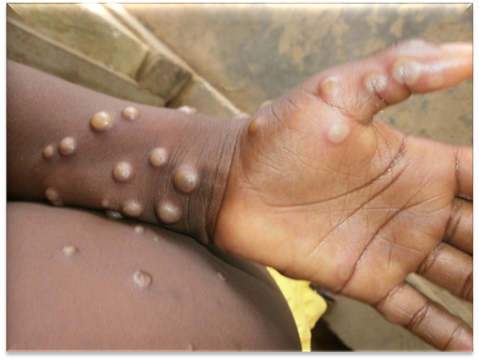
Mpox (Monkey pox)
-eradication of small pox allowed Mpox to rise
-transmitted through indirect and direct contact (sex, touching rash, contact with infected fabrics)
-SxS(flu-like): fever, chills, swollen lymph nodes, HA, backache, fatigue, myalgia; lesions all in different stages of healing is hallmark sign(rash appears days 1-4, which is very noticeable and painful, flat spots turn into blisters then scab over)
-CONTAGIOUS until rash scabs off and heals (2-4 weeks)
-2 types: Clade 1(central africa, more serious/deadly/spreadable), Clade 2(west africa, not as severe/deadly)
-people at risk: weaken immune system, <1 y/o, people with eczema, pregnant women
-VACCINE available for Clade2, not great for Clade 1
Lymes disease
-caused by ticks with bacteria borrelia burgdorferi and borrelia mayonii
-DAILY TICK CHECKS! use repellant preventatively
-can be transmitted any time of the year as long as its above 4 degrees C and there is no snow
-stage 1 and 2 mimic->bells palsy, arthritis, herpes zoster, fibromyalgia, flu, tinea corporis scaly rashes, powassan, Anaplamosis
-SxS: bull's eye rash(70%-80% of cases, present 3-30 days after tick bite, no hard lump like what is present with a bruise)
-stages: stages 1(1-3 to 21 days after bite, flu-like symptoms, malaise, erythema migrans/bulls eye rash at bite site), stage 2(early disseminated, weeks/months after incubation, fever, malaise, severe fatigue/HA, joint/neck pain, bells palsy, carditis), stage 3(months to years, recurrent meningitis, mental disorders, chronic arthritis, bladder issues), stage 4(RARE, permanent damage/death)
-Tx: high doxy dose at any engorged tick bite, then take doxy or amox. for 3 weeks
Babesiosis
-common co-infection with lymes
-malaria-like parasitic infection from tick
-SxS: gradual malaise/anorexia/fatigue, fever, DRENCHING SWEATS, muscle pain, HA, no rash
-can be asymptomatic, mild, or life-threatening
-increased if farmer or horse rider, usually on the North East Coast
Alpha-Gal
-infected from lone star tick bite, could be deer tick in upper midwest
-causes a histamine allergy reaction, can become allergic to meat products and dairy
-some protection is type B blood
prevention of vector borne tick illnesses
-stay on trails
-tuck pants into socks
-wear long sleeves
-check body often
-DEET/permethrin
-remove ticks immediately
-keep grass short
-remove garbage/dead brush
-chemically treat yard
-try to make yard "less attractive" to host animal such as birds, deer, and rodents(remove animal feeders)
-check pets when they enter the house
-outdoor occupations at increased risk