Soil Fertiity EXAM 1
 Call Kai
 Learn
 Practice Test
 Spaced Repetition
 Match
 Flashcards
 Knowt Play
1/60

Earn XP
Description and Tags
Based on exam review from Canvas and slideshows on Canvas
61 Terms
Liebig’s Law of the Minimum
When yield of a crop is held back by the essential nutrient in shortest supply.
Justis Von Liebig
Discovered that carbon in plants comes from CO2, and that Oxygen and Hydrogen comes from water. Father of modern soil fertility.
Soil Productivity
The ability of a soil to produce an adequate amount of plant growth with optimum management
Soil fertility
The quality of a soil that enables it to provide nutrients in adequate amounts and in proper balance for growth of plants
Plants obtain most biomass from C, H, and O; what percent of a plant’s biomass is mineral nutrients?
4%
Steenberg Effect
When nutrient concentration may decrease as yield increases within the deficient range due to Dilution.
NDVI
Normalized Difference Vegetation Index; A soil testing tool that uses reflectance information in red and near-infrared wavelengths
SPAD meter
A tool that estimates relative chlorophyll concentration in leaf tissue, used to find N deficiency
Corn stalk nitrate test
End-of-season diagnostic of N management
Macronutrients
N,P,K,Ca,Mg,S
Micronutrients
B, Cl, Cu, Fe, Mn, Mo, Ni, Zn
CEC
Cation exchange capacity
Isomorphic substitution
The substitution of ions with lower charge in place of Si 4+ and/or Al 3+; Creates an unchanging electrical charge on mineral surfaces that does not change with soil or water pH.

What is this?
Silica tetrahedra
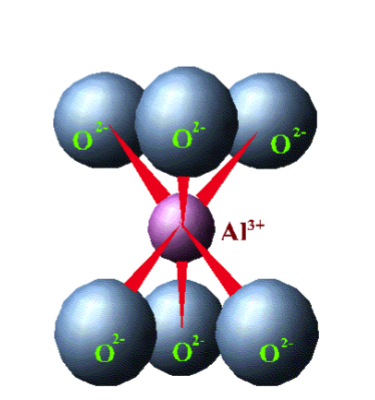
What is this?
Aluminum octrahedra
What makes up a 2:1 clay?
Two tetrahedral sheets surrounding one octahedral sheet.
What minerals have a low CEC?
Kaolinite
What minerals have a high CEC?
Smectite (montmorillonite),vermiculite, Organic matter
Base Saturation
The percentage of total CEC occupied by Ca +2, Mg +2, K+, and Na+. Generally increases as soil pH increases.
How many sq. ft. in 1 acre?
43,560
Nutrient Quantity
The amount of total nutrients in the soil, in both available and non available forms
Nutrient intensity
The concentration of a specific nutrient that is available for plant uptake.
Units to quantify CEC
meq/100g
What two things affect the CEC in soils?
The nature and quantity of clay minerals and OM in the soil.
What happens to nutrient intensity as plants absorb ions from the soil solution?
Nutrient intensity drops.
Buffer capacity
The soil’s ability to resupply an ion to the soil solution
Ksp
Mineral solubility product constant
Mineralization
Conversion of nutrients from organic forms to plant-available inorganic forms.
Immobilization
Conversion of inorganic nutrients into organic forms, temporarily reducing plant availability
What is Humus and how much of soil organic matter is humus?
Humus is the slowly decomposable type of soil organic matter. 50–85% of soil OM is humus

Which 2 nutrients are closely tied to soil organic matter content and decomposition rate?
N and S
Mycorrhizae
Extends the root zone of a plant and are important for uptake of relatively immobile nutrients like P.
What is Mass flow and which nutrient is most affected by it?
Ions in soil solution are transported to the plant via water uptake and transpiration. Major mechanism for nitrate-
N.
What is Diffusion and what nutrients are most affected by it?
Movement of nutrients to areas of low concentration. Major mechanism for K and P.
Root interception
Physical contact between the root and surfaces where ions are held. Accounts for a small amount of total plant ion transport.
What 3 things increase diffusion?
Greater soil water content, temperature, and diffusion coefficient.
What decreases diffusion?
Greater soil buffering
Why is Nitrate more mobile in soil than phosphate?
Nitrate is weakly retained by negatively charged soil surfaces, but phosphate is strongly sorbed/precipitated.
Why is precipitation a source of soil acidity?
Carbonic acid (formed from CO₂ + H₂O) is the primary natural contributor to the acidity of rainfall.
What is average rainfall pH?
pH 5.7
What are some Sources of Soil Acidity?
OM decomposition, microorganism activity, CEC, ion uptake
Which type of N fertilizer lowers pH the most in a soil?
Fertilizers containing NH4+
Which ammonium based fertilizer requires the most lime per amount of N applied?
Ammonium sulfate
Liming reaction equation
CaCO₃ + 2H⁺ → Ca²⁺ + CO₂ + H₂O
Which mineral has a greater acid neutralizing capacity per unit mass: Dolomite or Calcite?
Dolomite
Saline soil
High soluble salts; ESP not high
Sodic soil
High ESP; soluble salts may be lower
What are Salts?
Compounds that result from the neutralization reaction of an acid and base
ESP
exchangeable sodium percentage, commonly dS/m (mmho/cm).
Saline-sodic soil
high soluble salts and high ESP
What are the issues associated with sodic soil?
Na causes clay dispersion, poor aggregation, crusting and low infiltration
What are the issues associated with saline soil?
Low osmotic potential makes water uptake difficult
What mineral is commonly used to reclaim sodic soil?
Gypsum because its Ca can replace exchangeable Na.
Dispersion
Na-saturated clays repel one another, degrading aggregation and soil structure.
Physiological drought
When plants can’t uptake water even though it is in the soil because of high salt concentration
What happens to rhizosphere pH when NO₃⁻ uptake exceeds NH₄⁺ uptake?
Roots release OH⁻/HCO₃⁻ equivalents, increasing rhizosphere pH.
SAR
sodium absorption ratio, used to estimate the relative activity of sodium compared to calcium and magnesium
In WI, how many lb/ac of P₂O₅ raises the respective soil test by 1 ppm?
18 lb/ac
In WI, how many lb/ac of K2O raises the respective soil test by 1 ppm?
7 lb/ac
Neutralizing Index Equation
NI = Fineness factor x Purity factor /100
Why does ammonium sulfate acidify soils?
Through nitrification, ammonium is converted into nitrate and Hydrogen ions are released