Chapter 6 - Part 1: Skeletal system and Bone tissue
 Call Kai
 Learn
 Practice Test
 Spaced Repetition
 Match
 Flashcards
 Knowt Play
1/34

There's no tags or description
Looks like no tags are added yet.
35 Terms
How many bones are typically found in the adult skeletal system?
206 bones
what are the two divisions of the skeleton
Axial and appendicular
What belongs to the axial skeleton?
Skull, vertebral column, rib cage, hyoid, and auditory ossicles.
What belongs to the appendicular skeleton?
Pectoral girdle, arms/hands, pelvic girdle, and legs/feet.
What are the six functions of bone?
Support, protection, movement, mineral storage, blood cell formation, and chemical energy storage.
What is hematopoiesis, and where does it occur?
Blood cell production; occurs in red bone marrow.
What does yellow bone marrow store?
Triglycerides for chemical energy storage.
How does the distribution of red bone marrow change with age?
Widespread in young children; in adults, concentrated in parts of the axial skeleton and some long-bone ends.
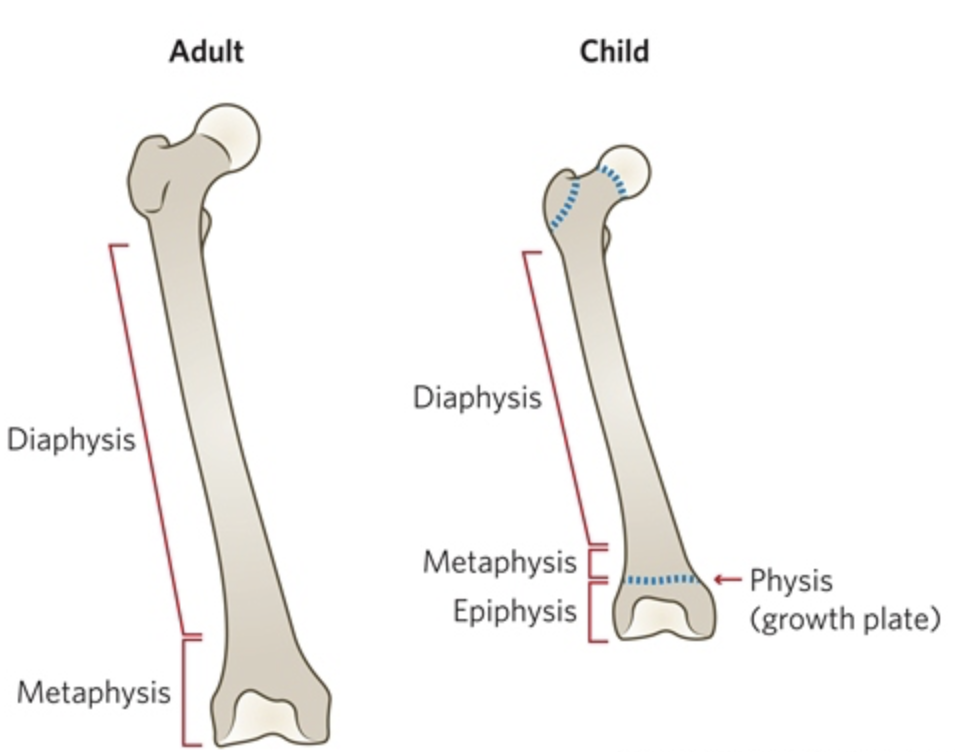
What is the diaphysis?
The shaft of a long bone.

What is an epiphysis?
The expanded end of a long bone.
What is the difference between an epiphyseal plate and an epiphyseal line?
Plate = cartilage growth region; line = remnant after growth ends.
What is the medullary cavity?
The internal cavity of a long-bone shaft containing bone marrow.
What is the nutrient foramen?
Opening through which nutrient blood vessels and nerves enter bone.
What are the periosteum and endosteum?
Periosteum covers the outside of bone; endosteum lines internal bone surfaces.
What is articular cartilage?
Hyaline cartilage covering bone ends at joints, reducing friction.
What are the four bone cell types?
Osteogenic cells, osteoblasts, osteocytes, and osteoclasts.
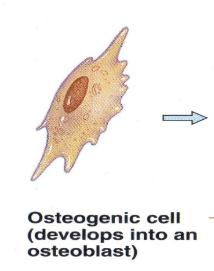
What do osteogenic cells do?
Act as bone-forming progenitor cells that can develop into osteoblasts.

What do osteoblasts do?
Synthesize and secrete collagen and organic bone matrix.
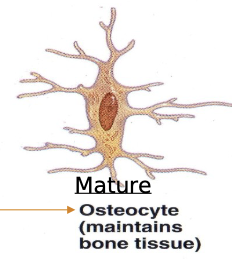
What do osteocytes do?
Maintain bone tissue. They are mature bone cells.

What do osteoclasts do?
Resorb bone by breaking down its matrix.
What is osteoporosis?
Decreased bone mass and deterioration of bone structure, increasing fracture risk.
What is Paget's disease of bone?
Excessive, disorganized bone remodeling that may cause deformities and fractures.
What is rheumatoid arthritis?
An autoimmune inflammatory joint disease that can damage cartilage and erode bone.
What is an osteon?
The structural unit of compact bone, organized around a central canal.
What is the Haversian canal?
The central canal of an osteon containing blood vessels and nerves.
What are Volkmann's canals?
Perforating canals that connect vascular pathways through compact bone.
What are concentric, interstitial, and circumferential lamellae?
Rings around canals; layers between osteons; layers around the circumference of bone.
What are lacunae and canaliculi?
Lacunae house osteocytes; canaliculi are tiny channels for cell communication and nutrient exchange.
What are trabeculae?
Interconnected plates and struts forming spongy bone, arranged along lines of stress.
What is the microscopic difference between compact and spongy bone?
Compact bone contains osteons; spongy bone contains trabeculae and has no osteons.
Why is bone richly vascularized?
Blood delivers nutrients, oxygen, and growth factors needed for development, remodeling, and repair.

Identify the name of this Bone cell type.
Osteoblast. Immature bone-forming cell that secretes bone matrix.

Identify the name of this Bone cell type.
Osteocyte. Mature bone cell that maintains bone tissue.

Identify the name of this cell type.
Osteoclast. Large bone-resorbing cell with a ruffled surface.

Identify the name of this tissue
Compact bone tissue. Look for circular osteons containing central canals and surrounding concentric lamellae.