Common Skin Conditions in General Practice
 Call Kai
 Learn
 Practice Test
 Spaced Repetition
 Match
 Flashcards
 Knowt Play
1/35

Earn XP
Description and Tags
Identification and management of several different skin conditions that commonly present in British General Practice.
36 Terms

What is this skin condition called?
Acne
Acne
An inflammatory skin disease affecting the pilosebaceous unit. It is clinically characterised by comedones, papules, pustules, nodules, cysts, and/or scarring, primarily on the face and trunk. It ranges from mild to severe.

Complications of acne
Permanent disfiguration
Psychological and social impacts
Pain
Systemic symptoms may be present with acne fulminans, a rare variant of nodulocystic acne.

Management of acne
Provide advice on skincare routines (avoiding comedogenic, alkaline, and other irritating skin products, do not pick lesions etc.)
Mild acne:
Multimodal topical therapy with benzoyl peroxide + retinoids/antibiotics (oral or topical)
Clascoterone, salicylic acid, or azelaic acid - combination with above, or as monotherapy
Moderate to severe / resistant acne:
A topical retinoid, benzoyl peroxide, and oral antibiotic.
Hormonal therapy with certain types of combined pill (women)
Oral isotretinoin

What are these skin conditions called?
Ringworm and athlete’s foot - caused by the same type of fungi.
How are fungal skin infections treated?
Antifungal cream / shampoo:
Terbinafine
Miconazole
Clotrimazole
Ketoconazole
Can add a steroid if significant inflammation.
If not improving, you can take a scraping and use oral antifungal treatment.
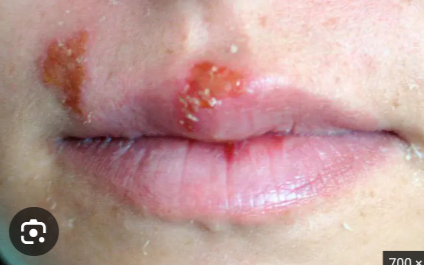
What is this skin condition called?
Herpes simplex (oral: HSV-1)

What is this skin condition called?
Impetigo
How can you differentiate herpes simplex and impetigo?
Characteristics of impetigo:
Honey coloured crusts (most cases).
Can also present as large, flaccid bullae (rarer presentation).
Lesions affect the face and extremities.
No prodrome.
Most common in children 2-5 years old.
Characteristics of HSV-1:
Grouped vesicles on an erythematous base that evolve to ulcers and crusts over 7-10 days. (papule → vesicle → ulcer → crust)
Sensory prodrome (tingling, burning, pain).
Recurrent episodes (usually at the same anatomic site).
Impetigo
A highly contagious bacterial skin infection that typically affects children and causes red sores or blisters that burst and form a yellow-brown crust.

Herpes simplex (HSV-1)
A viral infection caused by herpes simplex viruses (HSV) and is characterized by the development of painful, fluid-filled blisters on the skin or mucous membranes. HSV-1 is the oral subtype, while HSV-2 is the genital subtype. The virus remains in the body even after the symptoms have disappeared and can reactivate later causing outbreaks.

Management of herpes simplex (HSV-1)
There is no cure, but symptoms can be managed with antiviral creams, e.g. aciclovir
Treat the lesions as early as possible (e.g. when prodrome starts)
Reduce the spread of the virus by avoiding kissing other people when the cold sores are active.
Management of impetigo
If the lesions are small, hydrogen peroxide or antibacterial cream (e.g. fusidic acid) are first line.
If the lesions are large, systemic treatment with oral antibiotics will be required.
Inform the patient (or their parents) that the condition is extremely infectious - may be a good idea to warn the school / nursery.

What is this condition called?
Conjunctivitis.
Conjunctivitis
Inflammation of the lining of the eyelids and eyeball caused by bacteria, viruses, allergic or immunological reactions, mechanical irritation, or drugs. Presents as an irritated red eye with a watery or purulent discharge - no visual changes or pain.

Management of conjunctivitis
Supportive care with hot compresses and wipes.
Chloramphenicol / fusidic eye drops.

What is this condition called?
Otitis externa
Otitis externa
Diffuse inflammation of the external ear canal, which may also involve the pinna or tympanic membrane. It is a form of cellulitis. Infection occurs commonly when swimming in a pool.

How is otitis externa managed? (bacterial)
Antibacterial otic drops (ciprofloxacin)
Consider pain management
Ear toilet
If severe, give topical and systemic antibiotic therapy (fluoxacillin or doxycycline)
How is otitis externa managed? (fungal)
Oral or topical antifungal treatments (clotrimazole)
Consider pain management
Ear toilet

What condition is this?
Mouth ulcer
Mouth ulcers
Round or ovoid ulcers on the mucosa of the mouth with circumscribed erythematous margins and a greyish-yellow base.

Mouth ulcer management
Determine if the mouth ulcers are primary or secondary
Avoid triggers and irritants
Antimicrobial mouthwash
Pain management: tablet, mouthwash, spray, or gel
Corticosteroid lozenges / buccal steroid tablets
Saline mouthwash
What causes primary mouth ulcers?
Trauma - commonly ill-fitting dentures. Burning the mouth or using a mouthwash containing sodium lauryl sulfate can also cause them.
What causes secondary mouth ulcers?
Autoinflammatory conditions (e.g. Crohn’s)
Immunodeficiency states (e.g. HIV/AIDS, or coeliac due to nutritional defects)
Certain drugs
Inflammatory conditions (e.g. oral lichen planus)
Infections (HSV)
Malignancy

What is this condition called?
Shingles
Shingles
Reactivation of varicella-zoster virus (VZV) that was acquired during a primary varicella infection. It is characterised by dermatomal pain and a papular rash. The pain typically proceeds the rash, and may persist for several months after the rash has resolved (tends to last 4-5 weeks). (Not contagious!!)

Management of shingles
Treatment depends on whether the patient is immunocompromised or not.
Oral antiviral therapy (acyclovir)
Pain management
Referral to ophthalmology if the eyes are involved

What do these images show?
Various bug bites.
How are bug bites managed?
Antihistamine
Steroid cream
Analgesia

What is this condition called?
Cellulitis
Cellulitis
An acute spreading infection of the skin with visually indistinct borders that principally involves the dermis and subcutaneous tissue. It is characterised by redness, swelling, heat, and tenderness, and commonly occurs in an extremity.

How is cellulitis managed?
Oral antibiotics:
Flucloxacillin
Doxycycline
Clindamycin
Consider analgesia

What is this condition commonly called?
Warts
Common warts
Elevated, round, hyperkeratotic skin papules with a rough greyish-white or light brown surface. Although lesions may occur anywhere, they have a tendency to occur at sites prone to trauma, such as knees and elbows.

How are warts managed?
Salicylic acid
± lactic acid
Cryotherapy