Lec 1 PRIONS
 Call Kai
 Learn
 Practice Test
 Spaced Repetition
 Match
 Flashcards
 Knowt Play
1/48

Earn XP
Description and Tags
Recognize proteins can be infectious, Understand pathophysiology of transmissible spongioform encephalopathies, To learn different forms of prion mediated diseases
49 Terms
What are Transmissible Spongiform Encephalopathies (TSEs)?
type of disease
death rate
Cure
Neurodegenerative disease
always fatal
no available therapies
Why are Transmissible Spongiform Encephalopathies (TSEs) Transmissible?
b/c they can be transmitted experimentally by inoculation
ex.
in an experiment, brain tissue from an animal with a TSE is injected into a healthy lab animal. If the healthy animal later develops the disease, that shows the disease is transmissible by inoculation.
Why are Transmissible Spongiform Encephalopathies (TSEs) Spongiforms?
b/c microscopic vacuoles in brain tissue are feature that help identify the disease

Why are Transmissible Spongiform Encephalopathies (TSEs) Encephalopathies?
b/c they are disease (-pathy) of the brain (-encephalo)
What causes TSEs?
Prions
infectious agents
What is Scrapie?
when was it found (how old is it?)
what is the type of disease and who is it impacting?
what does this disease cause
transmission?
transmissible to humans?
Oldest known TSE
neurodivergent disease of sheep and goats
animals compulsively scrape off their fleece
transmitted from ewes to offspring (not well understood)
not transmissible to humans

What are the 5 different TSE diseases
Scrapie
Bovine Spongioform Encephalopathy (BSE)
Creutzfeldt Jakob Disease (CJD)
Kuru
Chronic Wasting Disease (CWD)
Define the prion theory
What were TSEs initially considered to be caused by?
What did S. Pruisner propose?
TSEs were considered to be caused by an unidentified slow virus
S. Pruisner proposed that TCE disease were caused by MISFOLDED PROTEINS rather than bacteria or viruses
What was the dogma about transmissible infections, and how did the prion theory challenge it?
DOGMA: that transmissible infections required nucleic acid
PRION THEORY: Suggested that proteins ONLY is what caused TSEs
What happened to S.Pruisner when he proposed the prion theory?
lost his funding
denied tenure
(article) Why does the prion theory propose that the scrapie agent is a protein-based infectious particle rather than one that relies on nucleic acids?
Sensitivity to proteases shows it contains a protein required for infectivity
while five procedures that modify nucleic acids failed to inactivate it.
What 2 words is Prion composed of?
Protein + Infection
What are prions and where can they be found in the body?
who has them?
What they are: A form of host protein that does NOT contain nucleic acid
Who has them: Everyone has prions (natural)
Found where: found predominantly on the surface of neurons
What is PrPC?
What does it stand for?
the natural protein in everyones bodies; NOT INFECTIOUS
The Cellular (C) Prion Protein
Why is PrPC a highly conserved protein in mammals?
its amino acid seq. has changed very little over evolution
What is the function of PrPC?
normal function is not well understood
thought to be involved in synaptic function
What is PrPSc?
What does it stand for?
the smallest known infectious agent
A modified form of PrPC
Stands for Scrapie (Sc) Prion Protein
Why does PrPSc not trigger an immune response?
Body recognizes it as a self protein
PrPSc shares the exact same primary amino acid sequence as the normal, PrPC
How do PrPSc appear in the body?
PrPC is converted into PrPSc
this happens through an irreversible conformation change
What is the difference between PrPC vs PrPSc?
the difference is the structure of both proteins
otherwise are the same protein
Describe the structure of PrPC
alpha helices or beta sheets?
soluble / insoluble
degraded or resistant to proteins
aggregates or doesn’t aggregate
Rich is alpha helices
Soluble
Degraded by proteases
Doesn’t aggregate
Describe PrPSc
Rich in beta helices
insoluble
resistant to proteases
aggregates
What is one of the reasons why PrPSc is very hard to find a cure?
It is extremely resistant to autoclaving, disinfectants, radiation etc..

How does PrPSc lead to cell death, according to the model?
PrPSc converts PrPC on the cell surface into more PrPSc, which is taken in by endocytosis and accumulates in endosomes
It keeps accumulating as the endosome contents are transferred to lysosomes, and the result is cell death.
A mouse with its prion protein gene removed is injected in the CNS with infectious prion protein from a sheep brain lesion. What happens to the mouse and why?
The mouse does not develop disease.
It has no PrPC for PrPSc to convert, so PrPSc cannot accumulate and cause cell death.
Where is the highest concentration of PrPc?
in the brain
What causes the neurons in the brain to die due to prions?
the accumulation of prions cause neurons to die
What are amyloid plaques (a feature of TSE disease)
misfolded protein that clump together in tissue in the brain
What are symptoms of TSE disease
takes long time for symptoms to appear
Personality changes
lack of coord.
involuntary jerking
What are three important characteristics of Prion diseases?
PrPSc can be infectious
prnp can induce TSEs and be heritable
Normal prnp can be mutated → sporadic
note: prions are proteins encoded by genes, therefore inheritable
What are the modes of transmission from prions? What is the most efficient and least eff.?
Intracerebral (IC) - Most
Intravenous (IV)
Intraperitoneal (IP)
Subcutaneous
Intragastric (Oral) - Least
What is Bovine Spongiform Encephalopathy (BSE)?
What is its history
mad cow disease
Britans started feeding cows the remains of other cows. One of those cows had sporadic disease. The caused contaminated beef in the food chain
What is the development of BSE?
can take 5 years or longer
What is Variant Creutzfeldt Jakob Disease (vCJD)?
transmission of mad cow disease to humans via consumption of cow brain or spinal cord
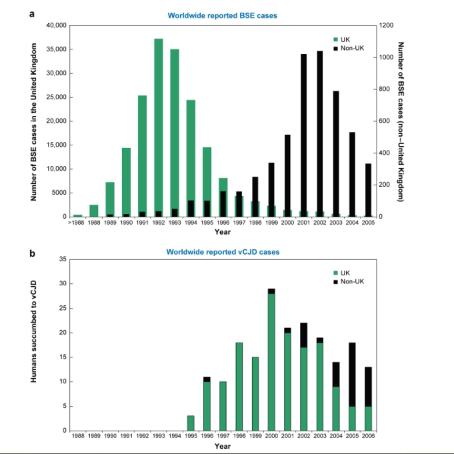
When comparing the second graph to the first, why did we only have 25 cases at the peak of the epidemic? (first graph is BSC cases and second is vCJD cases)
b/c oral consumption of prions is inefficient
Why did the Canadian Blood services have screening question regarding the mad cow disease?
To prevent mad cow disease from spreading they had a screening question asking if any canadians had lived in the UK during a certain period
Ban was lifted in 2023
What would happen in Canada if a Canadian beef cow had BSE?
the entire herd would be eliminated
What ban was placed to help prevent BSE
feeding of rendered protein products from ruminants
What is CJD? (Classic Creutzfeldt - Jakob Disease)
What are the three major categories?
also a prion disease that has 3 major categories
Sporadic → no known environmental source (85% of cases)
Hereditary (familial) → genetic mutation passed on (15% of cases)
Latrogenic: from a medical procedure due to contaminated equipment (<1%)
Is classic CJD contagious through casual contact?
No
What is Kuru?
how did it come about?
what does kuru mean?
The Fore people of Papua New Guinea practices ritual cannibalism during funerals
means “to shake” — b/c body tremors are symptoms of the disease
What is the incubation period of kuru?
anywhere from 5-20 years to develop the disease
What could the original source of Kuru be?
likely consumption of a sporadic CJD individual
Which mutation allowed the people of Papua New Guinea to be resistant to CDJ?
PrPC had a M129V mutation that allowed resistance to CDJ
was found in those exposed to kuru and survived the epidemic of Papua New Guinea
took 50 yrs to develop this resistance
What is Chronic Wasting Disease (CWD)? What is its mode of transmission?
TSE of deer
mode of transmission is unknown

What does the diagram show?
shows how PrPSc clump together into long amyloid fibrils
then shows how the fibrils are injected into mouse brain
Over time, the red prion deposits spread through the brain and the mouse dies
What happened to the lab tech. handling brain sections from transgenic mice expressing the human prion gene?
The lab tech accidently had their skin punctured with forceps that were used to handle the samples
the patient then died 9 years later with clear evidence of vCJD
What is Alzheimers disease?
build up of beta amyloid and Tau in the brain
What is the relation of Alzheimers disease w/ TSE?
Alzheimer is NOT a prion disease
they are both dementing disorders that involve the misfolding of proteins and causing aggregates